
The right lithium charger is the one that matches your battery pack's voltage and approved lithium charging profile—not simply the charger that fits the plug. Start by reading the battery label or manual for charging voltage and maximum current; then confirm the charger connector and cart system. If any value is missing, stop before buying and verify it with the battery maker. A lead-acid charger should not be treated as automatically compatible with a lithium pack.
Use this purchase-time match sheet
| Item to match | Battery/cart document | Proposed charger | Pass only if... |
|---|---|---|---|
| Pack nominal and charging voltage | ___ V / ___ V | ___ V / ___ V | Charger output profile is approved for this pack. |
| Maximum permitted charge current | ___ A | ___ A | Charger current does not exceed the battery/BMS limit. |
| Chemistry and end-of-charge curve | LiFePO4 requirements: ___ | Profile: ___ | The battery maker accepts that curve and any float behavior. |
| Plug, pinout and polarity | Connector diagram: ___ | Connector diagram: ___ | Physical fit and electrical pin assignment agree. |
| Vehicle/onboard charge control | Required handshake/interlock: ___ | Supported control: ___ | Cart and charger documentation confirm operation. |
Illustrative match: a pack manual permits the proposed LiFePO4 charging voltage and a 20 A current, and the charger is documented for that profile, connector polarity and cart control. Illustrative mismatch: a connector fits but the charger is a lead-acid profile or its output voltage/current exceeds the pack limit. In the mismatch case, do not charge until the makers confirm a compatible device. These examples specify no real product; model-specific numbers belong in the completed sheet above.
Match the charger to the battery voltage

Check the cart's complete battery-pack voltage, not just the voltage printed on one battery. Golf carts commonly use 36V, 48V, or 72V systems, but the correct charger must match the system specified for your lithium battery.
For example, a 36V lithium conversion needs a charger intended for that battery system. A charger for a different voltage is not an acceptable substitute just because its connector looks similar. If you are replacing several lead-acid batteries with one lithium battery, use the lithium battery's stated system voltage as the starting point.
Confirm the lithium charging profile
Lithium batteries need a charging profile approved for their chemistry and battery-management system. Do not assume that a charger used with flooded, AGM, or gel batteries will charge a lithium battery correctly.
Look for these details in the battery documentation:
- The battery chemistry, such as LiFePO4.
- The required charging voltage or voltage range.
- The recommended and maximum charging current.
- Any temperature limits or charging restrictions.
- Whether the charger must communicate with the battery-management system.
If the battery manual lists a specific charger model or charging profile, use that information instead of relying on a generic “lithium” label. A charger can be labeled for lithium batteries and still be unsuitable for your particular voltage or battery limits.
Choose the current rating from the battery limits
A higher amp rating is not automatically better. It may reduce charging time, but the battery documentation determines how much current the pack can accept.
Use the battery's recommended current when possible. Treat the maximum charging current as a ceiling, not a target. If your battery is rated at 105Ah, for example, do not calculate a safe charger size from capacity alone; you still need the manufacturer's approved charging-current range and the charger output specification.
The choice changes in two common situations:
- You want the fastest reasonable recharge: choose a charger near the battery's approved recommended current, provided the cart's electrical supply can support it.
- You use a limited household circuit or do not need rapid charging: a lower approved current may be suitable, although charging will take longer.
If the charger rating exceeds the battery's limit, choose another charger. If the rating is below the recommended value, it may still be usable only when the battery documentation allows it and the longer charge time works for you.
Check the connector and the cart system
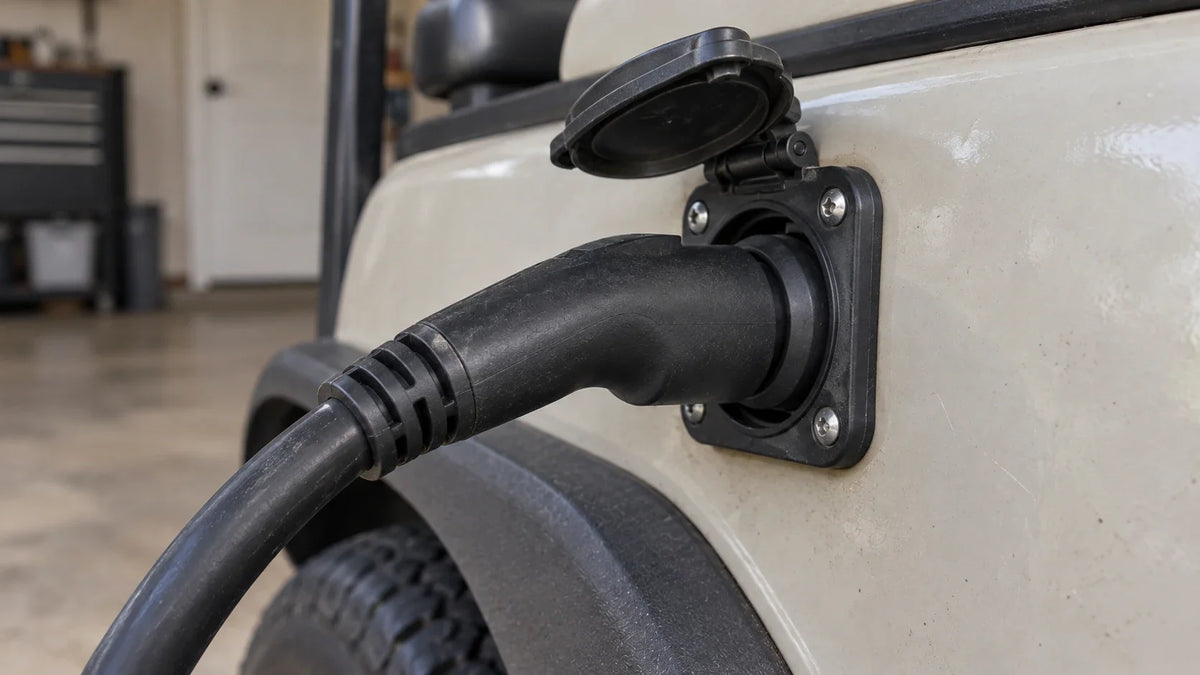
A matching plug does not prove that a charger is compatible. Confirm the connector style, polarity, cable condition, and how the charger connects to the cart or battery.
For a conversion, also check the battery compartment, cable routing, controller, accessories, and monitor. These details can change which charger or conversion package fits your cart. Follow the battery and charger manuals for connection order, mounting, and operating limits. If the wiring, polarity, or charging behavior is unclear, have a qualified technician verify the setup before use.
Do not charge a damaged battery or use a charger with damaged cables or connectors. Stop if the charger shows an error, the battery becomes unusually hot, or the system behaves differently from its manual.
When a conversion kit can simplify the choice
A complete kit can reduce the number of separate compatibility decisions when its included parts are intended for the same battery system. The supplied Vipboss 36V 105Ah Lithium Golf Cart Battery Conversion Kit includes a charger, cables, connector parts, and a monitor for the conversion and battery-status checks. That makes it worth considering when you are replacing a compatible 36V cart system rather than buying a charger for an unrelated battery.
Before ordering, confirm the kit's charger output, connector, battery voltage, and fit with your cart. You can review the Vipboss 36V 105Ah conversion kit and compare its current documentation with your battery and cart details.
A quick final check before buying

Write down these five values from your battery and cart documents:
- Battery chemistry.
- Complete pack voltage.
- Required charging voltage.
- Recommended and maximum charging current.
- Connector type and polarity.
Buy only when the charger matches all five. If one value is unknown, the safest choice is not to guess; verify that value first. This prevents the most common selection error: choosing a charger because it fits the cart physically while its voltage, charging profile, or current output does not fit the battery electrically.