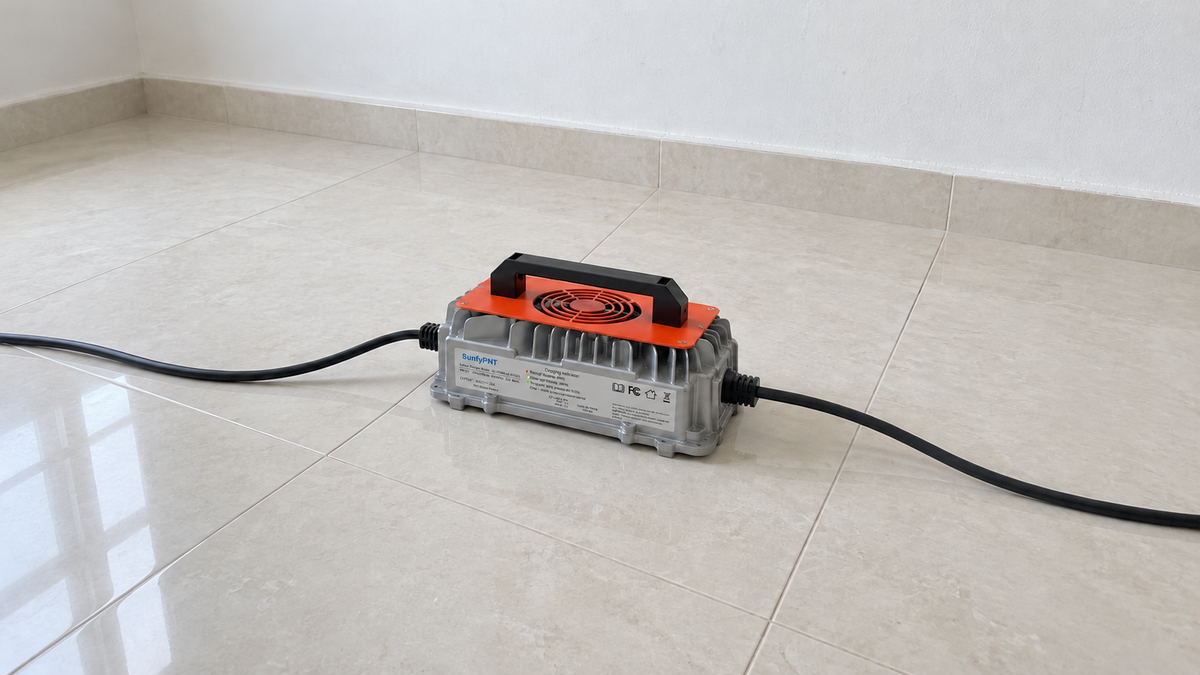

Yes. A LiFePO4 battery charger needs enough airflow to release the heat it produces, although that does not necessarily mean installing a separate ventilation fan. Keep the charger's vents and fan openings uncovered, do not operate it in a sealed box, and follow any clearance specified in the manual. Because cooling designs vary, there is no single safe clearance distance for every charger.
Why airflow matters during LiFePO4 charging
A charger converts incoming AC power into controlled DC power, and some of that energy becomes heat. Air around the case carries heat away. A charger pressed against a wall, covered by clothing, or placed inside a tight cabinet has less access to cooling air, so its temperature can rise even when the battery is operating normally.
Requirements for a charger installed in a regulated battery room, locker, vessel, or other enclosure may differ from household guidance. Follow the rules and installation instructions that apply to that location rather than treating this article as a substitute for them.
Where to place the charger

Choose a location that is:
- open to room air rather than inside a sealed container;
- arranged so the charger's cooling openings are not blocked;
- spacious enough to follow any clearance stated in the charger's manual.
Keep the charger's air inlets and outlets clear. Do not stack tools or batteries on it, wrap it in a blanket, or push it tightly into soft upholstery. If a fan is fitted, leave its intake and exhaust unobstructed. A clean case and clear vents matter more than adding a separate fan that blows into a blocked opening.
There is no safe universal inch measurement for every charger. Case design, fan direction, output power, ambient temperature, and the manual's installation instructions all affect the required space. If the manual gives a clearance, follow that value. If it does not, use an open placement with visible space around the cooling openings rather than treating an arbitrary gap as a certified requirement.
Match the charger to the installation environment
When selecting and positioning a charger, consider its enclosure protection, cooling design, specified operating environment, and required clearance together. An IP rating describes protection against ingress; it does not show how much surrounding space the charger needs or eliminate the need to follow its ventilation instructions.
For example, the Vipboss 36V 25A LiFePO4 battery charger is designed for compatible 36V LiFePO4 systems and has an IP65 enclosure rating. If it suits the battery voltage and charging requirements, the IP65 rating can be one factor in evaluating the installation environment—but placement should still follow the product's current instructions, with its cooling openings kept clear.
Frequently asked questions
Does every LiFePO4 battery charger need a cooling fan?
No. Some chargers use a fan while others dissipate heat through the case or passive ventilation. In either design, keep the specified cooling surfaces and openings unobstructed and follow the placement instructions in the manual.
Can I operate a LiFePO4 charger inside a closed cabinet?
Not unless the charger and cabinet are specifically designed for that installation and all required ventilation and clearances are provided. A sealed or tightly packed enclosure can trap heat around the charger.
How much space should I leave around the charger?
Use the clearance stated by the manufacturer. If no number is provided, place the charger in open air with visible space around its cooling openings; do not invent a universal clearance that may not suit its design.
Does an IP65 rating eliminate the need for ventilation?
No. An IP rating concerns ingress protection, not heat removal or mounting clearance. An IP65-rated charger still needs to be installed and operated according to its cooling instructions.
Can I cover the charger to protect it from dust or water while it is running?
Do not cover a running charger because a cover can block airflow and retain heat. Use a charger and installation method rated for the environment instead, while keeping all required cooling paths clear.