
Size an RV battery disconnect switch for the highest continuous current expected through the connected battery circuit. Then check its short-duration rating, DC-voltage rating, and ability to make or break the circuit under the intended load. Battery amp-hours measure stored capacity; they do not determine the switch’s required current rating.
1. Calculate the maximum continuous current
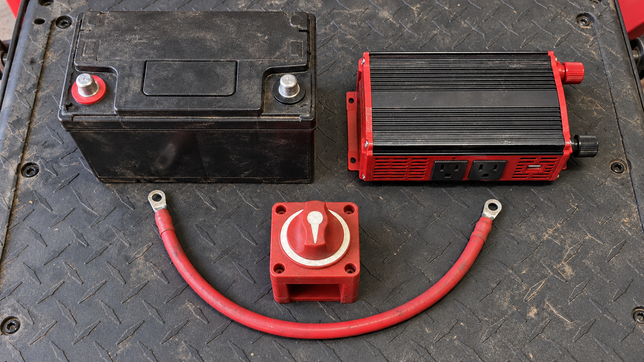
List the simultaneous loads. Identify every load downstream of the disconnect, including the inverter and direct 12-volt equipment. Record each load’s maximum DC current from its specifications. Use the largest combination the circuit design allows to operate at once; do not add loads that an interlock or control prevents from running together.
For an inverter, use the input-current formula and treat short-duration surge separately:
I = P ÷ Vmin ÷ efficiency
Where:
- I is estimated DC input current in amperes.
- P is the inverter’s rated output power in watts.
- Vmin is its minimum DC input voltage, not simply the battery’s nominal voltage.
- Efficiency is expressed as a decimal, such as 0.90 for 90%.
Count the inverter’s DC input demand when sizing the battery circuit. Do not add AC appliance amperage directly to the DC load total. Add any direct DC loads that can operate at the same time as the inverter.
2. Work through the inverter current
For a 1,000 W inverter, using a 12.0 V minimum input and 90% efficiency:
1,000 W ÷ 12.0 V ÷ 0.90 = 92.6 A, or about 93 A.
For a 2,000 W inverter under the same assumptions:
2,000 W ÷ 12.0 V ÷ 0.90 = 185.2 A, or about 185 A.
These are inverter-input estimates, not automatic switch recommendations. The switch must also carry any simultaneous direct DC loads and meet the inverter’s separate surge requirement. Use the actual inverter specifications; a different minimum input voltage or efficiency changes the result.
3. Match continuous and short-duration ratings

Continuous rating: Account for all simultaneous continuous loads according to the circuit design. Select a switch with an applicable continuous DC current rating at least as high as the maximum expected current. Apply any temperature, enclosure, mounting, or other derating required by the switch manufacturer.
Surge or motor-starting rating: Compare inverter surge demand and motor-starting current with the switch’s short-duration rating. Match both amperage and duration. For example, a demand specified for five seconds must be within a switch rating that covers at least that current for that length of time.
Engine-cranking rating: If the disconnect carries starter-motor current, use the engine’s applicable cranking demand and a switch rating specified for cranking service. This rating matters only when starter current passes through the switch.
If a switch specification does not state the rating needed for the intended duty, do not substitute an unrelated continuous, intermittent, or cranking number.
4. Check voltage and switching duty
DC voltage: The switch’s DC-voltage rating must be at least the battery system’s maximum operating voltage, including charging voltage—not just its nominal 12-volt designation.
Make-or-break duty: Decide whether you will operate the switch only after turning loads off or whether it must connect or interrupt current under load. If it will be switched under load, its make-and-break or load-switching rating must cover the applicable DC voltage and current. A continuous carry rating and a load-switching rating address different requirements.
Installation: Confirm that the switch’s marked terminals, permitted conductor or polarity, number of poles, mounting arrangement, and environmental rating suit the installation. Follow the manufacturer’s installation conditions because they determine which published ratings apply.
5. Coordinate the battery, cables, protection, and switch
Battery amp-hour capacity does not size the switch. The Vipboss 12V 105Ah Bluetooth LiFePO4 Lithium Battery is rated at 12.8 V, 105 Ah, and 1,344 Wh and has a built-in 100 A smart BMS. The 100 A BMS specification is a battery-side value to coordinate with calculated load, cables, overcurrent protection, and switch ratings; connected loads determine the switch’s current requirements.
Coordinate the calculated continuous and short-duration demand with battery and BMS limits, cable ampacity under the installation conditions, fuse or circuit-breaker characteristics, and disconnect-switch ratings. Account for each component’s applicable current, voltage, duration, and installation conditions. A higher-rated switch does not increase what the battery, protection, or cable can carry.
Selection checklist
Before choosing the switch, confirm:
- Maximum continuous current: Includes the inverter’s estimated DC input plus simultaneous direct DC loads.
- Continuous switch rating: Meets or exceeds that maximum after applicable manufacturer derating.
- Short-duration rating: Covers inverter surge and motor-starting current for the required duration.
- Cranking rating: Covers starter current when the switch is in an engine-starting circuit.
- Maximum DC voltage: Does not exceed the switch’s DC-voltage rating.
- Switching duty: The make-or-break rating supports operation under load when required.
- Installation: Polarity, terminals, poles, mounting, and environmental conditions suit the application.
- Circuit coordination: Battery limits, cable ampacity, overcurrent protection, and switch ratings are compatible with the calculated demand.
Choose a disconnect whose continuous rating covers the maximum simultaneous load, whose timed rating covers applicable surge or cranking events, and whose voltage and switching-duty ratings suit the installation. There is no universal RV amp rating; calculate it from the connected circuit.
FAQs
How do I calculate the current an RV battery disconnect must carry for an inverter?
Estimate inverter DC input current with I = P ÷ Vmin ÷ efficiency, using the inverter’s rated output power, minimum DC input voltage, and efficiency. Add any direct DC loads that can operate simultaneously, and consider inverter surge separately from continuous current.
Does battery amp-hour capacity determine the required RV battery disconnect rating?
No. Amp-hours measure stored battery capacity; size the disconnect for the maximum current expected from the connected loads, including simultaneous loads and applicable short-duration demands.
What ratings should I compare when choosing an RV battery disconnect switch?
Compare the switch’s continuous DC current rating with the maximum simultaneous load, its timed surge or cranking rating with applicable short-duration current, and its DC-voltage rating with the battery system’s maximum operating voltage. If the switch will be operated under load, check that its make-and-break rating covers the applicable voltage and current.