
You can wire your first circuit calmly and safely by combining a strict safety routine, dead-circuit practice, and simple, repeatable hand movements that take the drama out of electricity.
Do your hands start to tremble the moment you see bare wire or reach for the breaker panel, especially when that panel is feeding an inverter or battery bank you care about? The homeowners and off-grid builders who now confidently wire panels and lithium systems started in the same place: heart racing, convinced one wrong move would light up the room. With the right mindset and a clear process, your first wiring job can feel controlled, predictable, and almost boring in the best possible way.
Why Being Nervous Around Wires Is Actually Smart
Electric current can shock, burn, and start fires, which is why electrical safety is treated as a discipline with formal rules, training, and protective gear in professional environments, not as a casual hobby. The focus on controlling shock, arcing, and overheating in an electrical safety fact sheet is a reminder that your nerves are not a weakness; they are your built-in early warning system.
Home wiring standards in the United States are shaped by the National Electrical Code and related residential wiring standards, which set minimum requirements for wire sizes, grounding, overcurrent protection, and safe installation practices. That same framework underpins the circuits that feed your off-grid inverter, your lithium charger, and every outlet in your shop or cabin.
Instead of trying to "get over" your fear, focus on harnessing it. When you treat electricity with the same respect that licensed electricians are trained to show, and when you set up conditions so the circuit is actually safe to touch, your confidence grows without you having to pretend you are brave.

Build a Safety Net Before You Touch a Wire
Know your limits and the rules
Before you ever loosen a screw, decide what you will do yourself and what you will hand to a licensed electrician. Educational programs and trade guides on residential wiring standards emphasize that the code is a legal minimum and that complex work, like new service equipment or panel upgrades, is professional territory.
Many jurisdictions allow homeowners to replace devices like switches and receptacles if they follow code and permit rules explained in basics of home electrical wiring. The same references remind you to check with local building departments and to bring in a pro when you are unsure about legality or safety.
For a lithium or off-grid project, a sensible split is to let an electrician handle anything that ties into the utility service or main breaker panel while you focus on low-voltage wiring, conduit layout, labeling, and mounting equipment. That way you still learn the craft, but your first live work happens within a properly designed, inspected system.
Turn "Is it live?" into "I know it's dead."
Your hands shake most when you are not sure whether a conductor is live. The cure is a simple, repeatable sequence backed by the "golden rules" in the five golden rules of electrical safety: disconnect, prevent reconnection, test for absence of voltage, ground appropriately, and control the work area.
For house circuits, that means switching off the main disconnect or the correct branch breaker, then physically securing it so no one can casually flip it back on while you work, as described in guidance on how to wire a circuit breaker. After that, you verify at the work location with a non-contact tester or multimeter as stressed in basics of home electrical wiring, not just once but every time you move to a new box.
Give yourself physical space too. Keeping about 3 feet of clear area around panels and disconnects, as called for in professional electrical safety standards, lets you set tools, labels, and test equipment where you can reach them without awkward stretching that makes trembling worse.
Gear up so sparks get boring
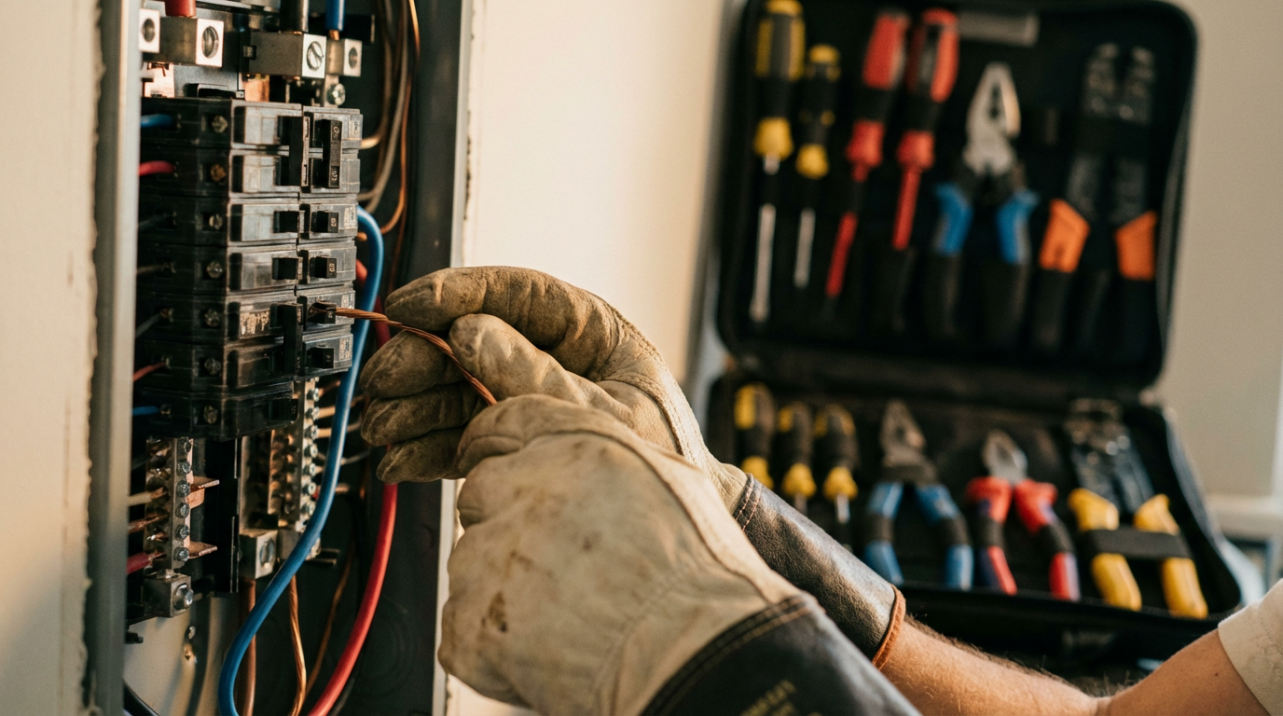
You will feel calmer when your body is protected and your tools are made for the job. Occupational guidance in the electrical safety fact sheet calls for grounded, well-maintained tools and personal protective equipment like gloves, goggles, and safety shoes for people exposed to electrical hazards.
Home and small-business installation advice, such as a safe electrical installation guide, reinforces the value of insulated hand tools, safety glasses, dry work areas, and non-conductive ladders so routine jobs stay uneventful. Breaker-panel guides like how to wire a circuit breaker add basics such as keeping a first-aid kit nearby and letting someone know you are working.
Set up your wiring bench or open wall with bright lighting, a stable stance, and tools laid out in the order you will use them.

When your environment feels organized and controlled, your hands tend to follow.
Taming Shaky Hands: Step-by-Step Confidence Builders
Practice on dead circuits until motions are automatic
The best way to calm your hands is to teach them the moves on wire that you know is cold. Training resources on home electrical wiring basics explain that most modern homes use nonmetallic cable with multiple insulated conductors and a ground inside a sheath, and that you should leave at least about 3 inches of free conductor in each box to make terminations easier.
You can practice that entire sequence on a scrap board. Mount a couple of boxes, run short pieces of cable into them, strip the outer jacket, and then strip individual conductors to the recommended length printed on your devices. Twist and cap hot wires together, then neutrals, then grounds, just as homeowner-oriented wiring guides describe when they show daisy-chained outlets and labeled feeds in a room wiring example.
Run that drill repeatedly before you ever touch a real circuit.

By the time you are working inside your off-grid cabin or battery closet, your hands will be replaying well-practiced motions instead of inventing them under stress.
Use repeatable techniques that feel steady
Shakiness often comes from fighting the hardware. For screw terminals, many DIY wiring tutorials on outlets and breakers, including how to wire a circuit breaker, show the same simple technique: bend a smooth loop in the bare wire, hook it clockwise around the screw, and tighten until the loop closes with no copper sticking out.
For splices, homeowner guides that walk through basic connections emphasize stripping about half an inch to an inch of insulation, aligning conductors, twisting them together clockwise, and then installing a properly sized connector so the metal spring grips all wires evenly, as reflected in safe-connection steps within home electrical wiring basics. That combination gives you a strong connection without needing a crushing grip.
Labeling removes mental pressure. Room-wiring walkthroughs like electrical wiring basics stress labeling each cable with tags like "power in," "power out," or "to light," and professional mapping advice in how to map electrical circuits recommends clear records of which breaker feeds each load. When every cable and breaker has a name, your brain stops trying to remember details and your hands can focus on making one clean connection at a time.
Control your workspace, control your nerves
Nerves spike when you are working in a dim, cluttered corner, unsure which breaker might suddenly bring a cable back to life. Circuit-mapping guides such as how to map electrical circuits suggest a methodical approach: identify and label breakers, match them to outlets and lights, and build a simple panel directory so you always know what you just turned off.
Home safety resources like electrical safety tips also encourage keeping cords and loads organized, avoiding makeshift extension-cord webs that hide hazards and make troubleshooting stressful. For your first wiring jobs, try to work with walls open where possible, keep your conductors neatly folded in boxes instead of crammed, and avoid overfilling boxes, which pro-level tips warn can be both unsafe and visually messy.
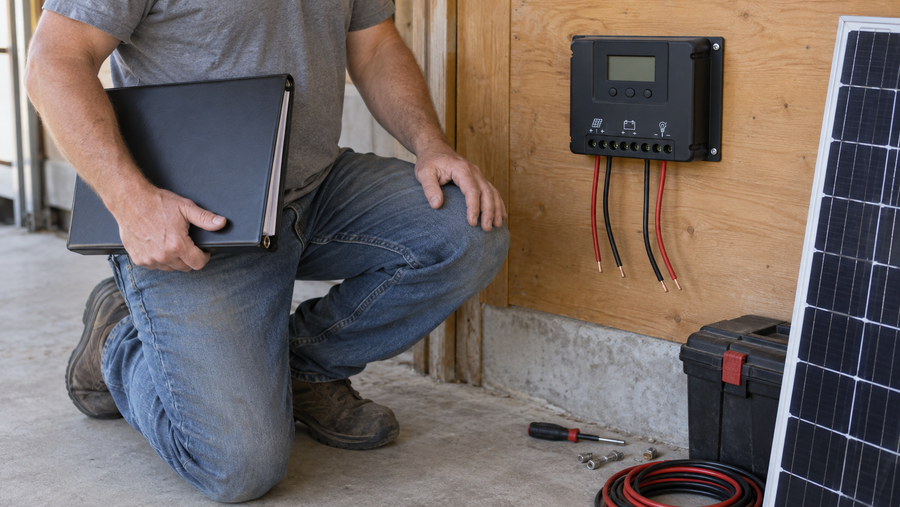
If you are wiring an off-grid system, start with a clean backboard where your inverter, charge controller, and disconnects are laid out with generous space between them. When breakers, disconnects, and raceways are easy to see and reach, every movement feels more deliberate and less shaky.

Managing Fear of Sparks While You Learn
Understand what usually causes sparks
Most visible sparks in household systems are a symptom of something wrong rather than a normal part of work. Breaker-panel troubleshooting guides like how to wire a circuit breaker explain that short circuits, where a hot conductor touches neutral or ground, are a common cause of tripping and can be accompanied by arcing at the fault.
Home-safety overviews such as tips for electrical safety at home and other residential safety articles point out that damaged or overloaded cords can overheat and arc, leading to sparks, smoke, or fire. In practice, that means your real enemies are crushed extension cords under rugs, loose outlets, and sloppy connections, not the act of carefully landing a conductor on a dead terminal.
When you power a circuit back up for testing, do it with all covers in place, your body off to the side of the panel, and your eyes and nose alert for any sign of trouble. If a breaker immediately trips when you energize a new circuit, that is a valuable signal to de-energize and recheck wiring rather than a reason to push through your fear.
Plan loads so your system runs cool and quiet
Fear of sparks often masks an underlying worry: "What if I overload something I cannot see?" The solution is to respect ratings and plan loads deliberately. Residential training programs and pro guides on residential wiring standards emphasize matching breaker size, wire gauge, and expected load, such as using 14-gauge wire on a 15-amp breaker for light and general receptacle circuits.
Panel and breaker how-to content, including how to wire a circuit breaker, outlines common breaker sizes like 15, 20, 30, and 50 amps, reminding you that larger loads need both heavier wire and dedicated circuits. Consumer-facing safety tips in electrical safety tips add guidance on choosing extension cords based on wattage and cord gauge rather than treating them as unlimited.
In an off-grid context, that same mindset extends to your inverter and battery bank. If you size branch circuits sensibly, avoid plugging space heaters and heavy shop tools into already busy circuits, and keep high-draw loads on dedicated breakers, your system will run cooler, breakers will trip less often, and sparks will remain something you study on paper rather than in your wiring closet.
Decide what to DIY and what to hand off
The last layer of confidence comes from knowing where you will stop. Residential standards discussions in residential wiring standards and general safety rules in the five golden rules of electrical safety both steer non-professionals away from high-risk work and toward qualified electricians for complex installations.
A simple way to think about it is summarized in this comparison.
Task or scenario |
Reasonable first-time DIY goal? |
Better handed to a licensed electrician? |
Swapping a standard light switch or receptacle on a clearly labeled, de-energized circuit |
Often acceptable after studying home wiring basics and following safety checks |
Recommended if your panel is unlabeled, box is overcrowded, or the house has old or unknown wiring |
Adding one new receptacle to an existing circuit in an open wall near a workbench or inverter |
Possible for a careful beginner who plans cable routing, box fill, and permits, using wiring a circuit as a conceptual model |
Preferable if walls are closed, access is tight, or circuit mapping from how to map electrical circuits reveals confusing or overloaded circuits |
Installing or upgrading a main panel or service equipment feeding a whole house or large off-grid system |
Not appropriate; this is high-energy work referenced by professional electrical safety standards |
Squarely in the pro's lane, including load calculations, grounding, bonding, and coordination with inspectors and utilities |
Clarifying this boundary increases confidence. When you know the big, high-risk jobs are reserved for pros, you can focus on clean, modest projects that build your skill and make your lithium or off-grid system easier to expand later.
Putting It All Together on Your First Real Circuit
Imagine you are adding a new dedicated circuit for a small inverter-fed subpanel in a shed. The process begins at your main panel, where you use the mapping approach in how to map electrical circuits to understand what already exists and to update labels before you add anything new. Once the plan is clear, you shut off the main, secure it, and verify with a tester that the segment you will work on is truly de-energized, echoing the sequence from the five golden rules of electrical safety.
Next, you rough-in the cable along framing members, through drilled holes, and into boxes, leaving generous conductor length as suggested in home electrical wiring basics. You strip, twist, cap, and land conductors using the steady, practiced hand motions you learned on your scrap board, treating each joint as another repetition, not a one-off improvisation.
Before you close anything up, you check every connection visually and with a continuity or voltage test as applicable, and you label boxes, cables, and breakers following the organizational habits highlighted in electrical wiring basics. Only then do you restore power, standing to the side of the panel, eyes and ears alert. When the breaker clicks on without drama and your new circuit powers its intended load without tripping, you have your proof: careful process beats fear.
FAQ
How do I know if I am ready to wire anything near my battery system? You are ready to handle simple tasks when you can explain, without notes, how to shut off and verify a dead circuit, how to match breaker size to wire gauge as described in residential wiring standards, and how to keep all splices inside proper boxes as stressed in home electrical wiring basics. If any of that feels fuzzy, spend more time on practice boards and documentation before touching the actual system.
What if my hands still shake even after practice? Mild shakiness is normal, especially the first few times you work near a panel. Focus on slowing your breathing, double-checking that the circuit is de-energized using the verify-before-work habit from the five golden rules of electrical safety, and limiting each session to a small, clearly defined task. As your checklist becomes familiar and every energizing step yields quiet, spark-free results, your nervous system learns that your process keeps you safe.
When you treat safety as non-negotiable, build simple hand skills on dead wire, and reserve high-energy work for pros, the fear of sparks fades and wiring becomes just another tool in your off-grid power-upgrade toolkit.