
To check whether a lithium battery fits your Club Car model and year, first confirm the cart's original system voltage. Then compare the model-year electrical setup, battery-bay space, charger, and controller requirements before ordering.
Club Car model-year and voltage reference
The table below gives practical voltage ranges based on documented Club Car configurations. It is more useful than a simple year cutoff, because the DS line included more than one electrical configuration. Club Car's official resources identify the vehicle model and year from the serial number, and its manual library contains separate manuals for different production years and configurations. Use the serial number and the applicable owner's manual to confirm the actual cart before ordering.
| Club Car reference | Year or production reference | Voltage reference for initial battery selection |
|---|---|---|
| DS electric | Early DS production, including the 1981-1988 manuals listed in Club Car's manual library | 36V is the main reference point; six 6V batteries are typical |
| DS electric | Later DS production, including the 2005 model-year manual | 36V or 48V; do not use the year alone to choose between them |
| Precedent electric | Precedent production and build-code ranges vary | 48V for the documented electric Precedent configuration |
| Tempo electric | Tempo electric production and trim vary | 48V for the documented electric Tempo configurations |
| Any Club Car electric cart | Any year, including modified or remanufactured carts | Choose a36V or 48V lithium battery only after the cart's actual system voltage is verified |
This is a practical reference, not a fitment guarantee. For initial screening, use 36V for an early DS reference, 36V or 48V for a later DS unless the installed system is documented, and 48V for the documented electric Precedent and Tempo configurations. Do not convert those ranges into a year-only purchase rule. Vehicles may differ by build code, market, battery option, replacement electronics, or previous modification. The official Club Car manual library explains that the serial number identifies the model and production year. See the Club Car manual library, the Club Car serial-prefix directory, the official 36V DS instructions, the official Precedent brochure, and the official Tempo electric specifications.
Purchase checks before ordering
- Read the voltage printed on the existing battery bank and charger; use battery count only as a cross-check.
- Record the serial number, exact model family, production year or build code, and whether the cart is stock, lifted, or modified.
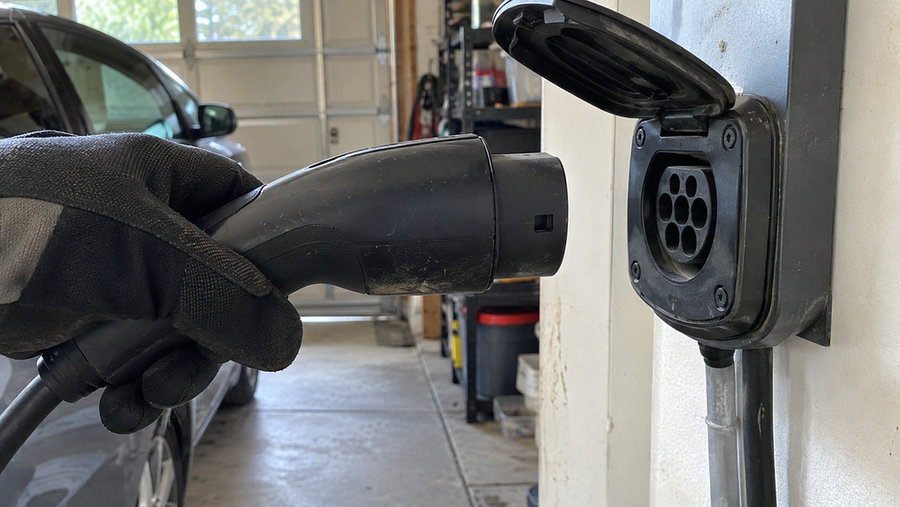
- Identify the controller, motor, OBC or charge system, charge receptacle, and any 12V accessory reducer.
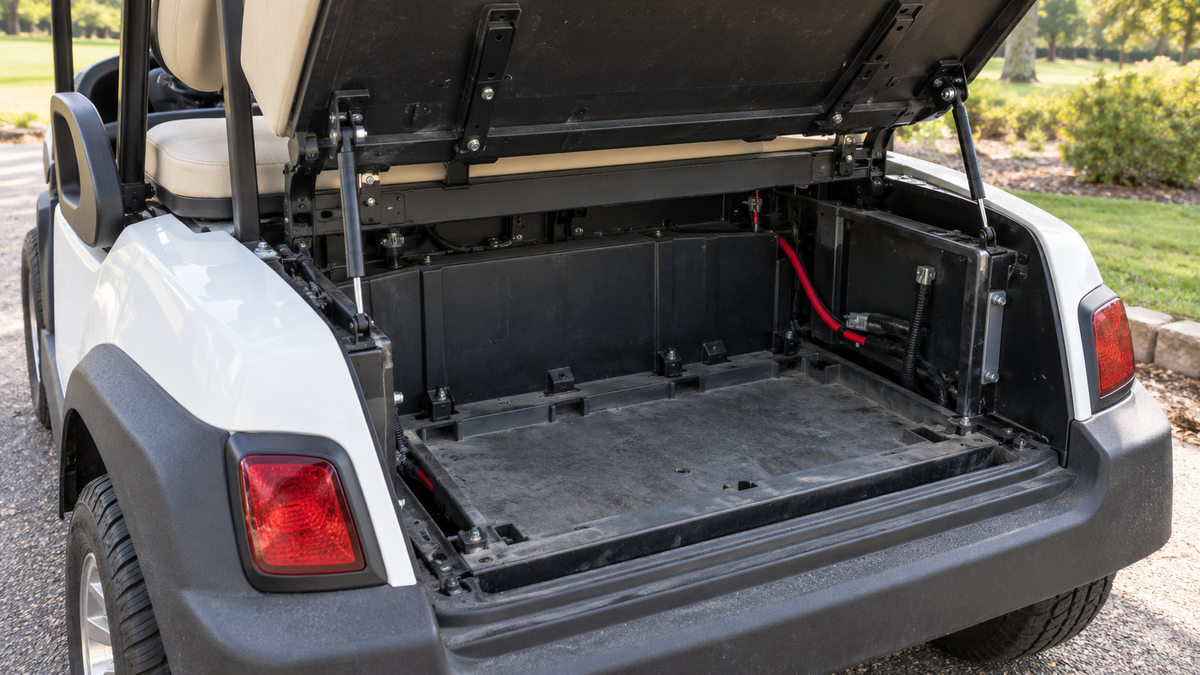
- Measure the usable battery-bay length, width, and height, including terminal clearance, cable reach, and hold-down points.
- Compare the candidate battery's nominal voltage, maximum charge voltage, BMS current rating, charger output, enclosure dimensions, and mounting hardware with the cart's documentation.
- Stop and obtain model-specific guidance if the voltage, charger, OBC, controller, or battery-bay measurements remain unknown.
Start with your Club Car's voltage
First confirm the cart's original system voltage. Check the owner's manual, the charger label, and the existing battery configuration. If the cart has been modified, trust the manual and component labels over battery count alone. A kit marketed for 48V is not a fit for a 36V or 72V cart.
Match the model-year electrical setup
Model and year narrow the search, but they do not finish it. Write down the exact model family, production year, original battery type, controller, charge port, and whether the cart has an onboard computer (OBC). Also note any aftermarket motor or controller work.

Older and modified Club Cars can use different charging or control arrangements. Do not bypass an OBC or rewire the charge path from a generic article. If you cannot identify the controller or OBC, treat the battery as unconfirmed until the owner's manual or a qualified golf-cart technician confirms the setup.
Check the battery bay before you order
Measure clear length, width, and height. Then check terminal clearance, cable reach, and the points used to hold the pack in place. A battery can have the right voltage and still fail the fit check because the enclosure or terminals do not work with the cart.
Make the final fit decision
Use one of these outcomes:
- Likely fit to verify: 48V is confirmed, the exact model and year are recorded, the controller and charger are known, and the bay and terminal layout fit.
- Not a fit: the cart is 36V or 72V, the enclosure is too large, or the controller or charger is outside the kit's usable range.
- Not enough information: the model and year are known, but the controller, OBC, charger, or battery-bay measurements are missing.
Apply the checklist to a candidate battery
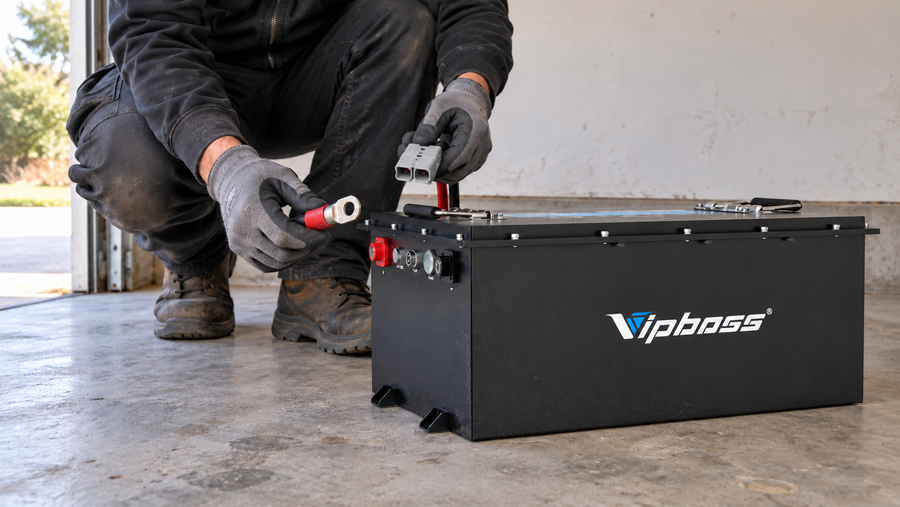
Once you have the cart details above, compare them with the candidate battery's specifications. For example, the Vipboss 48V 150Ah lithium golf cart battery conversion kit lists a 51.2V, 150Ah LiFePO4 pack, a 200A BMS, a lithium-compatible charger, and a 20.5 × 13.7 × 8.66-inch metal enclosure.
If your Club Car documentation confirms a 48V system, the battery bay provides enough usable space, and the controller and charger are compatible with those specifications, the kit passes the initial fit check. The 48V product label and 51.2V nominal value still need to be verified against the cart's components; the listed specifications do not establish universal Club Car compatibility.
For a cart that passes these checks, you can review the Vipboss 48V 150Ah lithium golf cart battery conversion kit as a candidate. If the electronics, wiring, or battery-bay measurements remain unknown, confirm them before purchase rather than relying on the model year alone.