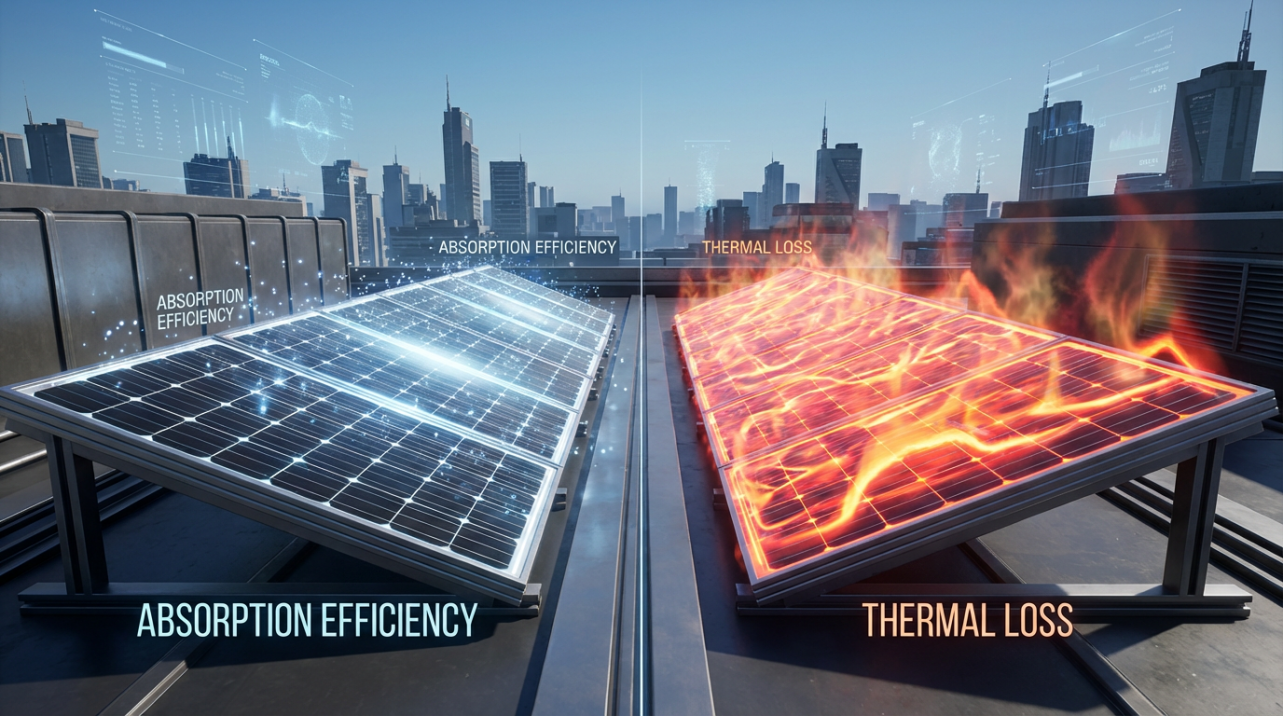

Darker panels can be highly efficient, but extra heat always cuts solar output, so the best systems keep cells cool while capturing as much light as possible.
You look up at a sleek black roof of panels on a blazing summer afternoon and assume they are cranking out maximum power because they feel scorching to the touch. Then your monitoring app shows a midday slump and your backup system leans harder on the battery bank right when the sun is strongest. With a clear view of how heat and color really affect solar output, you can choose the right panels, mounting, and storage so every upgrade delivers cooler, denser, more reliable watts.
The Popular Myth: Hotter Panels, More Power
The intuition comes from basic physics and old-school solar thermal gear: black surfaces absorb almost all visible light and convert more of it into heat than lighter colors, which is why dark clothing, roofs, and wetsuits get noticeably hotter in full sun black surfaces absorb almost all visible light. Early solar water heaters and air collectors were deliberately painted flat black because their whole job was to run hot and move heat into water or air.
Photovoltaic modules are different. They use semiconductor junctions to turn light into electricity, and while they still obey the same color physics, what you care about is photon-to-electron conversion, not making the glass and silicon as hot as possible. Modern monocrystalline modules are engineered to look black because their uniform silicon crystals, anti-reflective coatings, and dark backsheets absorb more light and reflect less, boosting how much sunlight reaches the cell instead of bouncing off the glass monocrystalline panels are typically black and highly efficient. The black look is about capturing light efficiently, not about using heat as a power source.

How Heat Actually Cuts Solar Output
As cell temperature rises, efficiency drops. Higher temperatures increase internal electrical resistance in the silicon and wiring, so more of the captured energy is lost as heat rather than delivered as usable current excessive heat during heatwaves reduces PV cell efficiency. At the same time, the energy bandgap of silicon shrinks as it warms, which pulls down the panel’s open-circuit voltage and reduces its maximum power point high temperatures reduce efficiency by shrinking silicon’s bandgap.
Most crystalline silicon modules are rated at about 77°F under standard test conditions. Out in the real world, dark panels over a roof can easily run in the 120–160°F range on a clear summer day, even when the air is cooler, because sunlight heats the glass faster than air can cool it. In hot climates, cell temperatures commonly reach roughly 122–158°F. Typical crystalline modules lose around 0.2–0.3% of power for every 1°F of cell temperature increase above 77°F. Over a 40–50°F swing above 77°F, that adds up to roughly 10–15% less output at the exact time the sun is most intense.

Put numbers to it: a 300 W panel that should deliver its nameplate rating near 77°F can effectively behave like roughly a 255–270 W panel once it bakes through the hottest part of the afternoon. Multiply that across a string of 10–20 modules and you are missing the equivalent of one or two whole panels whenever the roof is hottest. In off-grid systems, that means the battery has to carry more of the late-day load even with full sun on the glass.
Climate and mounting choices amplify the effect. Arrays that sit flush on dark shingles with minimal airflow tend to trap heat, raising cell temperatures beyond what the local weather forecast suggests and increasing those midday losses. Systems with good rear ventilation and some wind exposure can keep cells noticeably cooler, which translates directly into more kilowatt-hours.
Why Black Panels Still Lead — And Where They Struggle
If heat is bad, why do so many high-performance systems use black modules? Their edge comes from cell technology and optics, not from running hotter. Black modules are usually monocrystalline, made from single-crystal silicon that converts a wider slice of the solar spectrum into electricity with less internal loss. Modern full black panels layer in premium anti-reflective coatings, black frames, and black backsheets to absorb more light and can reach about 20–25% efficiency, with individual modules pushing beyond 500 W while maintaining long service lives of 30–40 years typical full black modules reach about 20–25% efficiency.
Field data from real projects show how that higher base efficiency plays out. In one case, replacing older blue polycrystalline modules with modern N-type all-black monocrystalline modules increased power by about 14% while using roughly 8% less roof area on a Northern European housing project upgrading to high-efficiency black modules delivered about 14%. A 10 kW rooftop system using black mono modules has been measured producing roughly 8–10% more annual energy than comparable blue poly arrays in similar sites, thanks to better conversion and newer cell architectures.

Heat still hurts even these premium modules. Full black designs with dark backsheets absorb more sunlight but also run hotter, and that black backsheet can trim photocurrent by around 3%, with another roughly 0.5% efficiency loss compared with similar mono panels that use lighter backsheets. In extreme heat, all-black modules can give up a little performance compared with more reflective blue panels, even though their overall yearly energy harvest is usually still higher because their starting efficiency is better.
The nuance is that newer black modules often carry better temperature coefficients than older designs. High-end monocrystalline panels with advanced cell structures and anti-reflective layers can maintain voltage more gracefully as temperatures rise, so they lose a smaller percentage of output per degree of heat than many legacy modules. Heat still reduces their efficiency; they just start higher and fall off more slowly.
What About Colored and Architectural Solar Panels?
Once panels become part of roofs, facades, and shading systems, color choices widen and the physics gets more interesting. Building-integrated PV products use colored front glass, printed patterns, or special coatings to blend panels into walls and cladding, but those color treatments selectively reflect parts of the visible spectrum before light ever reaches the cells. That means lower efficiency than a plain black or blue glass surface at the same size.
Colored BIPV systems use techniques like digital glass printing, mineral coatings, and plasmonic treatments to keep the surface visually appealing while trying to preserve as much electrical performance as possible. Practical experience and lab work show that lighter colors and heavier tints generally cut output further; many colored products operate around 70–90% of standard panel efficiency, and intentionally light or white designs can fall closer to about 55–65% of standard output. For design-driven projects, that tradeoff can be worth it, but from a pure performance and off-grid resilience standpoint, traditional black and deep-blue glass remain the benchmark.
The underlying reason is spectral. Solar cells respond differently to various wavelengths, and the goal is to let the most useful bands reach the silicon without unnecessary loss. Studies that filtered light by color found that certain yellow bands produced the strongest voltage and current on a test panel, underscoring how critical wavelength and spectrum are to PV performance. Any color treatment on the glass that cuts transmission of productive wavelengths, or that increases heat without adding usable photons, moves you away from peak performance.
Designing Cooler, Stronger Systems (On-Grid and Off-Grid)
If the goal is more kilowatt-hours per day and a deeper resilience margin, the target is not hotter panels; it is cooler cells that see more light. That starts at the spec sheet. Panels with lower temperature coefficients, such as advanced heterojunction (HJT) and TOPCon families, lose less power per degree of heat and can claw back around 3–5% more output than standard mono modules once cell temperatures climb into typical summer ranges.
Mounting and ventilation are the next big levers. Elevating panels so there is roughly a 4–8 inch air gap above the roof and using open racking rather than glued or flush-mount methods can cut cell temperature by about 10–20°F and improve annual energy yield by 2–5%. One Texas installation that moved from low, heat-trapping racks to elevated rails gained around 8% energy simply by letting wind flow under the panels, which is typical of what well-ventilated systems in hot regions can deliver.

Tilt and layout work for cooling as well as sun angle. Racks that are tilted instead of dead flat encourage hot air to rise away from the roof, and careful string layout to avoid high midday shading helps keep irradiance even across the array, reducing localized hot spots that roast certain cells. In high-heat climates, slightly adjusting orientation to spread production more into the morning and late afternoon can also reduce the length of time panels spend at peak temperature while still hitting daily energy targets.
Clean glass runs cooler and stronger. Dust, pollen, and grime do more than block light; they create hot spots where certain cells heat well above their neighbors. Routine cleaning every few months, using soft brushes and water when the panels are cool, has restored on the order of 3–7% production in real systems, with a California case recovering about 10% after a thorough wash. Smart monitoring that tracks both power and temperature can flag issues like blocked airflow around a combiner box or a string that is running 10°F hotter than its neighbors so you fix small problems before they become permanent losses.
For larger commercial arrays and mission-critical off-grid systems, active cooling and hybrid designs can push performance further. Options like reflective surface treatments, heat sinks bolted to the back of frames, thin water films, and phase-change materials embedded under modules have all been shown to knock several degrees off cell temperature and, in some water-cooled pilot projects, improve efficiency by 10–15% on hot days. Hybrid PV-thermal panels go a step further by capturing excess heat for water heating or industrial processes while simultaneously cooling the cells.
Finally, tie the array into a battery system that is sized and managed with heat in mind. Pairing rooftop PV with LiFePO4 battery storage lets you bank cooler-morning and late-afternoon production and ride through the midday efficiency dip without dragging on the grid or a diesel generator. In constrained roofs, higher-efficiency black modules plus a well-sized lithium bank often beat sprawling, cheaper arrays that run too hot and waste their advantage.
FAQ: Heat, Color, and Solar Choices
Do black solar panels work worse in hot climates?
Black panels do not become better as they get hotter; every degree of heat still reduces their efficiency. However, many black modules use higher-grade monocrystalline cells, better coatings, and improved temperature coefficients, so they tend to start with higher efficiency and lose a smaller fraction of their power as they heat up compared with older blue modules. In a hot climate, the right approach is to pick black modules with strong high-temperature specs, mount them for good airflow, and combine them with storage, not to rely on heat itself as a performance booster.
Is it worth paying extra for full black modules on a limited roof?
When roof area is tight or you are aiming for serious off-grid autonomy, full black monocrystalline modules often justify their premium. They pack more watts into each square foot and maintain that output over decades, with many products rated around 20–25% efficiency and service lives of 30–40 years. The tradeoff is slightly higher operating temperature and a small efficiency penalty from the black backsheet, but in most real installations, the higher starting efficiency and better aesthetics more than offset that loss, especially when paired with good ventilation and batteries; case studies show black modules delivering roughly 8–14% more energy than older blue arrays in similar conditions.
Are colored or façade-integrated panels a good idea for performance-focused systems?
Architectural and colored BIPV products are excellent when visual integration with walls, windows, or historic facades is the top priority, but the color treatments inevitably reflect some of the most useful wavelengths and reduce output compared with standard black or blue glass. Even with advanced pigments and coatings, colored modules usually operate at only a fraction of the efficiency of the best black monocrystalline panels, and many designs sacrifice 10–20% or more of potential output to achieve specific colors; ongoing development in colored BIPV focuses on expanding design options while closing that performance gap. For mission-critical off-grid setups and tight roofs, colored panels are usually best reserved for accent areas, with the main generation handled by dark, high-efficiency modules.
Closing Charge
Black panels do not make more power because they run hotter; they make more power when they combine high-quality cells, low-reflection optics, and smart, cool-running design. Treat heat as the enemy of PV efficiency, choose modules with strong high-temperature performance, mount them so they can breathe, and back them with the right lithium storage, and your power upgrade will show up as real, measurable watts instead of wasted heat shimmering off the glass.