
For most modern 36V trolling motors, a single purpose-built 36V lithium battery usually wins on runtime, weight, and simplicity, while a three-battery 12V series bank still makes sense when upfront cost and easy local replacements matter most.
You fire up spot-lock at sunrise in a stiff breeze, and by mid-afternoon the bow is hunting while your battery monitor dives toward empty far faster than your confidence. Anglers who swap bulky three-battery lead-acid banks for correctly sized 36V lithium packs routinely gain all-day holding power, a lighter bow, and fewer electrical gremlins. This guide breaks down how each setup behaves on the water and gives clear, scenario-based recommendations so you can pick the configuration that supports your style of fishing instead of limiting it.
How 36V Trolling Systems Deliver Power
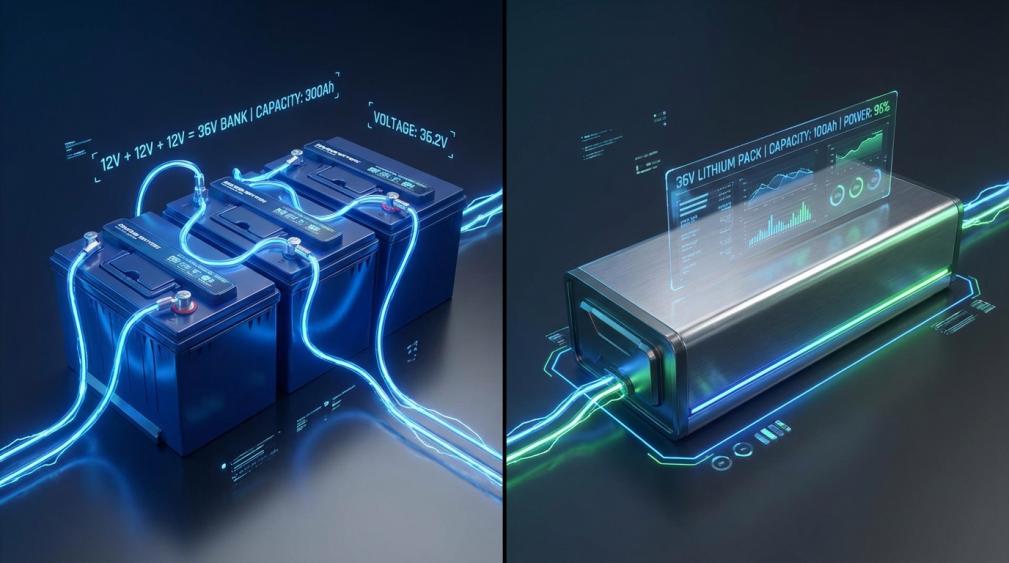
When you wire three 12V batteries in series, their voltages add to 36V while amp-hour capacity stays the same. That is how most traditional 36V trolling banks are built for high-thrust motors that favor higher system voltage and lower current draw for efficiency and reduced cable losses. Series connection is the right choice whenever the motor itself is designed for 24V, 36V, or 48V, but it comes with the catch that a single weak battery drags down the entire string.
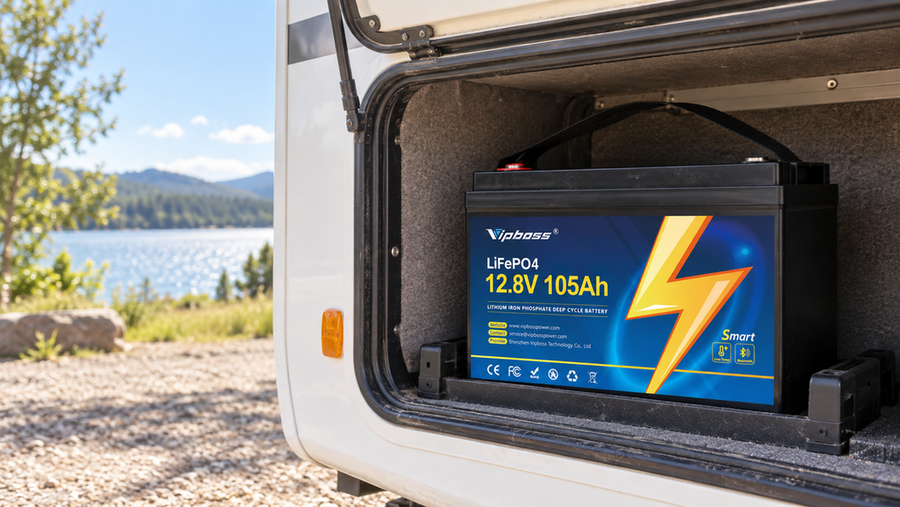
A single 36V trolling-motor battery packages that same 36V in one case, typically using lithium iron phosphate (LiFePO4) chemistry to deliver stable voltage and deep discharge over many seasons while being far lighter than three comparable lead-acid or AGM units. LiFePO4 trolling batteries are promoted as lighter, longer-lasting deep-cycle options that can endure thousands of charge cycles with minimal maintenance, often backed by multi-year warranties and marine-ready housings. Premium 36V lithium packs commonly deliver 3,000–5,000 cycles, while brands like Abyss market up to roughly ten times the cycle life of traditional lead-acid in compact cases tuned for trolling loads. Dedicated 36V trolling batteries are built around this use case, with integrated battery management systems and marine certifications.

In practice, the motor sees the same 36V either way, but the bank behind it behaves very differently in terms of usable capacity, voltage sag under load, charging, and failure modes.
Performance and Runtime: Which Keeps You Fishing Longer?
Runtime boils down to how many watt-hours you can actually pull out of the bank at 36V. A simple way to think about it is that runtime in hours is roughly battery amp-hours divided by the average amps the motor draws, assuming the battery can safely use most of its rated capacity without voltage collapsing. That Ah ÷ A estimate is standard in trolling-motor sizing and is used by battery manufacturers for planning trips and comparing chemistries.
Lithium shines here because almost the full rated capacity is usable. High-quality 36V LiFePO4 packs routinely allow close to 100% depth of discharge in normal operating conditions while maintaining a flat voltage curve, so thrust and GPS functions stay consistent until near empty. A 36V 100Ah lithium battery can power a 55–80 lb thrust trolling motor for about 6–8 hours at moderate speed before needing a recharge, a figure cited for 36V LiFePO4 packs designed for marine use. Manufacturers of 36V lithium banks highlight this combination of deep discharge and stable voltage as a core advantage over lead-acid.

By contrast, conventional lead-acid banks, even when sized to the same nominal amp-hours, typically offer only about half their rated capacity as truly usable energy before voltage sags, current draw rises, and battery life suffers. That 50% usable-capacity rule of thumb is a recurring theme in marine battery guidance and is one reason many anglers find their three-battery 12V lead-acid bank falls off sharply in the afternoon even though the math on paper looked fine. Lithium systems not only allow deeper discharge but also hold voltage throughout the day, so thrust stays crisp instead of feeling like you shifted down a gear after lunch.
Real-world data from offshore boats backs that up. Owners running 36V 100Ah lithium batteries on 112 lb thrust motors report that rough-water spot-lock sessions at high power typically use only a fraction of the pack, allowing multiple trips before hitting the recommended 80–90% depth-of-discharge limit where voltage begins to drop rapidly and the battery management system steps in to protect the pack. Detailed reports of 36V trolling systems on heavy offshore hulls describe about six three-hour outings on a single charge when usage stays moderate, compared with single-day limits and early voltage sag on smaller, cheaper packs.
The takeaway is that, for the same nameplate amp-hours, a single high-quality 36V lithium battery almost always delivers meaningfully longer, more consistent runtime than a three-battery 12V lead-acid or AGM series bank, especially under high thrust, wind, and current. Lead-acid still works, but you need significantly more capacity on paper to match the usable energy of a correctly sized lithium pack.
How Big Should Your 36V Bank Be?
Several manufacturers and real-world case studies converge on the idea that 36V packs in the 60–105Ah range cover most serious fishing applications, with the right choice depending heavily on boat size, windage, and how aggressively you use features like spot-lock. Abyss, for example, recommends a 36V 60Ah lithium battery for many trolling-equipped boats in the 22–32 ft range, while also offering 80Ah, 105Ah, and 120Ah options for heavier or more power-hungry vessels that run high thrust or long days on the bow mount. Their 36V lineup is built around that sizing guidance.
Forum discussions from offshore owners echo that experience, calling 65Ah 36V packs undersized for big boats with tall towers that sit broadside to the wind and recommending at least 100Ah for reliable all-day performance on rough days. Anglers comparing 65Ah versus 100Ah 36V packs consistently find that the larger capacity avoids abrupt battery-management-system shutdowns late in the day and keeps spot-lock from dropping out when it matters most.
Weight, Space, and Boat Behavior
If you have ever wrestled three group-size marine batteries into a bow compartment, you already know which setup wins on weight. LiFePO4 trolling batteries are typically up to about 70% lighter and physically smaller than comparable lead-acid banks, which can remove hundreds of pounds from multi-battery fishing rigs and free up space for tackle, coolers, and safety gear. Guides on lithium trolling motor retrofits emphasize that weight reduction as much as runtime.
Real-world owners routinely report 36V lithium packs in the 30–40 lb range, compared with three traditional marine batteries that can cost well over a thousand dollars for a full set and add a very noticeable load in the bow. Angler discussions on 36V lithium conversions highlight that boats not only ride higher but also feel more responsive once the bulk of a three-battery bank is removed.
Less bow weight improves holeshot and reduces plowing in small to mid-size boats, and it can also help trolling motors run more efficiently by letting you trim and set shaft depth precisely without fighting a nose-down attitude.
There are exceptions—some big offshore hulls benefit from a bit of ballast up front for ride—but in most bass, bay, and inshore rigs, being able to pull one or two hundred pounds out of the bow is a performance upgrade all by itself.
Space is the other quiet win. Replacing three cases, three trays, and multiple jumpers with one compact 36V pack can turn a cramped storage compartment into usable room for gear or allow a cleaner, more maintainable layout with proper cable sweeps and access to fuses and breakers.
Cost, Longevity, and Risk
Upfront, three 12V batteries almost always win on sticker price. Flooded deep-cycle batteries can be found near the low hundreds of dollars each, and even higher-end AGM options commonly cost significantly less per case than a single premium 36V lithium pack. Minn Kota’s battery selection guidance notes that flooded lead-acid remains the least expensive category, with AGM priced higher but still well below lithium for the same group size and voltage. Their overview of battery types and lifespan also points out that lead-acid typically delivers only a few years of service when cycled hard.
Lithium flips the equation when you look at the entire life of the system. Quality 36V LiFePO4 batteries are routinely rated for around 3,000–5,000 cycles versus roughly 300–500 cycles for conventional lead-acid, meaning that one pack can outlast many sets of flooded batteries if used and charged correctly. Lifecycle and runtime comparisons for 36V lithium packs stress this order-of-magnitude improvement, especially for anglers who fish multiple days a week. Abyss likewise promotes up to roughly ten times the cycle life of lead-acid for its 36V trolling batteries, reinforcing the idea that the higher upfront price buys you far more days on the water over the pack’s life. Their 36V product page makes that long-term value a core selling point.
Risk looks different between configurations. A three-battery 12V series bank offers modular replacement; if one battery fails, you can swap just that unit. However, any one weak battery drags down performance, and mismatched aging across the string is a common source of poor runtime and early shutdowns. Series banks also have more connections, jumpers, and potential failure points that must all be clean and tight to avoid voltage drop under load.
A single 36V pack simplifies the system but concentrates risk in one unit. If that battery fails or its battery management system shuts down due to fault or abuse, you lose the entire trolling bank at once and must replace or repair the whole pack. That is why serious anglers tend to favor reputable LiFePO4 manufacturers with proven test data, strong BMS design, and responsive service rather than chasing the cheapest import. Independent testing and owner reports have shown that some low-cost LiFePO4 brands perform poorly or have questionable safety margins in high-resistance fault conditions, which is why experienced boaters recommend either paying for top-tier lithium or sticking with well-maintained flooded deep-cycle batteries instead of gambling on unproven packs. In-depth user research on LiFePO4 trolling batteries calls out UL listings, real-world abuse testing, and solid after-sale support as non-negotiables. Broader buyer’s guides echo that message, urging anglers to weigh warranty, waterproofing, salt resistance, and service quality more heavily than a rock-bottom price.
Charging, Maintenance, and System Complexity
Three 12V batteries in series demand more attention. You either need a multi-bank charger that handles each 12V case individually or a dedicated higher-voltage charger that treats the string as a single unit. In either scenario, every jumper and terminal must be snug and corrosion-free or you will see voltage drop, uneven charging, and shortened battery life. Major trolling-motor manufacturers emphasize checking and tightening battery connections every or every other outing, fully recharging after each trip, and cleaning corrosion as routine maintenance because power problems so often trace back to tired cables and loose lugs on multi-battery setups. Maintenance recommendations from Minn Kota make this point explicitly.
A single 36V lithium battery is simpler to live with day to day. There is only one case to charge and monitor, and many packs now include Bluetooth apps that show real-time state of charge, current draw, and temperature, along with built-in protection against overcharge, over-discharge, and extreme temperatures. Owners of modern 36V trolling packs report that these smart features, coupled with waterproof housings and matched chargers, turn routine charging into a plug-and-forget process rather than a manual balancing act. Discussions of 36V lithium trolling batteries with integrated apps highlight how much easier it is to keep tabs on a single smart battery than on three independent cases.

However, lithium’s protective electronics add their own twist: when you run a pack hard enough to hit its low-voltage cutoff, the battery management system can disconnect entirely, leaving some alternator-based or stealth charging systems unable to “see” the battery and restart charging until a dedicated lithium charger is used. Offshore anglers with 36V systems repeatedly recommend sizing capacity so that you routinely stop at around 80–90% depth of discharge and using smart shunts or Bluetooth telemetry to avoid ever slamming into BMS shutdown during a trip. Best-practice threads on 36V lithium trolling systems stress combining ample amp-hours with active state-of-charge monitoring for exactly this reason.
From an off-grid and charging-in-the-wild perspective, lithium again has advantages. Quality LiFePO4 batteries can accept higher charge currents, recharge much faster than flooded lead-acid, and pair well with high-output alternators or marine solar systems designed to push significant amps back into the bank between spots. Real-world upgrades from small, slow chargers to robust, multi-chemistry smart chargers have cut recharge times from half a day to just a few hours for lithium trolling banks, making it far more realistic to top off between long runs or overnight while the boat is on a lift or trailer.
3x12V Series vs Single 36V Lithium: Side-by-Side
Factor |
Three 12V Batteries in Series |
Single 36V Lithium Battery |
Runtime per rated Ah |
Less usable capacity because lead-acid prefers shallow discharge and sags under load; often about half the nameplate Ah is practical on the water |
Nearly full rated capacity usable with a flat voltage curve, so more hours at consistent thrust for the same Ah rating |
Heavy multi-case bank, more bow weight and storage space consumed |
Up to about 70% lighter and more compact, able to remove hundreds of pounds and open storage space |
|
Upfront cost |
Lower initial cost, especially with flooded deep-cycle batteries; easy to source locally |
Higher purchase price, often comparable to several full sets of lead-acid over time |
Complexity and maintenance |
More cables, jumpers, and terminals to inspect, clean, and tighten; more opportunities for imbalance |
Minimal wiring, fewer connections, often one charger and one set of lugs to maintain |
Failure behavior |
Any weak 12V battery drags down the string, but you can replace just one unit |
Single point of failure; when the pack or BMS fails, the entire trolling bank is offline until the pack is repaired or replaced |
Charging and monitoring |
Requires either multi-bank charging or careful series charging plus regular voltage checks |
Typically uses a dedicated 36V lithium charger with built-in protections and Bluetooth or smart-shunt monitoring for easy state-of-charge tracking |
Best fit |
Budget-driven anglers, occasional use, or situations where local 12V replacements are critical |
High-usage anglers, heavy boats, and anyone prioritizing all-day runtime, lighter weight, and clean system design |
So Which Setup Wins for You?
When runtime, weight, and simplicity matter most, a single high-quality 36V lithium battery is the clear winner for powering a 36V trolling motor. You gain deeper usable capacity, faster charging, less bow weight, and fewer wiring gremlins, provided you size the pack correctly, pair it with a compatible charger, and choose a brand with robust safety features, certifications, and support.
A three-battery 12V series bank remains a valid choice when upfront budget dominates or when your fishing grounds and supply chain make it crucial to be able to grab standard 12V replacements on short notice. In that scenario, treating those lead-acid batteries as consumable, keeping them shallow-cycled, and maintaining every connection according to manufacturer guidelines can deliver dependable performance, just not the same all-day punch and agility that lithium brings.
The smart move is to start from how you actually fish. If you rely on spot-lock to hold a big boat in wind and current for long days and want your trolling system to feel like an upgrade rather than a constraint, invest in a properly sized 36V LiFePO4 pack with transparent monitoring and a matched charger. If your use is lighter or your wallet needs time to catch up, a well-maintained three-battery series bank will still get you on fish—just plan for shorter practical runtime and more frequent replacements until you are ready for the full power upgrade.