Every RVer learns quickly that comfort lives or dies with the RV battery. Lights, fans, fridge, and chargers all depend on that quiet box under the floor. Many owners hope a bank lasts "a few years" and are surprised when capacity crashes early. With a few clear numbers and realistic expectations, you can predict lifespan, plan runtimes, and adjust habits so your system feels predictable instead of fragile.
RV Battery Lifespan Basics: Years, Cycles, and Daily Runtime
"Battery life" usually mixes several ideas together. Once you separate them, planning gets a lot easier.
Years of Service
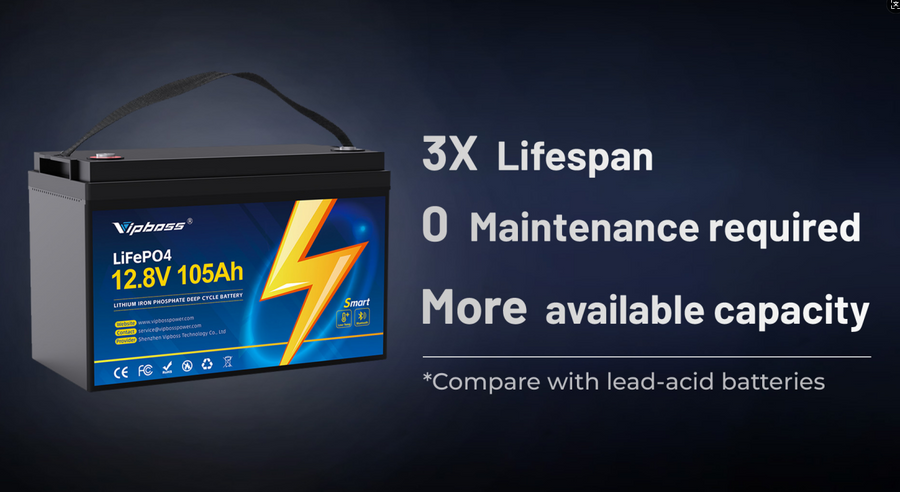
This is the calendar life. Deep-cycle lead-acid batteries in RV use usually deliver around 3–6 years when they are charged correctly and kept in moderate temperatures. Lithium iron phosphate packs that are built for house loads often stay useful for roughly 10–15 years in typical RV duty, especially if they are not pushed to the limits every day.
Charge and Discharge Cycles
Cycle life tells you how many times a bank can go from full down to a certain depth of discharge and back up again before capacity fades to about 70–80 percent of the original rating. Common ranges at moderate depth of discharge look like this:
- Flooded, AGM and gel deep cycle: about 500–1000 cycles at 50 percent depth
- LiFePO4: about 2000–4000 cycles at 80 percent depth
Daily Runtime
Daily runtime is the part you feel every night. It answers a simple question: with your usual mix of fridge, lights, fans, pumps, and chargers, how many hours can the system run before the voltage drops too low? Runtime depends on usable watt-hours in the bank, the size of your loads, and inverter efficiency.
Once you keep these three dimensions in mind, you can see why two packs with the same amp-hour rating behave very differently in real use and why some rigs burn through batteries faster than others.
How Long Do Different Types of RV Battery Usually Last?
Different chemistries age differently, so realistic lifespan changes a lot when you move from basic flooded batteries to sealed options and then to lithium. Typical numbers look like this under real RV conditions with correct charging and decent ventilation:
| Battery Type | Typical Cycles (Depth) | Approximate Service Life |
| Flooded lead-acid | 500–1000 @ 50% | 3–6 years |
| AGM lead-acid | 500–800 @ 50% | 3–5 years |
| Gel lead-acid | 500–1000 @ 50% | 3–6 years |
| LiFePO4 lithium | 2000–4000 @ 80% | 10–15 years |
Flooded batteries sit at the entry level. They can work well for several seasons if you stay on top of watering and equalization. If they live in a hot compartment, sit partially charged for long stretches, or are pulled very deep many times a week, sulfation builds quickly and service life moves toward the lower end of that range.
AGM and gel versions remove daily watering and usually handle vibration better. Their lifespan often lands in the upper side of the lead-acid range when they are kept around 50 percent depth of discharge and paired with chargers that reach proper absorption and float voltages.
A LiFePO4-based lithium RV battery changes the picture. With cycle life counted in the thousands at deeper discharge and gentler voltage sag under load, it can realistically cover a decade or more of active RV use when sized with some headroom and treated with basic care.

How Long Can One RV Battery Run Your RV Between Charges?
Trip planning revolves around runtime. You want to know how long a given bank can support your appliances before solar or a generator has to pick up the slack.
The simplest way to think about this is in watt-hours. A 12-volt 100-amp-hour battery holds about 1200 watt-hours on paper. With a flooded or AGM pack, protecting lifespan usually means using around half of that, so you work with roughly 600 watt-hours. With a modest 120-watt combined load from a small compressor fridge, some LED lights, and device charging, that gives you around five hours of comfortable use before the bank reaches about 50 percent state of charge.
A similarly sized LiFePO4 bank provides a very different experience. Safe depth of discharge often sits near 80 percent, so that same 100 amp-hour rating turns into about 960 usable watt-hours. Voltage stays more stable as the pack empties, so fridges and fans keep running at full strength longer and inverters hold steady instead of tripping early.
A simple estimate you can keep in your head looks like this:
Runtime in hours ≈ (Usable amp-hours × 12 V) ÷ Average load in watts
This rough math will not catch every efficiency loss, yet it gives a realistic planning number and keeps you from guessing. Accurate load analysis is the only way to calculate the specific amp-hours your RV lithium setup requires.
Habits That Quickly Shorten RV Battery Life
Batteries rarely fail from a single bad day. Instead, small habits shave months off their lifespan little by little. Several patterns show up over and over again in RV systems.
Deep Regular Discharges
Pulling a lead-acid bank down close to empty many times a week quickly eats through its cycle budget. Packs that might have lasted for years at 50 percent depth of discharge can slide into early retirement after long stretches near 80 percent depth or lower.
Chronic Undercharging
When a battery spends most of its life partially charged, sulfate crystals harden on the plates. Owners often notice that the bank seems to charge quickly all the way to "full," yet voltage dives whenever a heavier load, such as a microwave or coffee maker, comes on. That feeling of a fast charge and faster collapse usually signals long-term undercharging.
Heat and Freezing Conditions
High temperatures speed up every unwanted side reaction inside the cells. A bank in a sealed front compartment exposed to summer road heat will age faster than one in a cooler space. Very cold conditions cause their own problems. Available capacity drops sharply, and lithium cells can be damaged if charging continues below freezing without protection from a battery management system.
Mismatched Chargers
A converter locked to old flooded settings can leave AGM and gel packs undercharged. A lithium pack sitting behind a charger that never reaches suitable bulk and absorption voltages for LiFePO4 chemistry will also live below its potential. Over time, these mismatches translate into fewer usable cycles and shorter service life.
Once you see these patterns, it becomes clear that lifespan is not just about chemistry. The way the system is treated day in and day out matters just as much.
Simple Ways to Make a Lithium RV Battery Last Longer
A quality lithium RV battery already starts out with a big cycle life advantage. A few simple habits can turn that into many years of confident use.
Use a Charging Profile Built for LiFePO4
Modern converters and solar charge controllers often include dedicated lithium settings. Matching voltage and charging stages to the chemistry prevents chronic undercharging and avoids float levels designed for lead-acid. A correct profile lets the pack reach a healthy full charge when needed without sitting at that level for long periods in high heat.
Size the Bank for Shallow Daily Cycles
Instead of running a small pack very deep every night, many owners choose a bank that lets daily use sit in the middle of the state-of-charge range. A system designed so that normal camping keeps the battery roughly between 20 and 80 percent uses each cycle gently. That approach takes advantage of the high cycle count of LiFePO4 and turns it into a long service life that spans many seasons.
Store in a Calm State
When the RV sits for months, bringing the battery to a middle charge level, isolating it from parasitic loads, and keeping it in a cool space all slow aging. A quick voltage check every few months is usually enough to stay on top of things, especially when a built-in battery management system already handles cell balancing and safety limits.
These habits do not require constant monitoring. They simply align your routine with how the chemistry prefers to live.

When Is It Time to Upgrade to the Best Lithium Battery for RV Use?
Every pack reaches a point where extra tricks and maintenance no longer make sense. Clear signs include much shorter boondocking time than you remember from past seasons, voltage that sags sharply when larger loads such as an air conditioner startup or induction cooktop kick in, and an RV battery bank that seems to reach "full" unusually fast yet drops just as quickly once the sun goes down. When those symptoms appear and you find yourself planning entire trips around hookups, it is a good moment to look seriously at an upgrade to the best lithium battery for RV setups that match your travel style, and to check that chargers, cabling, and fusing are ready for a higher performance pack.
Make Your RV Battery Last Through the Trips You Love
A dependable RV battery setup does not come from luck. It grows from knowing the limits of each chemistry, sizing the bank for your style of camping, and respecting heat, depth of discharge, and storage. If you match a well-chosen pack with the right charger and a few simple habits, your house power turns into quiet background support instead of a constant question mark on every trip.
FAQs About RV Battery Lifespan
Q1: How often should I replace an RV battery that stays on hookups most of the time?
If you spend most of your time on shore power, a lead-acid RV battery still ages in the background. With decent charging and mild temperatures, many owners see three to five years of service. Heavy heat, constant high float voltage, or poor ventilation can shorten that to closer to three.
Q2: Is it a problem to mix old and new RV batteries in the same bank?
Mixing ages or brands usually pulls the new battery down to the level of the weakest one. The older unit reaches full charge sooner and limits how much energy the bank can accept. For best performance and lifespan, replace batteries as a matched set with the same type, age, and capacity.
Q3: How does my solar setup affect how long an RV battery lasts?
An undersized solar array leaves the bank partly charged for long stretches, which is hard on lead-acid cells. Oversizing slightly for your typical loads helps batteries reach full charge more often and reduces generator run time. The goal is a system that recovers to a healthy state most days, not just occasionally.
Q4: Do I really need a battery monitor, or is a voltage reading enough?
Voltage alone becomes misleading under load or right after charging. A shunt-based battery monitor tracks amp-hours in and out, average depth of discharge, and historical usage. That extra insight helps you change habits, size upgrades correctly, and catch problems earlier, which indirectly extends your RV battery's useful life.
Q5: Is it safe to leave an RV plugged in all winter without touching the battery?
It can be safe, but only if the converter or charger has a proper multi-stage profile and does not hold the bank at a high float voltage for months. Many owners prefer to use a quality maintainer or smart charger, check water levels on flooded cells, and verify temperature compensation in colder climates.