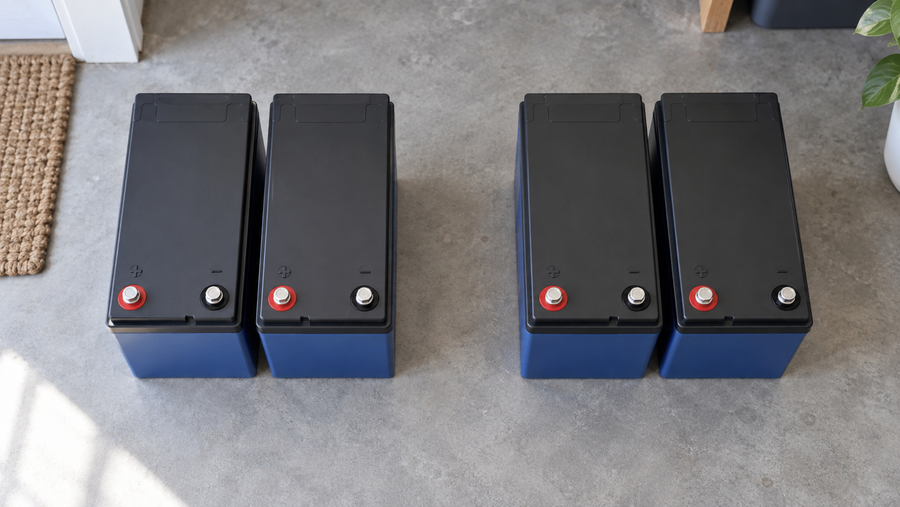

That mid-afternoon shutdown usually comes from lead-acid trolling batteries that cannot deliver their full rated capacity in real fishing conditions, compounded by aging, undersizing, and charging habits that quietly drain your power bank long before the day is done.
Ever watched your boat spin in the wind at 2:00 PM while the trolling motor fades to a stop just as the bite finally turns on? The pattern behind that moment is painfully consistent across countless rigs: the battery setup is the weak link, and the way traditional lead-acid is used almost guarantees a short day. Here is how to pinpoint exactly why your system quit and how to build a power upgrade that keeps your motor pushing hard until you decide the day is over.
What Really Happened at 2 PM
Lead-acid only gives you half the tank
Most anglers assume a “100 amp-hour” trolling battery gives them 100 amp-hours they can use. Deep-cycle guides from iPowerQueen and Abyss Battery make a blunt point: flooded and AGM trolling batteries tolerate only about half their rated capacity if you want them to last more than a couple of seasons. In practice, that means a 100 amp-hour lead-acid battery behaves more like a 50 amp-hour workhorse before voltage drops and long-term damage kicks in.
Put that into real terms. Imagine you spend the morning running your motor at speeds that average around 25 amps of draw, with bursts of higher thrust in wind or current. With only about 50 amp-hours of “safe” capacity, you hit the practical wall in roughly two hours of heavy use, maybe three if you baby the throttle. By early afternoon, voltage has sagged so much that the motor slows, control systems get flaky, and then it simply shuts down.
Battery age makes this worse. iPowerQueen and Abyss Battery both note that typical trolling motor lead-acid batteries deliver only about two to five years of life, especially when they are repeatedly run hard and recharged poorly. Inside the case, lead sulfate crystals slowly build on the plates, corrosion spreads, and internal resistance climbs. Johnson Controls’ automotive battery data shows the same pattern on the road: heat and irregular use quietly weaken plates long before the first obvious failure. On a boat, that decline shows up as “used to last all day, now it dies after lunch.”
Wrong battery, wrong job
There is another quiet killer: using the wrong type of battery. DrPrepare and several marine battery guides stress that trolling motors need deep-cycle batteries, not starting batteries meant for brief engine cranking. Many small rigs still rely on a dual-purpose or starter battery for the trolling motor because it looked cheap and convenient at the store. Those plates are not designed for hours of steady draw, so they heat up, shed material, and lose capacity fast. The result is classic: fine in spring, miserable by mid-season, dead by 2:00 PM on a windy tournament day.
Even with a proper deep-cycle, undersizing the bank guarantees short runtime. JD Power’s guidance for a 55‑lb thrust motor calls for roughly 120 amp-hours of capacity. DrPrepare’s sizing charts point out that higher-thrust 24‑volt and 36‑volt motors often need multiple 12‑volt 100 amp-hour batteries in series just to meet current draw and runtime. Running a big motor on one tired, undersized group 27 battery is inviting a lunchtime shutdown.
Temperature, parasitic loads, and “mystery” drain
Cold mornings temporarily reduce lead-acid capacity, while hot summers accelerate sulfation and aging. Johnson Controls’ research on car batteries shows how heat silently damages plates, then winter exposes the weakness; marine lead-acid behaves the same way. Add parasitic draws—small electronics or accessories left connected—described by Abyss Battery and JustAnswer experts, and you can arrive at the ramp with a battery already partially drained. By the time afternoon rolls around, you are running on fumes.
Is It the Battery, Wiring, or Motor? Fast Dockside Diagnosis
Start with voltage, then watch it under load
Before blaming the motor, confirm whether the power source is collapsing. Powerhouse Lithium, Abyss Battery, and Minn Kota all recommend a simple multimeter check. A fully charged 12‑volt battery should rest around 12.6 volts. If you see numbers closer to 12.0 or lower before you even leave the dock, the battery is already low or weak.
The more revealing test happens under load. Minn Kota suggests measuring voltage near the motor with it off, then running the trolling motor on a high setting in the water and watching the voltage drop. A healthy system should drop less than about 5 percent, roughly 0.6 volts on a 12‑volt battery. If your 12.6 volts drops to 11.0 or lower as soon as you hit higher speed, the bank is either failing or badly undersized for the draw.
JustAnswer technicians highlight an extreme example in a 24‑volt system: about 23.9 volts at the plug with the motor disconnected, but the voltage collapsing to roughly 3 to 4 volts at both plug and batteries when the motor was connected. That pattern points to either a dead short or batteries that show normal voltage at rest but cannot supply current under load. The cure was to isolate and test each 12‑volt battery individually and then correct wiring and protection.
Clean, tight, correctly sized connections
Power loss is not always chemistry; sometimes the electrons just cannot get through. Powerhouse Lithium, Newport Vessels, Abyss Battery, and Minn Kota repeatedly stress basic connection hygiene. White, green, or blue buildup on terminals is corrosion that adds resistance and starves the motor. Cleaning terminals with a baking-soda-and-water solution, using a wire brush, and coating them with dielectric grease restores solid contact. Loose terminals or undersized quick-disconnect plugs can heat up, melt, and intermittently disconnect under load.
In one 24‑volt trolling motor case collected on The Hull Truth, the owner kept seeing one “missing” battery on the charger. After chasing batteries and chargers, the real culprit was a loose connection at the battery terminal that only made intermittent contact. Once the terminal was properly secured, the mid-trip failures vanished.

Wire gauge and circuit protection matter just as much. Minn Kota and DrPrepare emphasize matching wire size and breaker rating to the motor’s maximum current draw. Undersized cable or an old plug with heat damage can introduce enough voltage drop that your motor behaves like the battery is dying even when it still has charge.
Rule out the motor only after the power path is clean
Powerhouse Lithium and JustAnswer marine experts point out that the majority of trolling motor “failure” complaints trace back to weak batteries or poor power delivery, not the motor itself. Only after the bank passes a load test, the voltage holds under throttle, and all connections, plugs, and breakers are confirmed healthy should you suspect worn brushes, damaged windings, or a failing speed controller. At that stage, symptoms like sparking, grinding, or a burning smell are strong clues that you need repair or replacement.
Why Lead-Acid Struggles While Lithium Keeps Fishing
Different chemistries, very different behavior
Lead-acid trolling batteries come in flooded, AGM, and gel variants. Guides from iPowerQueen, Abyss Battery, HZH Marine, and JD Power agree on the key trade-offs: flooded is cheap but heavy, spill-prone, and maintenance-intensive; AGM and gel are sealed and more vibration-resistant but still heavy and limited in usable depth of discharge. Across all three, typical service life is a few years, and practical use usually means avoiding discharge below about 50 percent if you want that lifespan.
Lithium iron phosphate (LiFePO4) changes the equation. DrPrepare and iPowerQueen describe LiFePO4 packs that safely deliver close to 100 percent of their rated capacity with roughly 3,000 to 5,000 cycles at deep discharge, often approaching a decade of service in marine use. For a trolling motor, that means the same 100 amp-hours on the label can provide nearly twice the usable runtime compared to a similar-rated sealed lead-acid battery.
DrPrepare also notes that a 12‑volt 100 amp-hour LiFePO4 pack can weigh around 22 lb, versus roughly 60 to 70 lb for an equivalent sealed lead-acid unit. Shedding 40 to 50 lb from the bow noticeably improves hole shot and trim on small boats while freeing space in the battery compartment. Because LiFePO4 maintains a flatter voltage curve during discharge, motor speed stays more consistent through the day instead of slowly sagging as the bank drains.
Most marine LiFePO4 batteries now include integrated battery management systems that protect against overcharge, over-discharge, overcurrent, short circuits, and sometimes low-temperature charging. That electronics layer, highlighted by DrPrepare and iPowerQueen, reduces the risk of user error compared with traditional lead-acid banks that rely solely on the charger and operator habits.
Side-by-side comparison
Factor |
Lead-acid deep-cycle (flooded/AGM/gel) |
LiFePO4 trolling battery |
Usable capacity |
Roughly 50% of rated amp-hours for reasonable life |
Up to nearly 100% of rated amp-hours |
Cycle life |
About 300–500 cycles; often 2–5 years in real use |
Roughly 3,000–5,000 cycles; can approach 10 years |
Weight (12V 100Ah class) |
About 60–70 lb |
Around 22 lb |
Voltage during discharge |
Noticeable sag; speed falls through the day |
Flatter curve; more consistent thrust |
Maintenance |
Water checks (flooded), corrosion cleaning, careful storage |
Maintenance-light; mainly charging and terminal checks |
Upfront cost |
Lower |
Higher |
Total cost over time |
Multiple replacements per decade |
Fewer replacements; often lower lifetime cost |
Consider that 2:00 PM shutdown again. With a 12‑volt 100 amp-hour lead-acid battery, you realistically count on about 50 amp-hours of usable energy. Swap that for a 12‑volt 100 amp-hour LiFePO4, and you nearly double usable energy. If your fishing style and motor draw consume roughly 20 amp-hours in the morning, the lead-acid bank may already be limping by early afternoon, while the lithium pack still has well over half its capacity in reserve. The practical difference is the ability to hold position, run spot-hold functions, and fight wind and current through the late bite instead of idling with a dead motor.

Designing a Battery System That Actually Lasts All Day
Match thrust, voltage, and capacity to the way you fish
The starting point is knowing your motor’s thrust rating and voltage requirements. JD Power notes that many 14 to 16 ft boats use 12‑volt trolling motors, while larger or heavier rigs step up to 24‑volt or 36‑volt systems. DrPrepare’s sizing guidance ties thrust to both voltage and capacity: moderate 30 to 45 lb thrust motors often pair well with a single 12‑volt 100 amp-hour battery, heavier 70 to 86 lb motors typically move into 24‑volt setups using two 12‑volt 100 amp-hour batteries in series, and 100+ lb thrust systems commonly rely on 36‑volt banks with three 12‑volt 100 amp-hour units.
Amp-hour capacity governs runtime. iPowerQueen and Abyss Battery both emphasize choosing at least about 100 amp-hours for most trolling applications, with 125 amp-hours or more providing a margin for wind, current, and electronics. JD Power specifically recommends around 120 amp-hours for a 55‑lb thrust motor. If you are routinely running out of power mid-day, the numbers on your battery labels are probably below these benchmarks or effectively lower because of aging and partial charging.
Wiring the bank correctly matters too. DrPrepare explains that connecting batteries in series raises voltage while keeping amp-hour capacity the same, which is how 24‑volt and 36‑volt trolling systems are built from 12‑volt units. Parallel wiring keeps voltage the same but increases capacity for more runtime. All batteries in a bank should be the same brand, type, model, and age to avoid imbalance and premature failure.
Charge and store the bank like you expect it to work
How you recharge and store the bank is often the hidden reason a “big” lead-acid battery still acts weak. iPowerQueen, Newport Vessels, JD Power, and Abyss Battery all converge on several habits.
After each trip, lead-acid trolling batteries should be fully recharged as soon as possible. Letting voltage sit low promotes sulfation that permanently reduces capacity. In the offseason, flooded and AGM batteries do best on smart trickle chargers or with monthly top-offs. Wet cells need periodic water level checks with distilled water, along with occasional equalization charges to balance cells.
Storage temperature also matters. Newport Vessels recommends keeping AGM batteries around 40°F to 80°F, while sealed lead-acid prefers roughly 50°F to 77°F in a dry, indoor location. Hot sheds and freezing boat barns both shorten life. Lithium packs, by contrast, prefer storage at about 40 to 50 percent state of charge in a cool, dry spot, as noted by iPowerQueen and other lithium care guides.
Before and after storage, inspect every case and cable. Bulging, cracks, leaks, or frayed cables are all reasons to retire a battery immediately, both for performance and safety, as emphasized by Abyss Battery, iPowerQueen, and Newport Vessels. Cleaning terminals and protecting them with terminal spray or dielectric grease keeps resistance low and voltage where it belongs.
Protect the system with proper breakers and wiring
Even a great battery can be sabotaged by weak support hardware. DrPrepare and Minn Kota both stress installing a properly sized circuit breaker or fuse between the battery and the trolling motor, mounted in-line on the positive lead close to the battery, typically within about 6 to 12 inches. For many systems, breaker recommendations fall in the 50 to 60 amp range, but the exact size must follow the motor manufacturer’s current-draw specifications. Minn Kota specifically warns that certain models, such as their Quest line, are not designed to pull more than 60 amps and must never be paired with a breaker rated above that threshold.
Wire gauge must also match the length of run and current draw. Minn Kota’s wiring charts and Powerhouse Lithium’s troubleshooting notes both highlight that undersized or heat-damaged wire creates voltage drop and hot spots under high thrust. If any section of cable feels warm during operation, that is a red flag that resistance is stealing power and potentially damaging insulation. Upgrading to appropriate marine-grade wire and replacing old plugs or receptacles can recover lost speed and reliability without touching the motor.
Putting It All Together on Your Boat
The path out of the 2:00 PM shutdown trap is straightforward once you see the pattern. First, inventory what you actually have: note the age, type, and amp-hour rating of every trolling battery, confirm how they are wired, and inspect every terminal, plug, and breaker. Next, perform a simple multimeter check before and during your next trip so you know whether voltage is collapsing under load or if the motor is losing power while the bank still shows healthy numbers.
If tests show that the battery is the bottleneck, you have a choice. You can oversize lead-acid, adding more amp-hours and weight, and commit to meticulous charging and seasonal maintenance. Or you can replace that heavy, aging bank with a purpose-built LiFePO4 pack sized according to thrust and runtime expectations, paired with a lithium-appropriate charger and properly rated breaker. At typical draw levels, the shift from roughly half-usable capacity to nearly full-use capacity is the difference between nursing the pedal by early afternoon and confidently holding an upwind edge all day.
Anglers who stop fighting their batteries and start designing their power systems with the same care they give rods and electronics quickly notice the change. Boat control stabilizes, electronics stop brownout-resetting, and the question shifts from “Will the motor die?” to “How late do you want to stay on this bite?”
FAQ
Can I just add a second lead-acid battery instead of switching to lithium?
Adding another matching deep-cycle lead-acid battery in parallel can extend runtime, and guides from iPowerQueen, Abyss Battery, and DrPrepare acknowledge this as a valid approach if the batteries are identical in type, brand, model, and age. The trade-off is weight, storage space, and the fact that you now have twice as many cells to maintain and eventually replace. A similar upgrade in LiFePO4 may cost more upfront but delivers more usable energy per pound, longer cycle life, and far less maintenance, so the total cost over several seasons often tilts in lithium’s favor.
Is my old charger safe to use with a new LiFePO4 trolling battery?
Most lithium vendors, including those cited by DrPrepare and iPowerQueen, insist on using a LiFePO4-specific charging profile. Traditional lead-acid chargers that float at higher voltages or have aggressive equalization modes can overcharge or confuse a lithium battery’s protective electronics. Some modern “smart” chargers have selectable profiles that include lithium settings; if yours does not explicitly list LiFePO4 support, replacing it with a marine-rated lithium charger is the safest move.
How do I know when a lead-acid trolling battery is truly done?
Abyss Battery, Minn Kota, and JustAnswer experts all converge on the same test pattern. If a fully charged battery shows normal resting voltage but sags hard under load in a proper load test, or if it cannot hold charge for more than a short period even with a good charger and clean terminals, it is at the end of its useful life. Visible signs such as bulging, cracks, or leaks mean it should be removed from service immediately. When those symptoms show up and the battery is already a few seasons old, replacement is the most reliable fix.
When your trolling motor dies at 2:00 PM, it is not bad luck; it is a power system telling you it was never designed for the way you fish. Redesign that system with the right chemistry, capacity, wiring, and charging strategy, and you turn that nightmare into the quiet confidence of all-day control on the water.
References
- https://www.hzhmarine.com/news/the-ultimate-guide-to-trolling-motor-battery-types-features-maintenance.html
- https://www.justanswer.com/boat/1xdvt-trolling-motor-stopped-working-new-battery.html
- https://www.thehulltruth.com/boating-forum/1252106-trolling-motor-lithium-battery-issues.html
- https://www.themobilemariner.com/post/how-do-i-know-i-have-a-parasitic-drain-on-my-boat
- https://www.abyssbattery.com/blogs/news/10-trolling-motor-battery-troubleshooting-tips
- https://drprepare.com/blogs/default-blog/trolling-motor-battery-guide-everything-you-need-to-know-this-season?srsltid=AfmBOop5giJOcB_dVa2OO1X8fmv7FseLUvGk4WkQ4GH2rqCQ5wvCSBA5
- https://ipowerqueen.com/blogs/tips-and-tricks/how-long-do-trolling-motor-batteries-last?srsltid=AfmBOoptnk2LULEN4wsZgbbpKYA74HfQdHvag8pNsVJFpMmZgmQ24WZz
- https://www.jdpower.com/boats/shopping-guides/how-to-make-trolling-motor-batteries-last-longer
- https://minnkota.johnsonoutdoors.com/us/blog/10-trolling-motor-maintenance-tips?srsltid=AfmBOooCwQlIHEHM-BXl915KYy3DEqdZFetM_N7IJ-XiWzeeDmufekIs
- https://newportvessels.com/blogs/learn/electric-motor-battery-inflatable-boat-maintenance-guide?srsltid=AfmBOor51efHfm9z3V5kueEqA5gDumTVjvp7V2RRJxlXGZa589wwtiRO