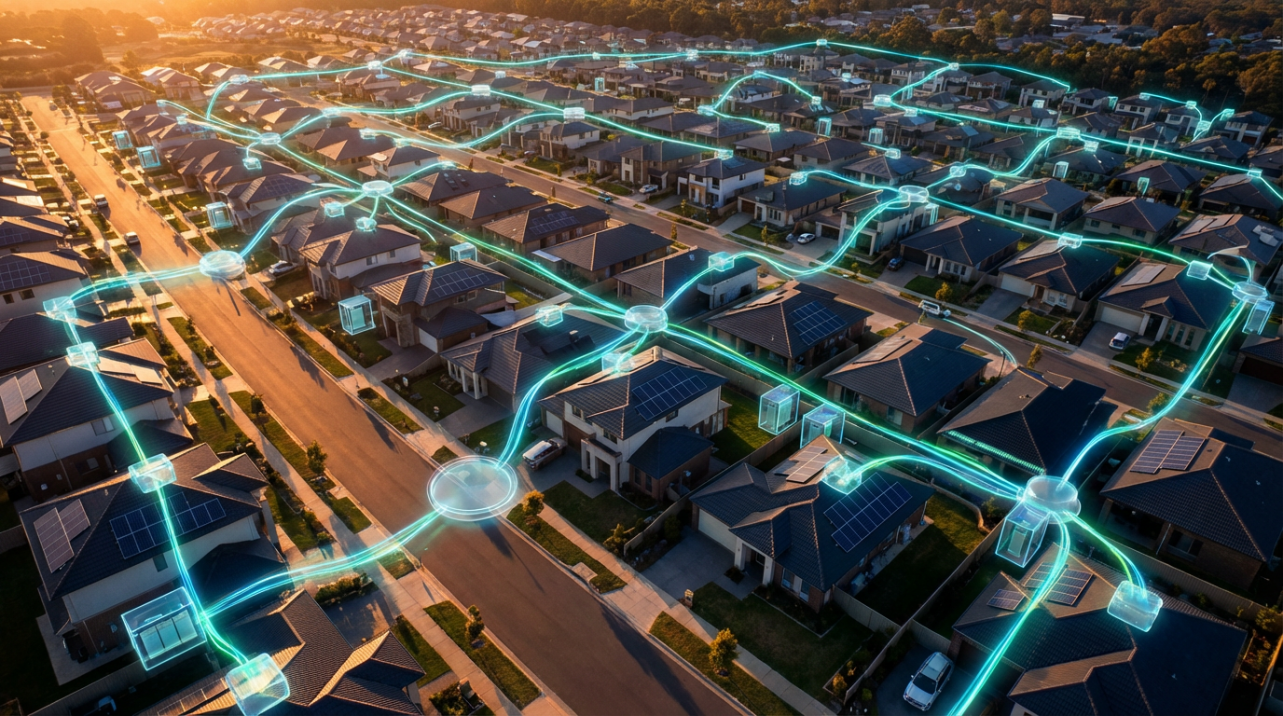

Connecting home batteries into a neighborhood-scale power network turns scattered backup systems into a resilient, money-saving community microgrid, and that is where home energy is headed.
Picture this: a storm knocks out lines across town, the main grid goes dark, yet the cluster of homes on your street with solar and batteries stays lit, phones charging, fridges cold, and medical devices humming. During the 2021 Texas winter crisis, neighborhoods with local power networks kept lights and heating on while the wider grid failed. Research on a real community in New Zealand shows that when homes interconnect and share power, their hours of annual shortfall can drop by about 97%. Linking your battery with your neighbors’ in a community microgrid is the logical next upgrade, and you can do it without sacrificing reliability, comfort, or control.
From One Backup System to a Neighborhood Power Network
Most homeowners who add lithium batteries think in terms of “my backup.” The system is sized so the fridge, a few outlets, the well pump, and maybe a mini-split keep running for hours or days when the utility fails. It is a solid upgrade, but if your neighbor across the fence has batteries and rooftop solar too, both of you are leaving value on the table by operating as islands.
A community microgrid is simply a local power network that ties together generation, storage, and loads within a defined area such as a street, subdivision, campus, or town block. According to engineering firms like Dynapower and Bloom Energy, these systems can run in parallel with the utility most of the time and then “island” during wider outages to keep critical loads powered. Community-focused organizations such as the Initiative for Energy Justice describe them as small, decentralized, self-sufficient energy systems built around resources like solar, wind, and batteries that can keep neighborhood infrastructure running when the big grid is in trouble.
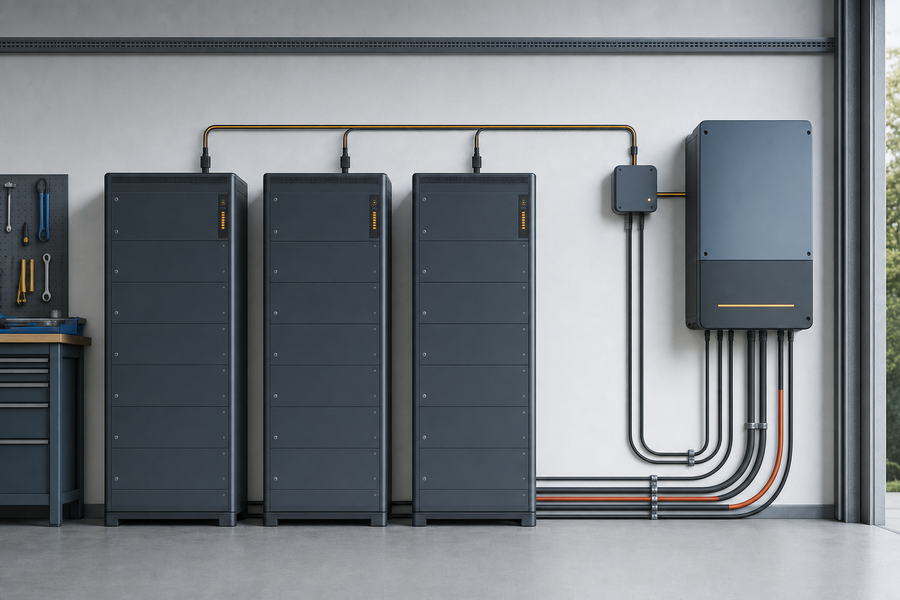
At the hardware level, a community microgrid looks very similar to what you may already have in your home: solar arrays, lithium batteries (often LiFePO4), inverters, smart meters, and a controller.

The difference is that instead of one house managing only its own power, a controller manages power flows across multiple buildings to keep everyone’s priority loads covered and make better use of every kilowatt-hour.
You can think of the choice this way:
Aspect |
Standalone home battery |
Community microgrid with neighbors |
Resilience |
Your house rides through outages; neighbors are on their own. |
Cluster of homes and critical sites stay powered together during outages. |
Use of surplus solar |
Excess often gets dumped to the grid at low credit or curtailed. |
Surplus is first shared with neighbors, then optionally sold to the grid. |
Bill savings |
Limited to what your single system can shift or shave. |
Peak shaving, load sharing, and bulk purchasing can cut costs for many homes. |
Control |
You decide only for your meter. |
Shared governance plus smart controls shape how the whole neighborhood uses energy. |
Once you see a home battery as one building block in a bigger neighborhood system, the advantages of connecting with other “battery neighbors” become obvious.
Why Sharing Power Beats Going It Alone
Real resilience in real disasters
Community microgrids are not abstract concepts; they have already proven themselves in some of the harshest events of the last decade. After Hurricane Maria, solar-plus-battery microgrids in Puerto Rico kept critical facilities operating when the centralized grid remained down for months, as described in analyses of renewable microgrids for remote communities. In the United States, the Texas winter storms and California’s fire-driven shutoffs have become case studies in how neighborhoods with local power networks can keep heat, communications, and refrigeration running while surrounding areas go dark.
Frontline and disaster-impacted communities have been early adopters because they feel the pain first. The Initiative for Energy Justice documents how climate disasters like major hurricanes and wildfires have left millions without power, often for weeks, with low-income and marginalized neighborhoods waiting longest for restoration. Community microgrids anchored in trusted resilience hubs—libraries, community centers, affordable housing—allow these neighborhoods to provide shelter, refrigeration for medicine, and device charging when the main grid fails.
The numbers from peer-reviewed research are striking. In one design for a Māori community at Motairehe, each of 10 homes and a community hall had 4 kW of solar and a 22.5 kWh battery. When each site operated alone, some houses experienced up to 317 hours per year when basic needs could not be met, and the hall faced about 2,184 hours of shortfall—roughly a quarter of the year—even though the community as a whole wasted about 18.8 MWh of surplus solar. When the very same hardware was networked as a community microgrid and power sharing was enabled, total shortfall hours across the community fell by about 97% to just 64 hours in the entire year, while surplus energy jumped to around 33.2 MWh that could serve flexible loads like hot water or electric vehicles. A neighborhood of “battery neighbors” behaves very differently once those batteries can help each other.
Community-scale designs show similar patterns. In a modeled 30-house residential microgrid where each home used about 18.2 kWh per day and had modest rooftop solar plus a 12 kWh battery, local generation met demand in more than half the hours of the year with no exports. Average daily imports from the main grid dropped by about 59%, and the annual peak import was cut by roughly 21%. That is the difference between a feeder that trips under stress and one that keeps supplying critical services during an extreme event.
Getting more value from every kilowatt-hour
Sharing does not just make outages easier to ride out; it also squeezes more value out of every panel and battery already installed on your block. Today, a typical retrofitted home might export midday solar when the family is at work and then buy that energy back at a premium during the evening peak. If the neighbors have similar profiles, everyone is exporting and importing at the same time, leaving batteries underused and the local grid strained.
Community microgrids tackle that by coordinating supply and demand at the neighborhood level. Studies summarized in open-access energy journals show that when multiple small systems are treated as a single microgrid, local generation can cover a much higher share of local load and exports can be timed for maximum value. The New Zealand 30-house example effectively added about 322 kWh per day of usable local renewable supply just by coordinating homes, without building a single large power plant.
On the bill side, real-world neighborhoods that share solar and storage report meaningful savings. Residential experts documenting community microgrids have found that using locally generated or stored power during high-tariff periods can reduce typical monthly electricity bills by about 15–25%, especially where demand charges or steep evening rates dominate. Because infrastructure and maintenance are shared, the upfront and ongoing costs per household can be lower than if every home tries to build a fully standalone system.
Cleaner power and stronger local economies
Microgrids are also a climate and economic development tool. Renewable-focused providers such as Wattcrop and Just Energy highlight how localized solar, wind, and storage cut dependence on fossil fuels and shrink a community’s carbon footprint, while environmental organizations emphasize the health benefits of cleaner air in neighborhoods near ports, industrial sites, or busy highways.
Community microgrids create jobs as well. Ameresco’s work on projects like the Slemon Park microgrid in Prince Edward Island shows how multi-megawatt solar and storage installations require local workers for design, construction, operations, and maintenance. Even as advanced controllers and artificial intelligence enter the picture, on-the-ground technicians remain essential. That means training opportunities for electricians and technicians, and new reasons for manufacturers or data centers to locate in regions with resilient, clean power.

Economic think tanks and property advisors such as the Center for Climate and Energy Solutions and JLL add another dimension: risk. As cities electrify buildings and vehicles, power demand rises faster than utilities can reinforce aging infrastructure. Microgrids help real estate owners and communities hedge against volatile prices and disruptive outages by providing local backup and better control over when and how grid electricity is used.
Is a Community Microgrid Right for Your Street?
Technical fit: what needs to be in place
From a technical standpoint, many neighborhoods considering home batteries already have most of what a small microgrid needs. A typical setup involves rooftop or carport solar, lithium-based storage, a hybrid inverter, and a critical-load subpanel. At that point, your home is effectively a tiny “nanogrid” behind a single meter.
To move from isolated nanogrids to a community microgrid, three additional ingredients are required. First, there has to be a way to electrically connect multiple buildings within a defined boundary, often using upgraded distribution lines and switchgear. Utilities such as PG&E describe these as special microgrid facilities that let a defined area disconnect safely from the wider grid when needed. Second, a central controller is needed to monitor real-time conditions and decide where energy should flow, prioritizing base loads and battery charging before discretionary uses. Engineering firms like Logic20/20 and Bloom Energy highlight how these controllers keep voltage stable, balance distributed resources, and prevent blackouts. Third, robust communications and metering ensure that every home’s contribution and usage is tracked fairly.
If your block already has several homes with modern hybrid inverters and LiFePO4 batteries, you are not starting from zero. Advanced battery manufacturers such as Dragonfly Energy position these systems as building blocks for multi-site microgrids, because they can be monitored and controlled as a fleet rather than as isolated backup boxes.
Social and regulatory fit: neighbors, rules, and ownership
A neighborhood power network is as much a social project as it is an electrical one. Recent research in Energy Research & Social Science emphasizes that the success of community microgrids depends heavily on social capital: trust between neighbors, strong local networks, and the willingness to engage in planning and governance. Without people ready to attend meetings, serve on a board, and hash out decisions about tariffs and priorities, even the best-designed microgrid will underperform.
Ownership models matter too. Organizations focused on energy justice recommend that community microgrids, especially in frontline and low-income neighborhoods, be structured to give residents real decision-making power through cooperatives, public ownership, or tribal entities rather than purely outside corporate control. Studies of community energy in the United Kingdom by groups like the Joseph Rowntree Foundation show that when local people share in the profits or benefit from lower bills, support for new infrastructure is dramatically higher.
Regulation is another piece of the puzzle. Analysts at the Center for Climate and Energy Solutions point out that most US states still lack clear legal definitions for microgrids, leading to uncertainty about who can own wires, how power can be sold, and how costs should be allocated. Some states, including California, Connecticut, Massachusetts, New Jersey, and New York, have created grant programs or resilience banks specifically to fund microgrids, while places like Oregon are actively working on legislation to clarify who may develop, own, and operate community microgrids. In parallel, the US Department of Energy has launched the Community Microgrid Assistance Partnership to provide technical support and funding for remote, rural, and Indigenous communities, with pilot efforts focused on regions such as Alaska and Hawaii.
If your neighborhood can combine technical readiness, social cohesion, and at least a reasonably supportive regulatory environment, then tying batteries together into a community microgrid is not only feasible but increasingly well supported by policy.
How to Start Moving from “My Battery” to “Our Microgrid”
The first practical step is often the simplest: map interest and assets on your street. That can be as informal as a block meeting where neighbors list who already has solar, who has or wants batteries, and which buildings are critical in an emergency, such as a home with medical equipment, a daycare, or a small grocery. Case studies in Puerto Rico and Appalachia underline how powerful it is to anchor microgrids in sites people trust and actually use.
Next, bring your local utility or distribution operator into the conversation early. Utilities like PG&E explicitly encourage communities to invest time upfront to size microgrids correctly and to design “Project Resources” such as solar and batteries so they can interconnect under existing tariffs. Separating the interconnection process from the microgrid design process avoids costly rework and delays. In some jurisdictions, utilities now have dedicated resilience coordinators or microgrid teams to guide communities through the process.
Financing deserves just as much attention. Because microgrids naturally mix technologies and customer types, traditional project financing can be tricky. Policy groups and market analysts recommend blended approaches that combine grants, low-interest loans, community investment, and public–private partnerships. Examples include resilience banks in New Jersey, clean energy funds in New York, and non-competitive county grants in Oregon that underwrite early planning work. In frontline and Indigenous communities, federal programs and philanthropic capital are often layered with state support to reduce debt burdens and keep ownership local.
Design decisions should follow a few clear principles highlighted by case studies from Aotearoa New Zealand.

First, maximize the local use of local renewables: size solar and batteries so that most of what you generate is consumed within the microgrid over the year. Second, include flexible loads such as water heating, space conditioning, EV charging, and community services that can soak up surplus power instead of wasting it. Third, think fractally: start at the household level, then link up multiple homes, then add public and commercial buildings to diversify the load profile, always under smart controls that can shift demand gently rather than just oversizing every individual system.
Electric vehicles are a natural extension. Research and utility pilots in places like New York and California show that buses and cars equipped with vehicle-to-grid technology can feed power back into a microgrid during peaks or outages, effectively acting as mobile batteries. Programs such as PG&E’s vehicle-to-microgrid pilots and the school bus experiments documented by Renew Wisconsin demonstrate how EV fleets can support local resilience as well as mobility.
Pros, Cons, and Tradeoffs When You Connect with Neighbors
Community microgrids do not magically solve every energy problem, but the balance of benefits and challenges is clear when you look at evidence from across regions and sectors. On the plus side, they deliver resilience by islanding during outages and keeping critical loads powered, as documented by national laboratories, utilities, and real-world cases from Puerto Rico to Wisconsin. They improve efficiency and lower emissions by shortening the distance between generation and use and by favoring renewables. They can lower bills through peak shaving, load shifting, and demand response, and they create pathways for local job creation and community wealth building.
On the downside, they require serious upfront capital and long-term planning. Analysts at organizations like the Center for Climate and Energy Solutions stress that each microgrid is highly customized, which raises development and financing complexity. Regulatory barriers—such as restrictions on running wires across streets or unclear rules about selling power to neighbors—can slow or even stall projects. Community engagement can also be a double-edged sword: when done well, it builds trust and shared ownership; when rushed, it leads to mistrust and conflict.
The tradeoffs can be summarized this way:
Dimension |
Upside of a community microgrid |
Key challenge to manage |
Resilience |
Keeps neighborhoods powered during grid failures and disasters. |
Requires careful design and maintenance of controls and storage. |
Economics |
Can cut bills 15–25% and open new revenue streams from surplus power. |
High upfront costs demand creative financing and patient capital. |
Control and equity |
Shifts decisions closer to residents and can build local wealth. |
Needs inclusive governance so benefits reach low-income households. |
Grid interaction |
Eases strain on aging infrastructure and supports decarbonization. |
Depends on supportive utility relationships and clear regulations. |
Understanding these tradeoffs upfront lets you design a system that fits your community’s risk tolerance and priorities rather than discovering surprises mid-project.
FAQ: Common Questions from “Battery Neighbors”
Do I lose my own backup power if I share my battery in a microgrid?
No. Well-designed microgrids prioritize each building’s essential loads before sharing energy outward. The New Zealand case studies are explicit about this: smart controllers serve a node’s base load first, then charge the local battery, then support the wider microgrid, and only later supply discretionary loads. In practice, that means your fridge, well pump, and key circuits stay at the front of the line, even as your battery helps stabilize the neighborhood during a crisis.
What if my neighbors do not all have solar and batteries yet?
Community microgrids are designed to mix different types of participants. Some buildings provide generation and storage, others mainly consume, and some serve as community hubs. Examples from places like Adjuntas in Puerto Rico and Chelsea and Chinatown in Massachusetts show microgrids where a relatively small number of solar-plus-storage sites keep multiple businesses and public buildings operating during outages. Over time, more homes can add their own batteries and panels, but that is not a prerequisite for getting started.
Is this only for rural or disaster-prone areas?
Not at all. While remote villages and fire-prone regions have been early adopters, microgrids are expanding into dense urban neighborhoods and commercial real estate. The Brooklyn Microgrid in New York allows residents to generate, store, and trade energy locally, and commercial campuses from California hospitals to Canadian industrial parks now rely on microgrids for both resilience and sustainability. Real estate advisors note that as power demand rises and grids age, microgrids are increasingly seen as standard infrastructure for high-performance buildings, not fringe technology.
Closing Thoughts
If you have already invested in a lithium battery, you have taken the first step toward energy independence. When your neighbor has one too, the smartest next move is to stop thinking in terms of isolated systems and start thinking in terms of a neighborhood power network. Community microgrids turn scattered batteries and panels into a resilient, flexible, and cost-effective local grid—and the communities that begin that journey now will be the ones keeping the lights on, bills manageable, and air clean in the energy future that is rapidly taking shape.
References
- https://www.energy.gov/oe/articles/us-department-energy-launches-community-microgrid-assistance-partnership
- https://pmc.ncbi.nlm.nih.gov/articles/PMC12054575/
- https://iejusa.org/community-microgrids-powering-resilience-in-frontline-disaster-impacted-communities/
- https://www.renewwisconsin.org/powering-the-future-how-microgrids-are-transforming-energy-resilience-and-sustainability/
- https://www.sustainablenorthwest.org/blog/microgrids-oregon-4-2025
- https://www.c2es.org/content/microgrids/
- https://www.residentialsolarpanels.org/uncategorized/community-microgrids-how-your-neighborhood-can-power-through-any-crisis/
- https://sustainabilityglobal.org/article/community-microgrids-for-rural-sustainability/
- https://www.ameresco.com/how-microgrids-can-boost-economic-development-for-a-community-and-its-residents/
- https://brightpathassociates.com/microgrids-for-communities-planning-sustainable-energy/