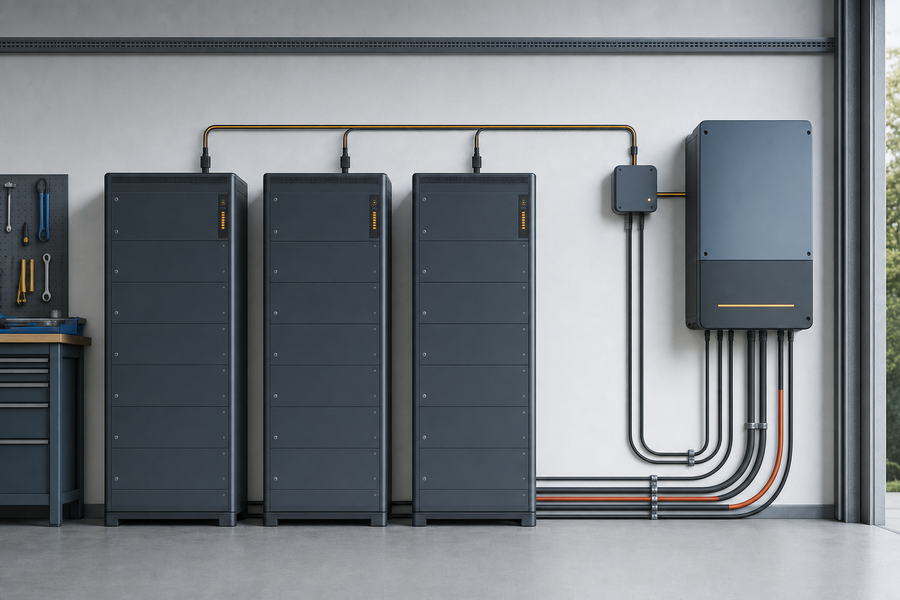

Shorter wires usually improve off-grid systems by cutting resistance and wasted heat, but in heavy parallel runs you sometimes need near-equal lengths so each path shares current safely.
You bolt in a new lithium bank and inverter, tidy one set of cables into a short, straight shot, and leave another snaking around combiner boxes and shunts. Now you are wondering which path is secretly working harder. Field experience and lab work show that smart routing and sizing can hold voltage drop to a few percent while keeping every parallel path comfortably within its thermal limits. This guide explains when to keep cutting cable, when to match lengths, and how to make parallel wiring work for you instead of against you.
Why Shorter Wires Usually Win
For a given material and thickness, resistance is directly proportional to wire length, so doubling the length roughly doubles the resistance the current has to push through. That extra resistance shows up as voltage drop along the cable and as heat in the copper instead of useful power at your inverter or loads.
Designers often treat wire resistance per foot as a basic building block: resistance for your actual run is that per-foot value multiplied by length, and it rises again as the wire gets thinner because the cross-sectional area shrinks. The same piece of copper is described two ways: its intrinsic resistivity (a material property) and its overall resistance as cut and installed, which also depends on length and cross-sectional area, as explained for power conductors in wire resistance references. In practice this means a long, thin run to a shed or cabin will drop more voltage and run hotter than a short, thick one at the same current.
In off-grid DC systems, voltage is low and currents are high, so these losses show up quickly. A modest drop of 3% on a 12 V bank is only about 0.4 V, but that can be the difference between the inverter staying happy or nuisance-tripping during surge loads. Industry practice for branch circuits and feeders often targets a few percent voltage drop end-to-end, which is only possible when cable length and wire gauge are chosen together rather than treating “any copper” as good enough.
A Simple Length–Drop Reality Check
The relationship between resistance, length, and wire size is captured in the familiar formula (R = \rho L / A), where resistivity and cross-sectional area stay constant for a chosen cable and only length changes. Educational experiments show that plotting resistance versus length for a uniform wire gives a straight line through the origin, confirming this direct proportionality across a wide range of lengths for copper and similar conductors. That same physics applies to your battery leads and PV home runs.
Consider two runs made from the same cable: one 5 ft long, the other 20 ft. The 20 ft run has about four times the resistance of the 5 ft run. If both carry the same current, it will see four times the voltage drop and four times the I²R heating. The fix is straightforward: keep the path as short as layout and service access allow, and move to a lower-gauge (thicker) cable when distance is not negotiable.

At typical mains voltages with thick conductors, you need extremely long runs before wire resistance really limits current. Measurements with 18 AWG copper (about 6.4 ohms per 1,000 ft) show you would need on the order of 100,000 ft to get hundreds of ohms of resistance into the loop—hardly a realistic house run. In a 12 V lithium system, by contrast, even small fractions of an ohm matter, which is why “short and thick” is the default strategy between batteries, busbars, and inverters.
Parallel Paths: Why “Equal Length” Even Comes Up
Parallel circuits take one voltage and split current between several paths. A fundamental result of current division is that each branch’s current is inversely proportional to its impedance; the lower-impedance branch carries more current, while higher-impedance branches carry less, as shown in basic parallel-resistor analysis of multiple branches at the same voltage source. In practical wiring, those impedances are set by wire resistance, layout-dependent inductance, and contact quality along each path.
For PV modules and batteries, parallel connections are how you increase total current or amp-hours while holding voltage constant. Solar training material shows modules wired in series to raise voltage and in parallel to raise array current, and the same logic applies to batteries in a bank wired positive-to-positive and negative-to-negative to increase storage at fixed system voltage, as described for series-parallel arrays in off-grid PV design examples. Each parallel string “sees” the same bus voltage and contributes its share of current depending on cable and connection details.
In heavy feeders, codes step in to keep that current sharing under control. The National Electrical Code (NEC) allows large conductors to be paralleled, but only when each conductor in a given phase set is the same length, material, size, insulation, termination, and raceway type. This “same length” rule is described for parallel feeders in discussions of NEC 310.4/310.10 and related sections on grouping circuit conductors, where the goal is to keep impedances close enough that no single path is overloaded, as summarized in equipment grounding and parallel conductor guidance. The same logic applies to all live conductors in the paralleled set, not just the grounds.
Engineers studying high-capacity parallel power cables have repeatedly found that geometry and routing strongly influence how current splits between branches. Unequal spacings, differing proximity to ferromagnetic structures, and different sheath or shield paths all tweak AC resistance and effective impedance, which in turn biases one cable to run hotter while its neighbor loafs. That is why large industrial and utility designs treat layout and sameness of parallel paths as a serious engineering problem instead of a cosmetic detail.
Real-World Duct Banks: Perfect Equality Is Fiction
If you stand over a big duct bank where six, eight, or ten conduits pop out of the ground, you will rarely see perfectly symmetrical routing. Conduits in the back row often take slightly wider sweeps or tighter nineties at each end than those in front, building in a little extra path length. Field discussions of these installations suggest that just the geometry around the bends can add roughly a foot or more of extra conductor on some paths, and across both ends of the bank you can easily accumulate a difference on the order of a few feet between the shortest and longest phase runs.
Code language still calls those conductors “the same length” because the intent is to avoid deliberate, large differences in impedance, not to demand tape-measure perfection in a crowded vault. In practice, good designs aim to keep all parallel conductors very close in route length, number of fittings, and termination style, then verify actual currents during commissioning with clamp meters to confirm nothing is running hotter than expected.
When It Makes Sense to Lengthen Wires on Purpose
The core question is whether you should ever add wire just to equalize length in a parallel setup. The answer depends on scale and stakes.
Parallel Battery Strings and Busbars
In a lithium battery retrofit, you might parallel several 12 V or 48 V strings to build up amp-hour capacity while keeping system voltage fixed. Guidance on wire sizing for such banks emphasizes choosing a gauge that can carry the combined current of all strings, keeping paths short, and avoiding excessive voltage drop between the bank and loads. For example, using multiple 100 Ah batteries in parallel can push total current into the hundreds of amps, where appropriately thick copper (such as 2 AWG or even 0 AWG on longer runs) is recommended to keep both heating and voltage drop under control in typical solar and UPS systems.
Within a battery rack, the goal is not tape-measure-identical cables but similar impedance for each string. You get most of the benefit by doing three things: using the same gauge and type of cable for all strings, keeping positive and negative leads for each string close to the same length, and landing them on common busbars or terminals in a symmetric pattern. If one string has to reach around an obstruction and ends up a couple of feet longer, the added resistance is still small if the cable is thick; stretching all the other strings just to match that detour usually adds clutter and cost without materially improving balance.
Where systems push very high currents and run close to cable limits, such as large inverters near their continuous rating, it can be worth re-routing the shorter paths or adding modest extra length so every string has the same number of lugs, bends, and approximate feet of cable. The key is to make “equal length” a by-product of a clean, symmetric layout, not a rigid rule that forces awkward cable spaghetti.
Parallel Feeders and Long Runs
On building-scale feeders where the NEC’s parallel-conductor rules apply, you do sometimes extend the short path to match the long one, but that decision is part of a full design, not an after-the-fact tweak. The design starts from conductor size, number of parallel sets, and raceway routing chosen to meet ampacity and voltage-drop limits, then the installer pulls identical conductors along each path so that every A-phase, B-phase, and C-phase leg has essentially the same length, material, and physical environment, consistent with parallel feeder and equipment grounding requirements.
In that context, adding a few extra feet on the “short” route to keep all legs matched is absolutely worth it. The alternative is a built-in imbalance where one conductor in the set runs hotter and ages faster, potentially limiting future load growth or forcing derating.
For typical off-grid cabins, RVs, and small homesteads, you are almost never in this regime. You usually have one set of fat battery cables, a few home runs to combiner boxes, and maybe a short feeder from a power room to a small subpanel. Here the best move is nearly always to shorten the long paths within reason and upgrade gauge where distance is locked in, rather than lengthen the neat, short run just to chase an abstract notion of equality.
Electrical Length vs Physical Length: When RF Rules Do Not Apply
Another source of confusion comes from “electrical length,” which is how long a conductor is in terms of signal wavelength instead of feet. In RF and microwave work, designers treat a line as electrically long once its physical length approaches a significant fraction of a wavelength, and they start worrying about reflections, standing waves, and phase shifts along the run, as summarized in explanations of electrical length and transmission lines.
Your lithium battery cables and most off-grid feeders are at the opposite extreme. At 60 Hz, the free-space wavelength of the signal is thousands of miles; a 20 ft cable is electrically tiny, far below the usual one-tenth-wavelength threshold where transmission-line effects dominate. Even the higher-frequency components from inverter switching are usually handled by local filtering and layout rather than by trying to trim cables to specific phase lengths. For these systems, impedance differences due to length are almost entirely resistive and inductive in the low-frequency sense, not phase delays in the RF sense, so you focus on resistance, cross-section, and geometry rather than matching electrical lengths the way a radio engineer would.
Putting It All Together
You can make sense of the “short vs equal length” question by separating ordinary single runs from true parallel conductors sharing the same current, and by matching your strategy to system scale.
Scenario |
Preferred strategy |
When equal length matters |
Example move |
Single run from battery bank to inverter |
Keep it as short and straight as practical, then size gauge for low voltage drop and heating |
Only to the extent that positive and negative runs should be similar for symmetry and inductance |
Relocate the inverter closer to the bank and move from 4 AWG to 2 AWG instead of looping cable around obstacles |
Multiple parallel battery strings feeding a common DC bus |
Use the same gauge, similar lengths, and symmetric busbar landings for all strings |
Useful when total current is high and one string risks hogging load |
Re-arrange the rack so each string feeds a common busbar with similar lead lengths, rather than stretching the shortest string |
Large parallel AC feeders in conduit or tray |
Follow code: conductors for each phase must be effectively identical in length, material, and raceway |
Critical for reliability and compliance; you may intentionally add length to keep all paths matched |
In a duct bank serving a big service, run all phase conductors through conduits with the same geometry and accept a bit of extra length on the most direct route |
For most lithium retrofits and off-grid power upgrades, the practical rule is simple: chase short, thick, tidy runs first, then worry about matching lengths only when multiple conductors truly share the same current path at significant amp levels. When you do step into big parallel-feeder territory, treat “same length” as a design requirement from the start, not a last-minute patch, and verify current sharing once the system is live. Done right, your cables will run cooler, your voltage will stay steadier, and your upgraded system will deliver the power you paid for instead of quietly burning it off in copper.