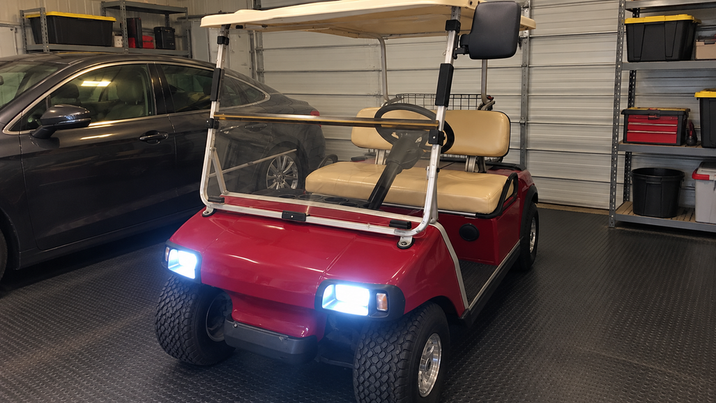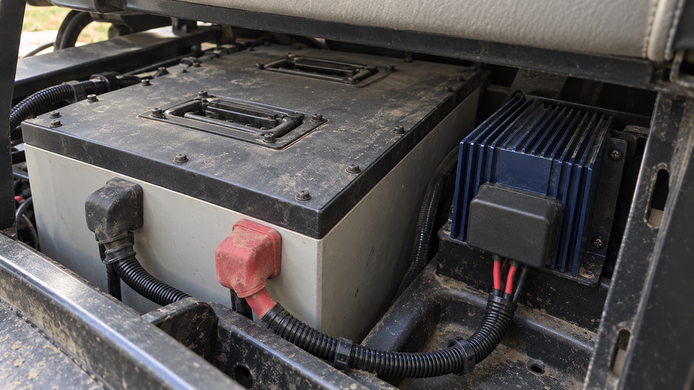

A voltage reducer can handle a fully charged 48V lithium golf cart only when its published input range includes the battery’s highest charging voltage and its output rating covers the accessories that can run at the same time. The “48V” label by itself does not answer either question.
A fully charged 48V lithium battery is above 48 volts
“48V” is a system class, not the voltage the battery remains at throughout a charge cycle. A common 48V LiFePO4 golf-cart battery is 51.2V nominal and reaches a higher voltage while charging. The battery manual or product specification—not the nominal label—provides the value that must be checked.
For example, the Vipboss 48V 150Ah golf-cart conversion kit lists a 51.2V nominal battery and a 56.8–58.4V charging range. For this battery, a reducer whose maximum input is below 58.4V fails the full-charge voltage check. A reducer rated only as “48V input,” without a published input range, does not provide enough information to confirm compatibility.
Compare the battery maximum with the reducer input range

Use the battery’s specified maximum charge voltage and the reducer’s maximum continuous input voltage:
- If the reducer maximum is lower than the battery maximum, do not use that reducer.
- If the reducer maximum is equal to or higher than the battery maximum, it passes this voltage check.
- If the reducer lists an input range, also confirm that the battery remains within the usable range as it discharges.
Do not assume the reducer can tolerate voltage above its published limit, and do not substitute the controller voltage, charger label, or 48V nominal system name for the battery’s maximum charge specification.
A published range makes the decision much clearer. For example, a reducer with a documented 32–70V input range includes a 58.4V full-charge value. This establishes voltage compatibility for that example, but it does not yet show that the reducer can power a particular set of accessories.
Check output current as well as input voltage
After the input-voltage check passes, add the current draw of the 12V accessories that may operate together. Lights, a stereo, a USB outlet, a fan, or other equipment can share the reducer, so the combined load—not the rating of the largest single accessory—must remain within the reducer’s continuous output rating.
Also check brief startup or peak demand where the accessory manufacturer specifies it. An audio amplifier or motor-driven accessory may draw more current during a short event than during normal operation. The reducer must satisfy the relevant continuous and peak ratings under the installation conditions stated by its manufacturer.
Battery amp-hour capacity and BMS current do not determine reducer size. A 150Ah battery can feed either a small or a large 12V accessory load; the reducer is selected from the accessory demand and the battery’s voltage range.
When the answer is no
Do not use the reducer when any of the following is true:
- its maximum input voltage is below the battery’s specified maximum charge voltage;
- the manufacturer provides only a “48V” label and no usable input range;
- its continuous output is below the combined current of accessories that can run together;
- its peak rating does not cover a documented startup demand; or
- the required wiring, fuse, ventilation, mounting, or environmental conditions cannot be met.
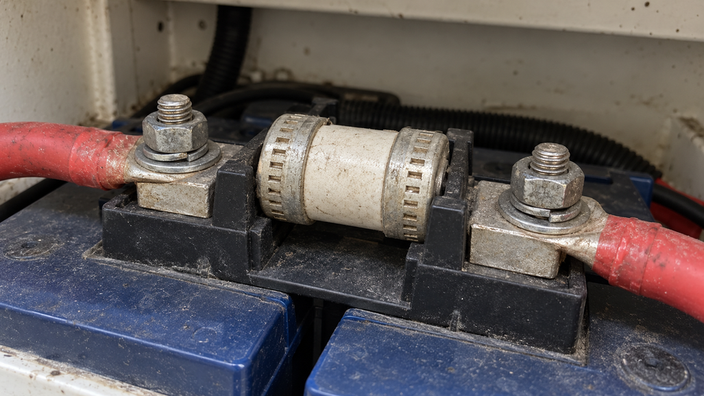
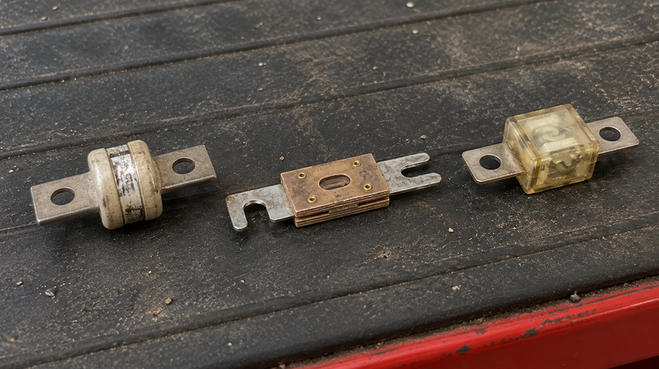
A reducer that fails one of these checks should be replaced with a correctly rated model. Adding a fuse does not increase the reducer’s input-voltage capability or output capacity.
Installation checklist
Before connecting the reducer:
- Record the battery’s nominal voltage and specified maximum charge voltage.
- Confirm that the reducer’s full input range includes the battery’s operating range.
- Add the simultaneous 12V accessory loads and compare the total with the reducer’s continuous output rating.
- Check any specified startup or peak demand.
- Follow the reducer manufacturer’s fuse, cable, grounding, ignition-wire, mounting, and ventilation instructions.
- Verify the 12V output at a full battery charge before connecting sensitive accessories.
This sequence answers the title question directly: a fully charged 48V lithium golf cart is compatible only when the reducer is rated for the battery’s actual maximum voltage and for the load it must supply.
FAQs
Is a 60V maximum input enough for a battery that charges to 58.4V?
On the stated voltage values, yes: a 60V continuous maximum is above 58.4V. Confirm that 60V is the manufacturer’s actual continuous input limit and that the battery is not specified to charge above 58.4V. The reducer must still pass the output-current and installation checks.
Can I choose a voltage reducer from the “48V” label alone?
No. Compare the battery’s specified maximum charge voltage with the reducer’s published input range. Two products described as 48V equipment can have different operating limits.
Does the battery’s BMS current rating determine the reducer size?
No. The BMS rating describes a battery limit. The reducer’s output size is based on the combined current and peak demand of the accessories it supplies.