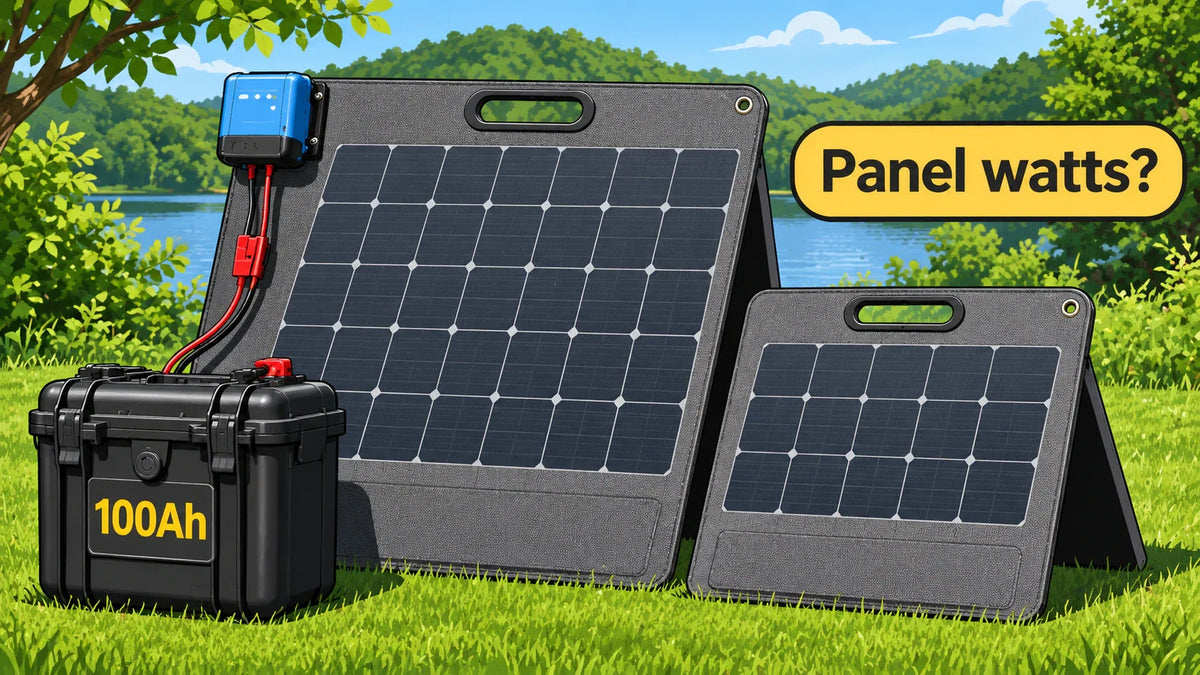

There is no single panel wattage for every 100Ah LiFePO4 battery box. Size the array from the watt-hours you need to replace, the peak-sun-hours available during your charging period, and the expected system yield after losses: panel watts = target watt-hours / (peak-sun-hours x system-yield factor).
Calculate the panel wattage

- Find the energy target. Use the power box’s rated usable energy if its specifications provide it. Otherwise, estimate the energy you need to replace from your daily use or desired recharge amount and timeframe; do not assume all nominal battery energy is usable. Daily use can be calculated by multiplying each load’s watts by its hours of operation, then adding the results. A 12.8V, 100Ah battery has 1,280Wh of nominal energy (12.8 x 100), not a guarantee of 1,280Wh usable. A watt-hour rating is calculated by multiplying nominal voltage by rated amp-hours, as defined in the federal watt-hour regulation. For comparison, the Vipboss 12V 105Ah LiFePO4 battery is rated at 12.8V and 105Ah, or 1,344Wh nominal (12.8 x 10⁵).
- Choose the sun-hours for the place and season. Use peak-sun-hours applicable to your location and intended charging period. For year-round sizing, base the estimate on the relevant lower-insolation season, not a sunnier-season average; the seasonal solar resource affects array size.
- Account for system yield. Use a yield or loss estimate that applies to your array and setup. In the equation, the system-yield factor is the share of panel energy expected to reach the battery after applicable losses, expressed as a decimal. Do not treat a modeling tool’s default loss assumptions as universal: PV performance models use user-specified loss inputs.
- Divide to get watts. Divide the target watt-hours by peak-sun-hours multiplied by the system-yield factor. The result is the estimated panel wattage for those inputs. More energy to replace, fewer peak-sun-hours, or lower system yield increases the required wattage. A different recharge target or season changes the result.
For example, if your target is 600Wh, your applicable resource is 4 peak-sun-hours, and your supported yield estimate is 0.8, the calculation is 600 / (4 x 0.8) = 187.5W. These are illustrative inputs, not a default recommendation; use values appropriate to your location, season, and system.
Check the power box input limits

After estimating array watts, check the power box’s solar-input and controller limits before choosing panels. The array’s voltage and current must fit the equipment’s specified input range, and the charging setup must support the battery chemistry. Use the solar charge controller selection steps to assess those constraints; wattage sizing alone does not establish electrical compatibility.
FAQs
How do you calculate the solar panel wattage needed for a 100Ah LiFePO4 battery box?
Divide the watt-hours you need to replace by peak-sun-hours multiplied by the expected system-yield factor: panel watts = target watt-hours / (peak-sun-hours x system-yield factor). Use values for your location, charging season, and setup; more energy to replace, fewer peak-sun-hours, or lower yield requires more panel wattage.
Should you use the battery’s full nominal energy as the solar recharge target?
No. Nominal energy is voltage multiplied by rated amp-hours, but it does not establish how much energy is usable; use the power box’s rated usable energy if provided, or estimate the energy you actually need to replace.