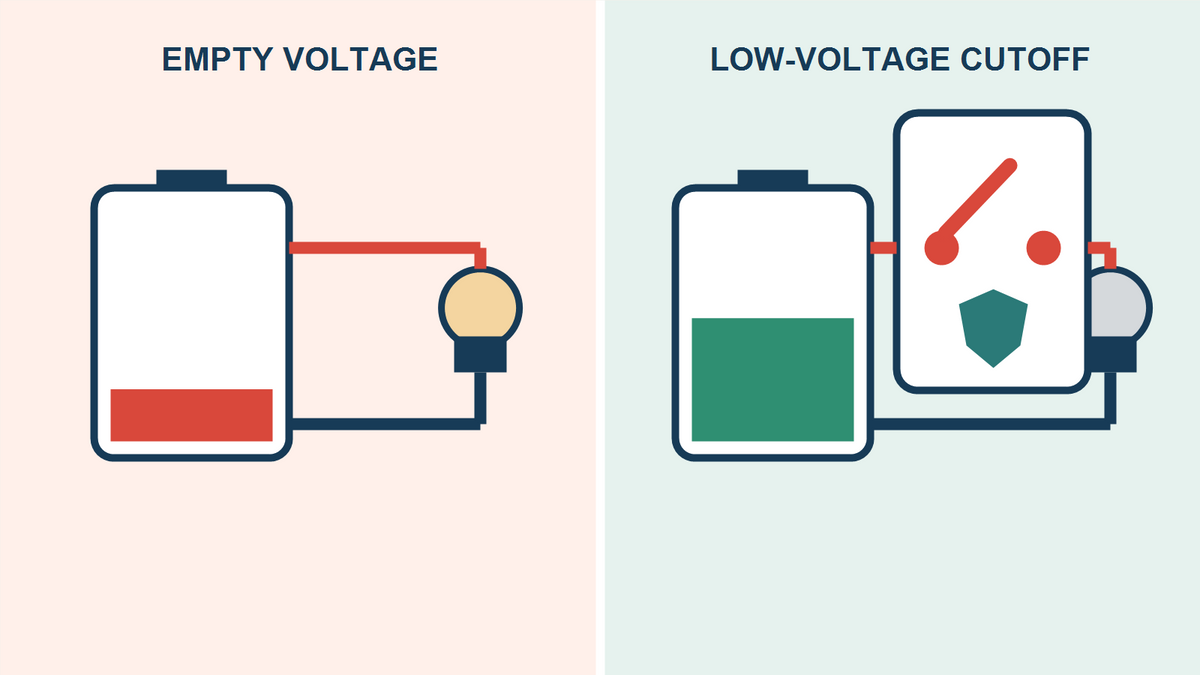

LiFePO4 empty voltage is an end-of-discharge reference or a practical description of depleted usable capacity. Low-voltage cutoff is a control or protection threshold that stops discharge. The two are related, but they are not interchangeable: a cutoff can occur under load before the battery later shows a different resting voltage.
Empty voltage describes an endpoint
“Empty voltage” usually means the voltage associated with the end of a defined discharge process. It does not identify one universal real-time voltage that always represents zero remaining charge. The applicable endpoint depends on how discharge is defined, including the battery, system, load, and measurement conditions.
Battery voltage can be lower while current is being drawn than after the load is removed. A later resting reading may therefore be higher than the voltage observed near the end of discharge. This does not change the defined endpoint; it shows why readings taken under different conditions should not be treated as directly equivalent.
Low-voltage cutoff stops discharge
A low-voltage cutoff is the configured trip point at which a battery management system (BMS), inverter, controller, or other protective device stops discharge. Its purpose is control or protection, so reaching it means the system has interrupted output. It does not establish a universal voltage for absolute zero remaining charge.
The distinction also appears in a specific laboratory context. The U.S. Department of Energy battery-charger test procedure defines specified end-of-discharge endpoints for testing, while allowing protective circuitry to stop discharge before the specified endpoint can be reached. That example demonstrates that an end-of-discharge reference and a protection-imposed stop are separate limits; its test values are not universal LiFePO4 settings.
How to interpret a reading or cutoff event

- If discharge has just stopped: Treat the event as confirmation that a configured cutoff condition was reached. Do not interpret the trip voltage by itself as proof that no charge remains.
- If voltage rises after the load is removed: Compare it with other resting readings, not directly with a voltage recorded under load.
- If you are comparing battery condition over time: Take readings under consistent conditions, including similar load or rest state, so the comparison is meaningful.
- If you are operating or configuring the system: Use the settings specified for the battery and connected equipment rather than substituting a generic “empty” voltage.
- If you use the Vipboss 12V 105Ah Bluetooth LiFePO4 battery: Record its Bluetooth-monitored battery status immediately before cutoff and again after the load is removed, then compare those observations alongside readings taken under the same load or rest conditions.
FAQs
Does a LiFePO4 low-voltage cutoff mean the battery is completely empty?
No. It means the BMS or another protective device stopped discharge at its configured threshold, not that no charge remains.
Why can LiFePO4 voltage rise after a low-voltage cutoff?
Voltage measured under load can be lower than a later reading after the load is removed. Compare readings taken under similar load or rest conditions.
Is there one universal empty voltage for every LiFePO4 battery?
No. Empty voltage is an end-of-discharge reference whose meaning depends on the battery, system, load, and measurement conditions.