
A golf cart voltage reducer can contribute to parked battery drain if it remains energized. Compare settled battery current with the reducer circuit connected and with that circuit isolated. A repeatable decrease points to consumption in the reducer branch, but it does not by itself prove the reducer is faulty: connected accessories can draw through it too.
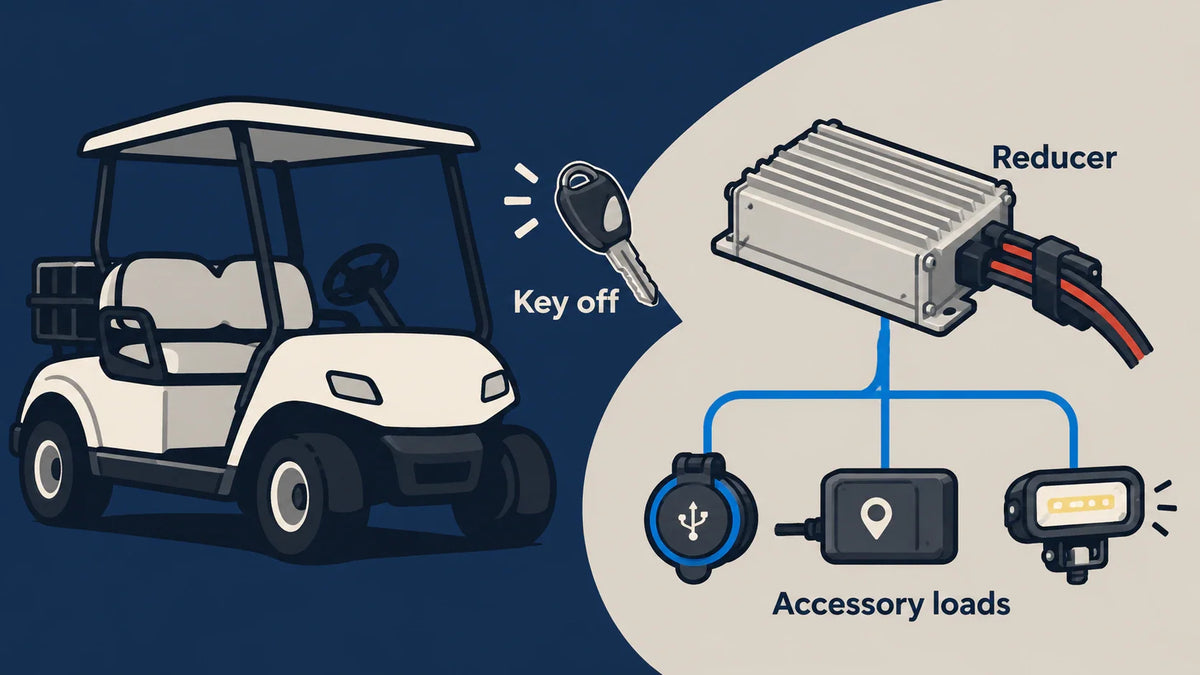
Separate the reducer from its accessory loads
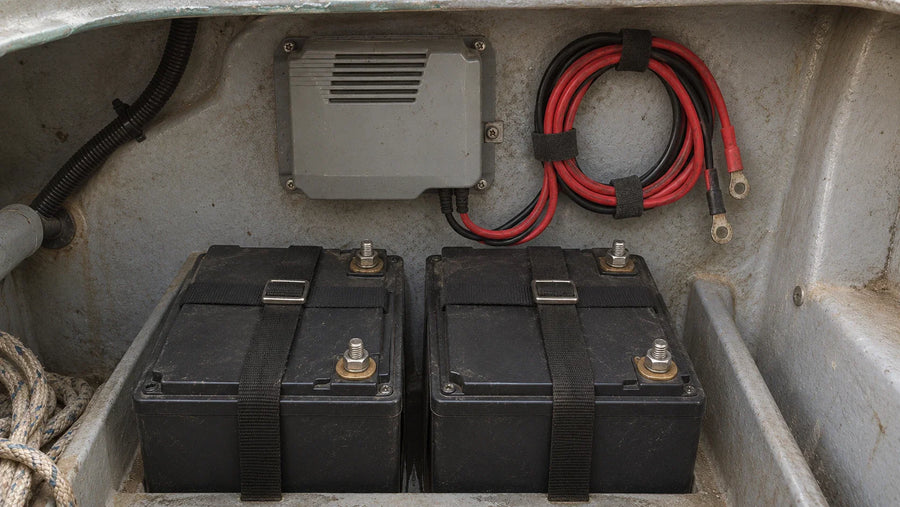
A reducer supplies a lower voltage to an accessory circuit. The output is not always 12V: use the actual unit's output specification, whether fixed or adjustable, and the accessories' required supply voltage.
Three conditions matter when investigating parked consumption:
- Accessories operating: input current supplies the reducer and the active output loads.
- Accessories off, reducer enabled: the reducer may still consume current with little or no output load.
- Reducer disabled by a control input: its main input may remain connected and some disabled-state current may remain.
Turning off a light or an audio system therefore does not prove that the reducer branch draws nothing. Equally, a reducer that provides power to an intentionally continuous device is not necessarily malfunctioning.
Compare current with the reducer connected and isolated
-
Prepare a consistent parked state. Follow the cart's service procedure, remove the key, and disconnect charging equipment as directed. Note which accessories remain connected and their settings. Keep other loads and conditions the same during the comparison.
-
Allow systems to settle. Wait for startup, sleep, or control activity to stabilize before recording current. Use the equipment's service information; there is no universal settling time for every cart and accessory combination.
-
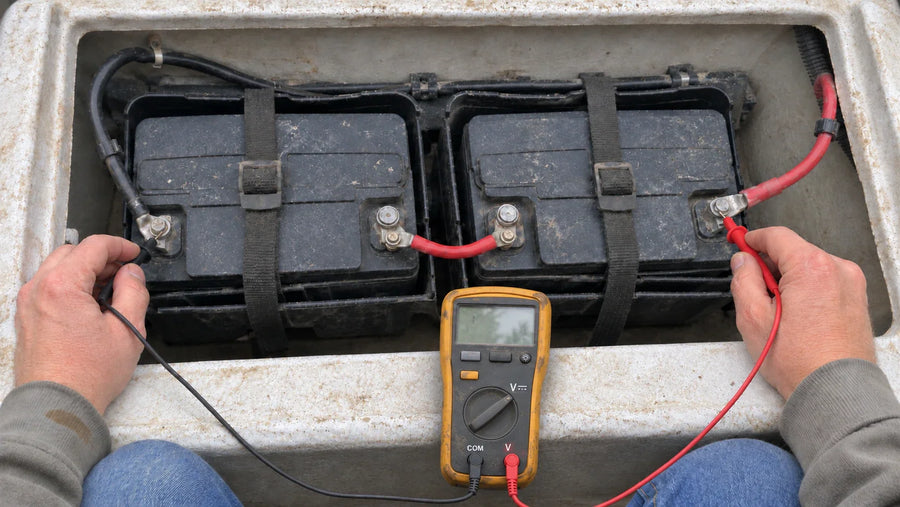
Measure baseline battery current. Use a DC current clamp with enough resolution for the expected small parked current. Zero it as instructed and clamp around one conductor, not a positive-and-negative pair. Fluke's current-clamp guidance explains DC zeroing and measurement setup. Record the settled value and measurement conditions.

-
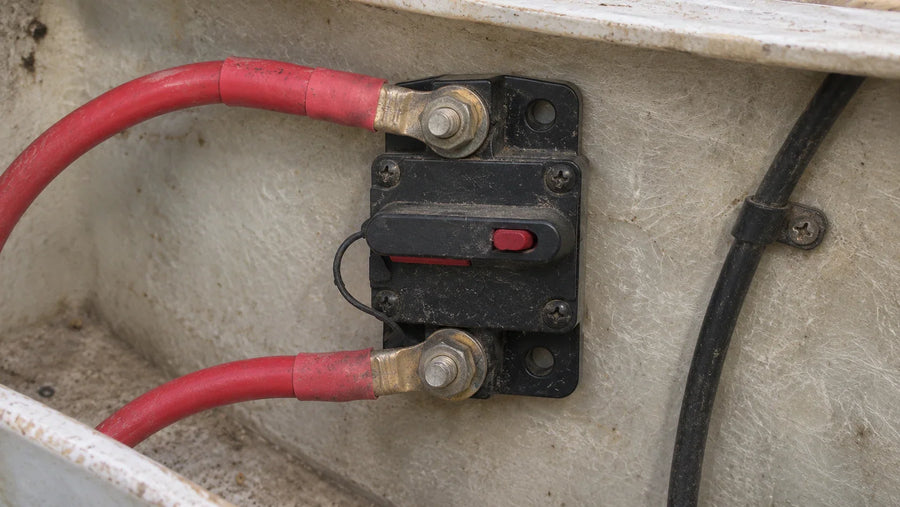
Isolate the reducer branch. Follow the cart or reducer procedure to remove that branch's input supply. Do not pull energized connections without the required isolation procedure. If the test requires powering the remaining cart circuits again, restore them as the service procedure directs.
-
Repeat the measurement. Allow the same settling conditions and record battery current again. Compare like-for-like readings and repeat if switching activity or meter drift makes the result uncertain.
If a clamp cannot resolve the expected current, an appropriate in-series measurement may be needed. A handheld meter must be rated for the current and possible transients in that test, and the cart must not be operated through its current input. Never place an ammeter across the battery. Have a qualified technician carry out this measurement if the required limits or isolation procedure are unclear.
Interpret the difference before replacing parts
A reproducible drop after branch isolation means that branch contributed to the measured draw. It includes the reducer itself and anything supplied through it. Next, use the approved procedure to isolate output loads and compare the reducer's own idle or disabled-state draw with its specification. Check whether its key-off or enable control behaves as intended.

If the battery-current reading does not noticeably change, check the meter's resolution and repeatability before concluding that the branch draws nothing. Then investigate other circuits according to the service procedure. Intermittent loads may not appear during a short measurement window.
There is no single acceptable parked-current threshold for all golf carts. Evaluate the measured draw against the actual equipment specifications, intentionally active devices, and expected parking period. Battery condition and charging problems can also cause a low battery; this comparison tests the electrical draw from one branch rather than every possible cause of lost usable charge.
FAQs
Do all voltage reducers power 12V accessories?
No. Their output voltage depends on the model and, for adjustable units, its setting. Identify the actual accessory output before testing or reconnecting a load.
Does lower current after disconnecting the reducer prove it is defective?
No. It shows that the isolated branch contributed to the draw. Separate the reducer's own consumption from its connected accessory loads and compare with the relevant specifications before deciding which component needs attention.
Why can turning the key off leave some current draw?
The reducer may have an always-on input, its enable wiring may leave it active, or its disabled state may still consume some current. Other devices can also remain connected. The key-off condition must be checked against the actual wiring and equipment behavior.