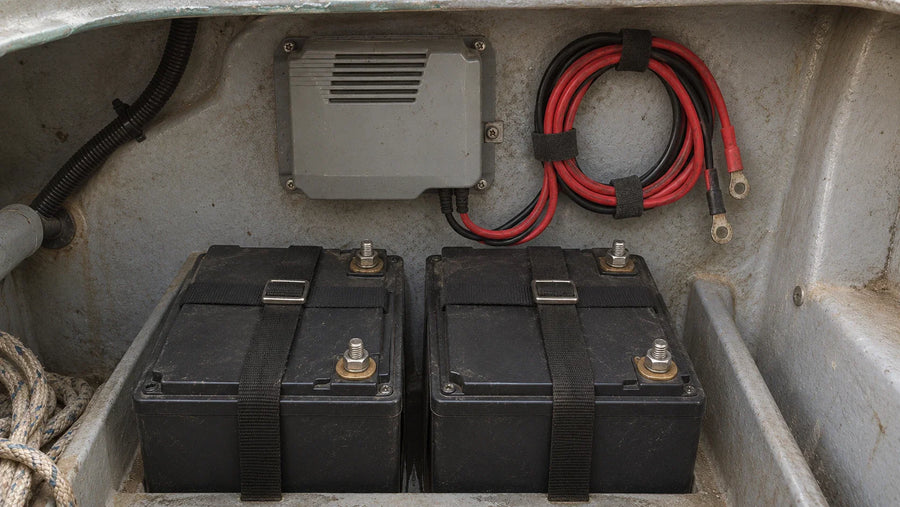
Measure DC voltage across the marked output terminals of the 24V bank and across each battery's marked positive and negative terminals. To verify bank polarity, compare the bank's marked positive and negative output points with the trolling motor's marked positive and negative input points, or with the applicable wiring diagram. If the polarity does not match or you cannot identify the points, leave the motor disconnected and off until you have the correct diagram or equipment instructions.
Check voltage and polarity

-
Prepare the bank. Follow the instructions for your battery bank and equipment to isolate loads before testing; do not assume a universal disconnection sequence.
-
Set up the meter. Select DC volts, put the black lead in
COMand the red lead in the meter'sVinput. Keep the red lead out of theAormAjack, which can short the meter's measurement circuit if used to measure voltage. Digital multimeter guidance for DC voltage explains the setup and how a digital meter indicates reversed probe polarity. -
Measure the full bank. Place the probes across the bank's marked output terminals. Record the voltage and whether the display shows a minus sign. The nominal 24V label alone does not define a pass/fail measured voltage.
-
Measure each battery. Place the probes across that battery's marked positive and negative terminals. Record the voltage and sign for each battery.
-
Compare bank and motor polarity. Identify the bank output's marked positive and negative points and the trolling motor input's marked positive and negative points, using the equipment markings or applicable wiring diagram. With the meter set to DC volts, measure across the bank output points with the red probe on marked positive and the black probe on marked negative. A negative sign means the probes are reversed relative to the measured polarity. Check that the bank's positive and negative correspond to the motor's positive and negative. If they do not match, or you cannot identify the points, leave the motor disconnected and off; consult the applicable wiring diagram or equipment instructions before use. Do not proceed by guessing at connections.
Compare voltage readings with the specifications for the actual batteries and equipment. A nominal 24V rating is not a universal voltage threshold, and the readings alone do not establish that an unspecified bank and motor are compatible.
For broader pre-trip checks, continue with this trolling-motor battery check.
FAQs
How do I know whether a 24V battery bank has the correct polarity for a trolling motor?
Compare the bank’s marked positive and negative output points with the motor’s marked positive and negative input points, using the equipment markings or applicable wiring diagram. If they do not correspond, leave the motor disconnected and off until you have the correct diagram or equipment instructions.
What voltage should a 24V trolling motor battery bank read to pass a test?
There is no universal pass/fail voltage based only on the nominal 24V rating. Compare the measured bank and individual-battery voltages with the specifications for the actual batteries and equipment.