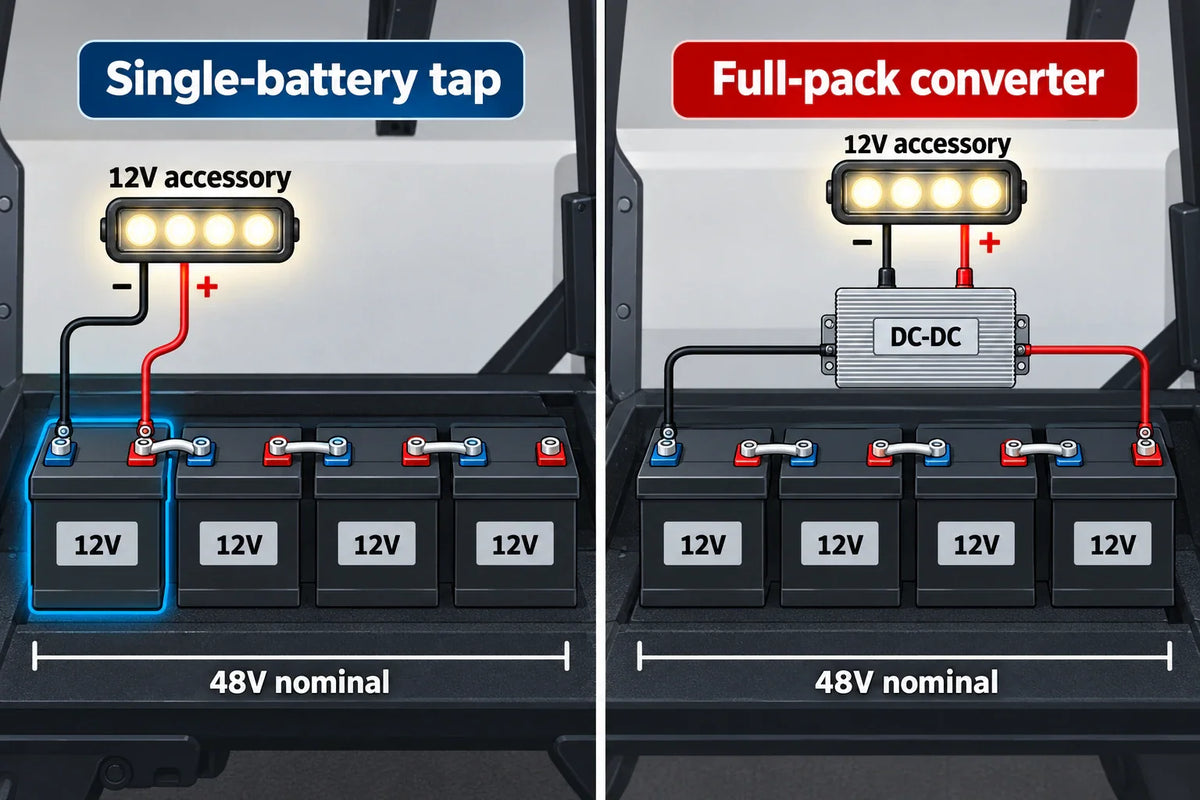

Power 12V accessories from a higher-voltage golf cart pack through a DC-DC converter rated for the full pack input and the required 12V output. Connecting an accessory to just one battery in a series pack makes that battery supply an extra load. A full-pack converter takes its input across the entire pack and provides a separate lower-voltage supply for the accessories.
What does tapping one battery mean?
Suppose a 48V nominal pack contains four 12V batteries in series. The cart uses all four together, but someone connects a 12V light across only one of them. That connection is a single-battery tap: when the light operates, that battery supplies the light as well as taking part in the cart's pack.
The other three batteries do not supply that extra accessory current. The tap therefore creates unequal use within a pack whose batteries are intended to operate together. This explains the imbalance concern without requiring a prediction about how quickly a particular battery will deteriorate.
Also check the voltage of the individual batteries. One 6V or 8V battery does not supply 12V nominal. Taking power from two 6V batteries within a larger series pack would still load only a subset of the pack. A convenient voltage at a pair of terminals does not make that subset the preferred accessory supply.
Here, “one battery” means one member of the traction pack. A separate, dedicated 12V accessory battery is a different system with its own charging and maintenance needs.
How a full-pack converter changes the power path
The converter's input uses the pack's main positive and negative supply points, subject to the cart's approved wiring and protection arrangement. Its output supplies the accessory circuit at the specified lower voltage. The accessory is connected to the converter output rather than directly to the higher-voltage pack.

In a series string, the pack current flows through every battery. The series-circuit relationship explains the difference: a converter across the full string draws through the pack, whereas a tap adds a separate load across only the selected battery or batteries.
A converter still consumes energy from the pack. Its benefit here is supplying the appropriate accessory voltage without creating the selective loading caused by a tap. It does not correct an already weak or mismatched traction battery.
| Arrangement | Where accessory energy comes from | Main decision point |
|---|---|---|
| Tap one battery or part of the traction pack | Only the selected part of the series string | Unequal accessory loading within the pack |
| Full-pack DC-DC converter | The complete pack through the converter | Match input range, output voltage, and load capacity |
| Separate accessory battery | An independent battery | Provide a suitable charging arrangement |
Match the converter to both sides of the circuit
Start with the input-voltage range. It must cover the battery pack's operating range, including its highest voltage during charging when the converter remains connected. A 48V system label alone is not the full specification.
For example, the Vipboss 48V 150Ah lithium conversion kit uses a 51.2V LiFePO4 battery. Use that battery's operating and charging specifications when selecting the converter input range; the 51.2V nominal value identifies the battery but is not its maximum charging voltage.
Next check the output. This article concerns 12V accessories, so choose an output suitable for those accessories' required voltage range. Add the loads that can run together and account for any documented startup demand when selecting output-current capacity. Do not mistake the converter's input current for its output-current rating.

Finally, decide whether the accessories should work with the key off. Follow the converter and cart instructions for switching, wire size, and circuit protection. Use the pack's designated supply points rather than an intermediate battery terminal chosen for convenience.
FAQs
Does a converter eliminate all accessory battery drain?
No. It draws energy from the pack to operate the accessories and can also draw current while energized without an active load. Its control arrangement determines whether it remains powered while the cart is parked.
Why not use two 6V batteries from a 36V pack?
Two 6V batteries in series provide 12V nominal, but that tap makes only those two batteries supply the additional accessory load. A full-pack converter avoids selectively loading that part of the traction pack.