
There is no universal fuse size for a golf cart voltage reducer. Select a separate fuse for the reducer-to-fuse-block feeder and for each 12V branch. Each fuse must accommodate the expected load and normal startup demand, satisfy the reducer or accessory and fuse-holder requirements, and protect its conductor within the conductor’s allowable current capacity.
Size the feeder fuse
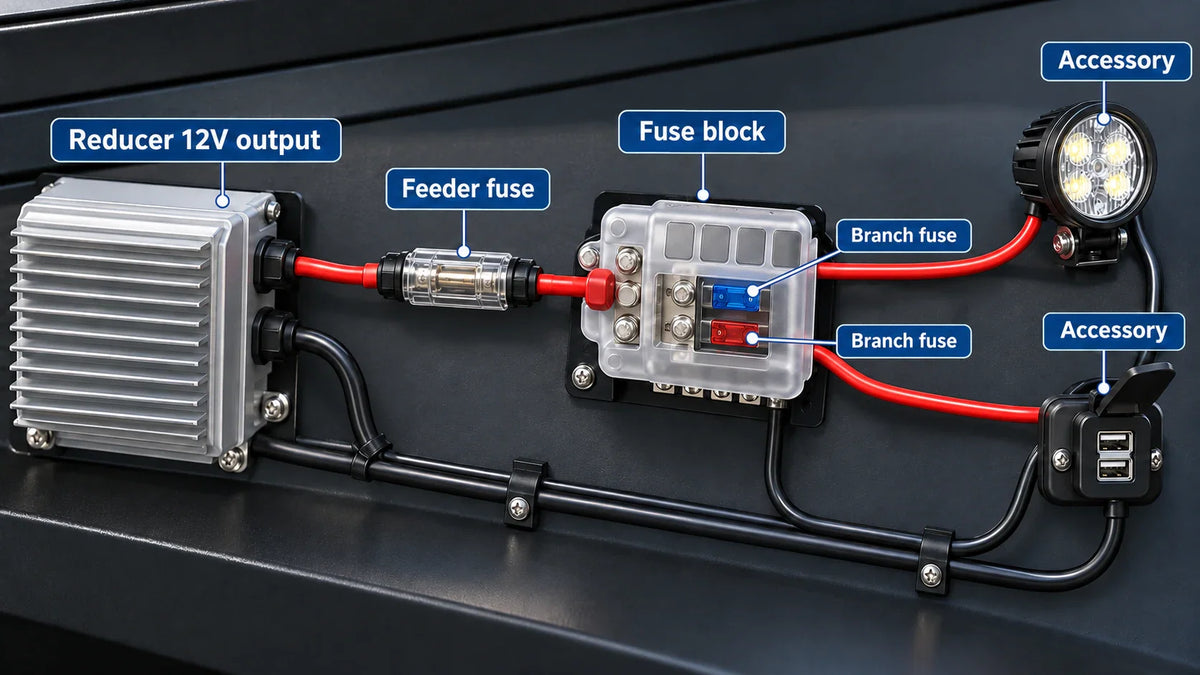
The feeder fuse protects the wire from the reducer’s 12V output to the fuse block. Identify that wire’s allowable current capacity under its installation conditions, then select a fuse that meets the expected total load and startup demand while staying within the reducer’s output-protection requirements, the fuse holder’s rating, and the wire’s capacity.
If the wire capacity does not match a standard device size, Caltrans guidance allows the next larger overcurrent device only when it does not exceed 125% of that capacity. This is the condition in Caltrans guidance, not a golf-cart-specific fuse-sizing standard. If no fuse meets the load and equipment requirements while protecting the conductor within its allowable capacity, do not increase the fuse beyond that limit; change the wiring or equipment to meet the load.
Size each branch fuse
Each fuse-block branch fuse protects its own wire from the block to the accessory. Select each branch fuse independently, accounting for that accessory’s operating current and normal startup demand while meeting its equipment and fuse-holder requirements and protecting its wire within its allowable capacity. Do not size a branch fuse from the feeder’s total load alone or assume the feeder fuse adequately protects smaller branch wires.

For both feeder and branch circuits, the fuse’s DC voltage rating must be at least the nominal voltage of the circuit it protects. A battery-side or reducer-input fuse protects a different circuit; its rating does not determine the reducer’s 12V output feeder or branch fuse sizes.
Gather the ratings
Before selecting fuses, identify the reducer’s output-current and fuse requirements, each wire segment’s capacity under its installation conditions, each holder’s rating, and each connected load’s operating and startup current. Apply the constraints together: if no fuse accommodates the expected load and equipment requirements without exceeding the protected wire’s allowable capacity, the wiring or equipment must change to meet the load.

FAQs
Why does a golf cart voltage reducer need separate feeder and branch fuses?
The feeder fuse protects the wire from the reducer’s 12V output to the fuse block, while each branch fuse protects the wire from the block to its accessory. A feeder fuse sized for the total load may not protect a smaller branch wire, so size each fuse for its own protected conductor and load.
How do I choose the fuse voltage rating for a 12V fuse block?
Choose a fuse with a DC voltage rating at least as high as the nominal voltage of the circuit it protects. The fuse’s voltage rating does not determine its current rating; select current protection based on the connected load, equipment requirements, and protected wire’s allowable capacity.