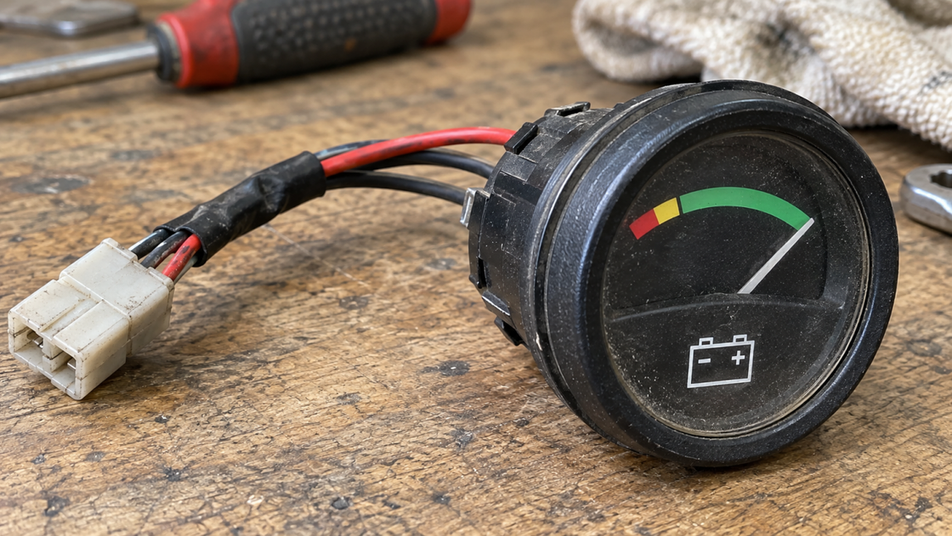

Usually, yes: replace the old meter if it was designed for lead-acid batteries or only estimates charge from pack voltage. Lithium batteries hold a relatively steady voltage through much of their discharge, so the old gauge can show a misleading level or fail to reflect the battery's actual state. Check whether your conversion kit includes a lithium-compatible state-of-charge display or app; if it does, use that system instead of relying on the original meter.
Why the old meter can be inaccurate

Many golf cart meters estimate remaining charge from the battery voltage. That approach can work reasonably well with lead-acid batteries because their voltage changes more noticeably as they discharge. Lithium batteries behave differently: their voltage can remain fairly stable until the battery is much closer to empty. These lithium-ion discharge characteristics explain why a voltage-based lead-acid gauge may stay high for too long, drop suddenly, or display a percentage that does not match the usable charge.
The problem is not simply that the meter is old. It is that its measurement method may not match the new battery chemistry. A meter that reads pack voltage only is not automatically a lithium state-of-charge meter.
What to use after the conversion

Use one of these options, in this order:
-
The battery's supplied display. If the kit includes an LCD monitor designed for that battery, it is the simplest replacement for the old gauge.
-
The battery's monitoring app. A built-in Bluetooth system can show charge level and battery status from a phone when the battery supports that feature.
-
A lithium-compatible state-of-charge meter. Choose one that is designed for your battery's voltage and monitoring method, rather than reusing a lead-acid gauge just because it fits the dash.
The display should report the battery system's charge level or state of charge, not only its instantaneous voltage. Follow the battery maker's wiring and mounting instructions when connecting or installing a replacement meter.
For a 48V conversion, the Vipboss 48V 150Ah conversion kit includes an external LCD monitor and Bluetooth monitoring, allowing charge checks through its dedicated display or mobile app instead of an old lead-acid meter. Its suitability depends on the cart's voltage, physical fit, wiring, charger requirements, and installation conditions, which should be confirmed before purchase or installation.
When you can leave the old meter in place
You can leave the original meter physically installed if it is disconnected, clearly labeled as unreliable, or used only as a nonessential voltage display. Do not treat its percentage reading as a dependable fuel gauge unless the meter is explicitly compatible with your lithium battery.
For example, if the old gauge says the cart is nearly full but the battery's own display shows a much lower charge, trust the lithium battery's compatible monitoring system. The conflicting readings are a sign that the old gauge's calibration or measurement method does not fit the conversion.