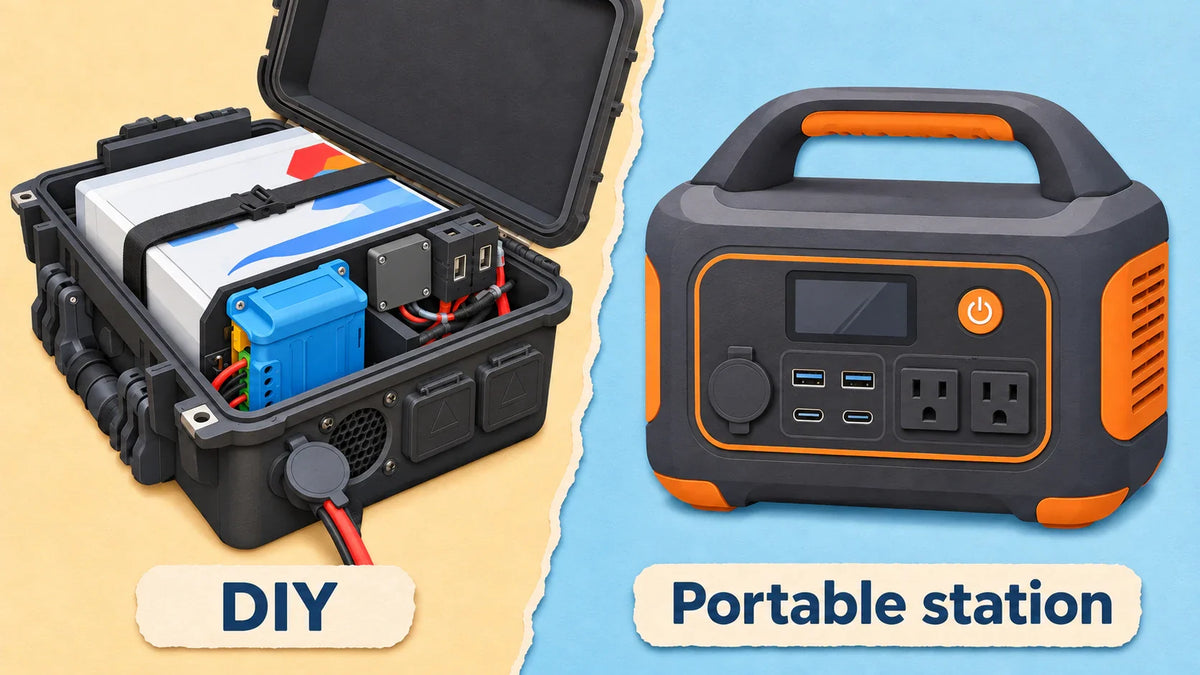

Build a DIY solar generator when you want to select and assemble components and accept the added planning and setup; buy a portable power station when a ready-made unit meets your loads and better fits your priorities. Neither route is automatically cheaper, more capable, or easier to carry. Start by matching actual loads and candidate specifications, then compare setup, portability, expansion, service, and total cost.
Match the power to your loads
List each device, its power draw in watts, how many hours you expect to use it, and which devices may run at the same time. For each device, multiply watts by hours to estimate energy in watt-hours (Wh); add those estimates to get the energy required for the period you are planning. This method follows the DOE load assessment approach, which treats total energy and peak simultaneous power as separate needs.
Then compare two different limits:
- Energy: Compare your estimated Wh with each candidate's stated usable energy for the same use period. Allow for the fact that estimates and operating conditions can affect actual runtime; do not treat rated energy as a guaranteed runtime for every load.
- Output: Add the watts of devices that could run at once. Check that total against the unit's continuous output, and check relevant startup or surge needs against its stated surge rating. Energy capacity alone does not show whether a unit can power a load at one time.
If you plan to recharge from solar, compare the panels and expected conditions with the candidate's stated solar-input limits. Do not assume a panel will work with a particular unit without checking the relevant input specifications.
Compare what you must choose and manage

A DIY power box requires you to choose and integrate the functions your use case needs. In a typical off-grid solar arrangement, a charge controller regulates charging into a battery, and an inverter converts battery power to AC when AC loads need it; some DC loads can be powered directly. The DOE explanation of off-grid system roles describes these functions, while its consumer guide to solar-electric components describes a typical household system. Treat those components as a checklist of functions, not a required recipe for every portable box: a DC-only setup may not need an inverter, and the right configuration depends on the loads and charging plan.
When selecting a battery for a DIY design, compare its stated energy and relevant ratings with the rest of the components you choose. For example, the Vipboss 12V 105Ah Bluetooth LiFePO4 battery is rated at 12.8 V, 105 Ah, and 1,344 Wh, with a built-in 100 A smart BMS. Those are battery specifications, not a complete power-box specification.
With a packaged station, compare the particular unit's usable energy, continuous and surge output, charging inputs, output types, and included accessories. Do not assume every station integrates the same components or supports the same charging options.
Compare practical tradeoffs and total cost
| Factor | DIY power box | Portable power station |
|---|---|---|
| Choices and setup | You select the parts and how they work together. Planning and assembly take effort; the amount depends on the design and your experience. | The unit arrives as a packaged product. Setup effort depends on the model and what you want to connect. |
| Portability and enclosure | Size, weight, enclosure, and carrying convenience depend on the components and build. | Compare the particular unit's dimensions, weight, handles, and enclosure against how you will transport and use it. |
| Expansion and repair | Changes or repairs depend on the chosen parts, their interfaces, and your ability to work on the build. | Expansion and service options vary by model; check what the manufacturer documents and what the purchase includes. |
| Warranty and support | Coverage may differ across components and sellers. Account for each part's applicable warranty and the support available. | Check the unit's warranty and service terms as part of the purchase. |
| Total cost | Add the battery, charging components, any inverter, enclosure, wiring, protection, and other parts your design needs. | Compare the unit price with any separately needed panels, cables, or accessories. |
Compare complete costs for the same intended loads and included functions. A low initial price is not a fair comparison if one option still needs components or accessories the other includes. Prices, portability, repair options, and setup effort vary by design, model, seller, and user, so decide from the actual candidates rather than assuming a universal winner.
Make the choice
Use the load estimate first. Favor DIY if you want to choose and assemble the required functions and are comfortable with the planning and effort. Favor a packaged station if its documented specifications meet your energy, output, and charging needs and its ready-made form suits how you plan to use it. If neither candidate meets the load and input requirements, compare different candidates rather than choosing by format alone.
FAQs
Which is cheaper to build or buy: a DIY solar generator or a portable power station?
Neither option is automatically cheaper; compare complete costs for the same intended loads and included functions. For a DIY build, include the components your design needs, such as a battery, charging components, an inverter if required, enclosure, wiring, and protection; for a packaged station, include any separately needed panels, cables, or accessories.
What components does a DIY solar generator need?
The components depend on the loads and charging plan: a typical off-grid solar arrangement uses a charge controller to regulate battery charging and an inverter when AC output is needed, while some DC loads can be powered directly. Treat those as functions to account for in the design, not a fixed recipe; for example, a DC-only setup may not need an inverter.