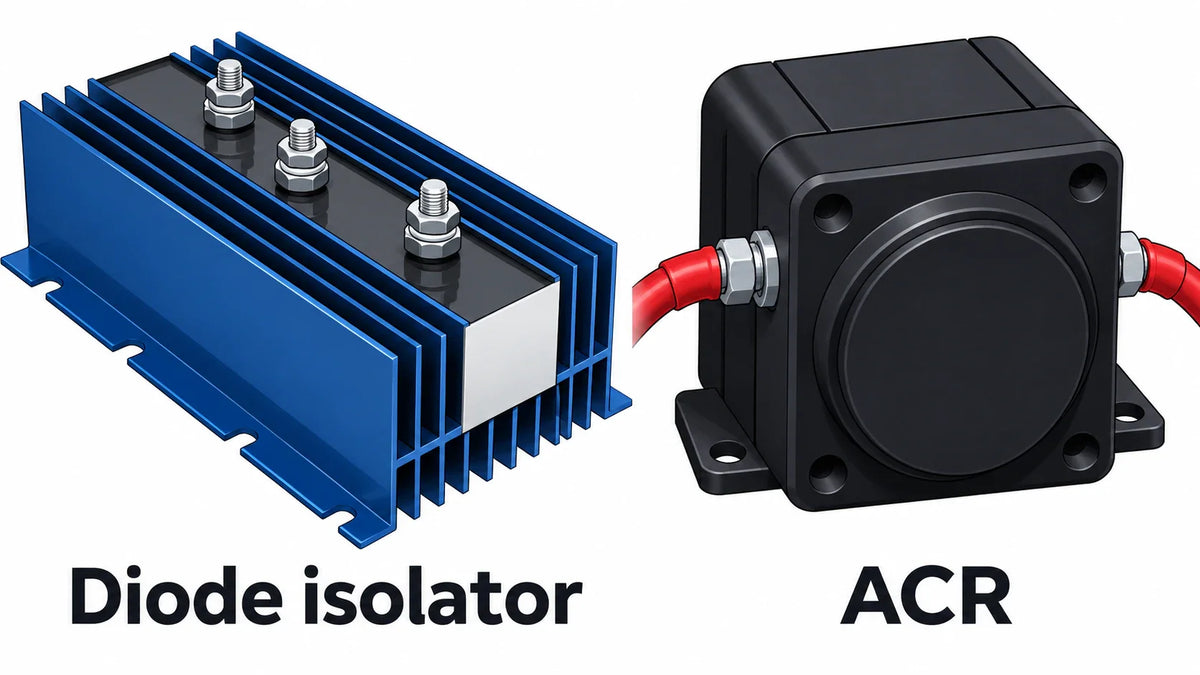

Choose a diode battery isolator when one-way charging to multiple banks is the goal and the charging source can account for its voltage drop. Choose an automatic charging relay (ACR) when battery banks should connect as sensed voltage rises and separate as it falls. The right choice depends on which sources charge which banks, whether any charging connection must also carry current in reverse, and how the charger and devices behave together.
How they work

A diode isolator routes current from a charging source to multiple battery banks while blocking reverse current between them. Its diodes create a voltage drop, which can leave batteries undercharged unless the regulator or charger compensates, for example through remote voltage sensing. This tradeoff applies to diode-type isolators; other isolator designs may work differently. A marine comparison explains the diode isolator’s one-way flow and voltage-drop tradeoff, as well as how an ACR switches between banks.
An ACR is a voltage-sensing switch. It connects banks when sensed voltage indicates charging and disconnects them as voltage falls. That can keep a house-bank load from discharging a reserve or start bank after charging stops, but the relay’s thresholds and timing depend on the specific device.
Choose by the current paths

-
List the charging sources and banks. Identify whether the alternator, shore charger, or another source charges one bank or more than one, and note which bank each source connects to. A diode isolator may suit a source that needs to feed multiple banks while keeping them from feeding current back into each other.
-
Check for a path that must work in both directions. If a charging lead may also carry current back from a bank when that source acts as a load, a diode isolator blocks that reverse flow. An ACR may fit that arrangement because it connects the banks when its voltage-sensing conditions are met, subject to the actual devices’ requirements.
-
Account for the isolator’s voltage drop. If considering a diode isolator, check whether the regulator or charger can compensate for the drop. Without compensation, the voltage reaching the batteries may be lower than intended.
-
Consider how a multi-stage shore charger behaves with an ACR. For this documented topology, the charger connects directly to one bank and the other bank connects through the ACR. During float, voltage at the directly charged, lightly loaded bank may not rise enough to reconnect the ACR while the other bank is loaded. The charger connection and which bank carries the load can therefore affect whether both banks receive charging as intended. Check the actual charger and ACR instructions for that arrangement; this behavior is conditional on the described topology and load pattern, not universal.
-
Compare the actual device instructions with your system. Use the charger, isolator, and ACR instructions to resolve device-specific operating requirements that the general comparison cannot determine. If a required reverse-current path rules out a diode isolator, or its voltage drop cannot be accommodated, that points away from that option. If an ACR’s sensed-voltage behavior does not suit the charging sources and bank loads, it is not the right fit either. Choose only after those paths and conditions are clear; these general differences do not establish compatibility with a particular battery, alternator, charger, or BMS.
The choice is about the required charging and load paths: one-way distribution with a diode isolator, or voltage-controlled bank connection with an ACR. Device-specific charging behavior can change which arrangement works as intended.
FAQs
When is a diode battery isolator a better choice than an ACR for a boat?
A diode isolator may suit a charging source that needs to feed multiple battery banks while blocking reverse current between them, provided the charger or regulator can account for the isolator’s voltage drop.
When can a diode isolator be unsuitable for a boat’s charging system?
It can be unsuitable when a charging lead must also carry current in reverse, because a diode isolator blocks that flow.
How does an ACR decide when to connect or disconnect boat battery banks?
An ACR connects banks when sensed voltage indicates charging and disconnects them as voltage falls. Its thresholds and timing depend on the specific relay.
Can a multi-stage shore charger fail to reconnect an ACR during float?
Yes, in the specific arrangement where the charger connects directly to one bank and the other connects through the ACR, float-stage voltage at a lightly loaded directly charged bank may not rise enough to reconnect the relay while the other bank is loaded.