
Picture this: the yard is glowing, the roofline is perfectly outlined, but instead of admiring the display you are doing mental math about next month's power bill. Now imagine the same show, running from dusk to dawn, with the grid meter barely moving because your lights sip sunshine stored in a lithium battery. This guide lays out how to make that shift, from realistic runtimes to sizing your solar and battery so the twinkle stays on all night without a surprise bill.
Why Holiday Lights Hit Your Wallet So Hard
Christmas lights use an estimated 6.63 billion kilowatt-hours of electricity in the U.S. each year, roughly enough to run 14 million refrigerators, and most of that demand still comes from plug-in displays powered directly from the grid holiday light energy use. Traditional incandescent strings burn power by heating filaments; a roofline display with about 300 C9 incandescent bulbs can draw around 2,100 watts, while the same number of LED C9 bulbs uses only about 29 watts for a similar visual punch from the street. That difference is why you can daisy-chain only a handful of incandescent strands on one circuit, yet safely run dozens of LED strands from the same outlet.
Once you switch to LEDs, the numbers start working in your favor. The same analysis that highlights the national energy use also shows LED Christmas lights typically use 80 to 90 percent less electricity than incandescent, and households that change over see their seasonal lighting costs drop from the tens of dollars into the single digits for typical displays. Eco-focused lighting studies go further, estimating that widespread LED adoption can prevent billions of pounds of carbon dioxide emissions each year, while also reducing fire risk because LEDs run much cooler than old-school bulbs. From a power-upgrade perspective, cutting the load this aggressively is the first key move: a smaller, more efficient display is dramatically easier to run all night on solar plus a compact lithium battery.

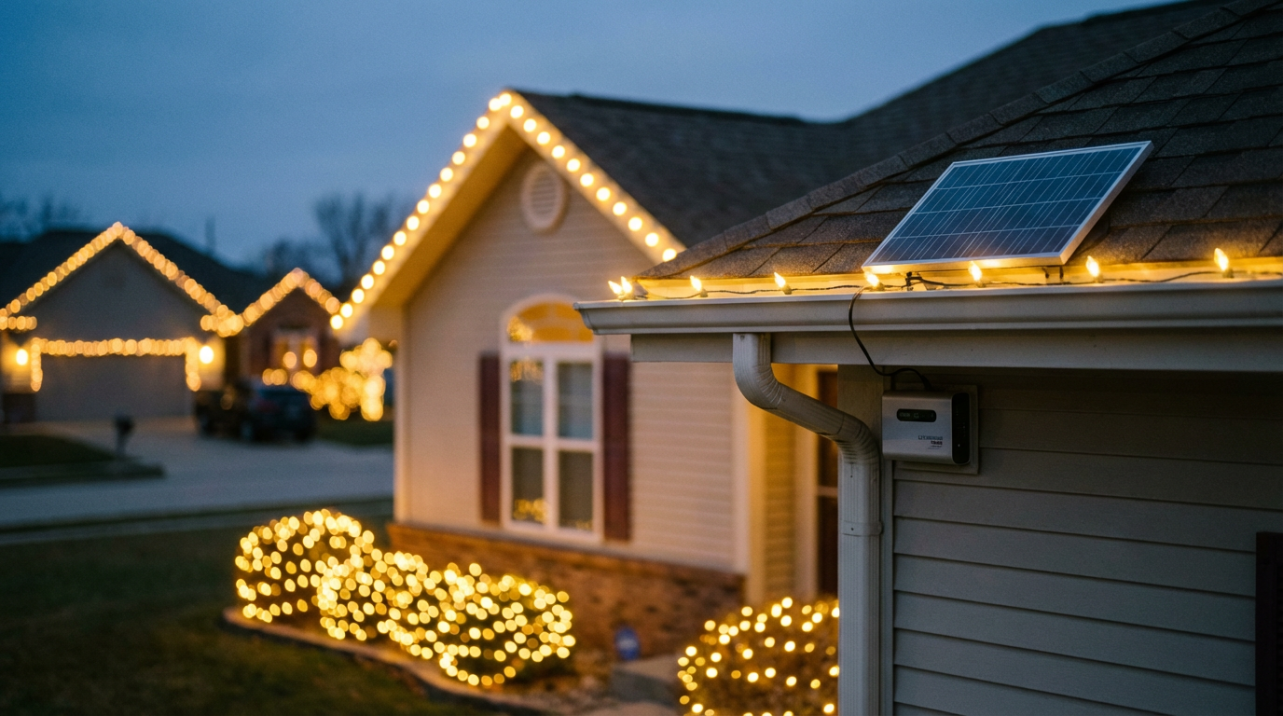
Solar holiday lights take that lower demand and disconnect it from your outdoor outlets. Compact crystalline panels paired with LEDs can charge even under hazy daylight, then hand off to a battery when it gets dark, so the lights run without pulling from the grid at all solar-powered Christmas lights. For remote locations where running extension cords isn't practical, an off-grid Christmas tree setup can bring holiday lighting to even the most secluded spots.
Can Solar + Lithium Really Stay On All Night?
The short answer is yes, if you respect the physics: how much energy your lights use each night, and how much sunlight your panel can turn into stored charge. Outdoor solar lighting is already designed around that idea; a properly sited solar fixture charges during the day, fills an onboard battery, and then runs for a specified "nightly run time" without touching your electric bill outdoor solar lighting. Government guidance notes that lower winter sun can cut runtimes by about 30 to 50 percent if the system is only sized for summer, and shading from trees or roofs will further reduce how long the lights stay on. That is why panel placement and winter sizing matter more than any single component brand.
A small DIY Christmas light project shows how forgiving the math can be when you combine LEDs with even a modest panel and battery. In that setup, a simple solar panel fed a charge controller and battery, which then powered a decorative light string drawing about 40 milliamps; over six hours, that string used roughly 240 milliamp-hours per night, and the system kept the lights running every evening for roughly two weeks straight on solar alone with no manual intervention solar Christmas lights project. Measured charging current from the panel approached 500 milliamps in good sun, so a single sunny hour could replace an entire night's usage, and multiple overcast days still left enough reserve in the battery to keep the lights glowing.
Scaling that logic up to a yard display is straightforward. A common example is a 100-count LED string that uses about 7 watts; run that for 12 hours overnight and you need around 84 watt-hours of stored energy in your battery just for that one string. Three of those strings for a full tree wrap would use about 21 watts; run them ten hours and you are looking at roughly 210 watt-hours per night. As long as your lithium battery stores more than that, and your panel can replenish at least that much energy during the day, an all-night runtime is very achievable. In real retrofits, many displays draw far less than a kitchen appliance, which makes them perfect candidates for a small, dedicated solar-plus-lithium system.
Sizing Your Zero-Bill Solar + Lithium Light System
The fastest way to avoid guesswork is to size your system from your load backward: first the lights, then the battery, then the panel.
Measure your light load
Start with the labels on your holiday light boxes or the tags on the cords. You are looking for watts per string rather than bulb count. Energy-focused Christmas-light guides provide a useful benchmark: about 300 C9 incandescent bulbs can pull roughly 2,100 watts, while 300 C9 LEDs of similar brightness draw only about 29 watts. If you are still using incandescents, replacing them with LEDs can shrink your wattage by a factor of ten or more, which is mandatory if you want to stay off-grid and off-bill.
Once you know the wattage per string, multiply by how many identical strings you plan to run. For example, four seven-watt LED strings along a fence amount to 28 watts total; a few higher-output nets on bushes might push that to 50 or 60 watts. Keep track of these numbers in a quick sketch of your yard layout so you can see which sections use the most power and where solar strings or dedicated off-grid runs will give you the biggest bill relief.
Translate watts into nightly energy
Next you turn power into energy. Practical holiday lighting advice uses a simple process: take your total wattage, multiply by hours of use per night, then multiply by days in the season to estimate energy use and cost. For solar sizing, you are most interested in a single night. If those four seven-watt strings run for eight hours, the display uses about 224 watt-hours per night. If you like your lights on from late afternoon to early morning, say twelve hours, that same setup would consume roughly 336 watt-hours.
The earlier 100-count string example shows the same math from a different angle. At seven watts, running twelve hours requires around 84 watt-hours from your battery. Six of those strings on a larger tree or roofline would need roughly 504 watt-hours per night. Having clear numbers makes it much easier to decide whether you are better off putting everything on one off-grid system, splitting it into zones, or keeping critical decorative elements on grid-tied LED circuits while pushing the rest fully off-grid.

Match battery and solar panel to the job
With your nightly energy figure, you can pick a battery. Deep-cycle batteries sized for solar are typically rated in amp-hours at a given voltage; to match them to your display, translate that rating into watt-hours by multiplying voltage by amp-hours. A battery that can comfortably deliver more than one night of your lighting load gives you resilience; for example, if your display needs around 250 watt-hours per night, a battery that stores several hundred watt-hours gives you room for cloudy days and battery aging. Lithium iron phosphate batteries cost more than sealed lead-acid options, but they generally offer better performance and longer lifespan, which matters when you are cycling them every night of the season.
For the solar panel, your goal is to put at least as much energy back into the battery each day as the lights take out at night. Many solar Christmas-light setups are designed around panels that get six to eight hours of direct sun, with the panel mounted on a sunny roof or post away from shade. A practical way to think about it: if your display uses 300 watt-hours per night and you expect about six decent hours of sun in winter, your panel needs to deliver an average of around 50 watts during that window. You can hit that by choosing a panel with a nominal rating comfortably above 50 watts, then giving it excellent placement and tilt. Real-world tests with small panels and light loads show that when you oversize the panel relative to the lights, it can replace a night's energy in an hour or two of bright winter sun.
Lithium vs Other Holiday-Light Batteries
Holiday lights run on several battery chemistries, each with trade-offs in cost, cold-weather behavior, and lifespan. Outdoor solar fixtures commonly use nickel-cadmium, sealed lead-acid, or related technologies, all fed by a small panel and a simple controller that turns the LEDs on at night. Many standalone solar lights now favor nickel-metal hydride cells because they hold more energy than nickel-cadmium of the same size, tolerate partial charging without a "memory" effect, and handle temperatures from roughly -4F to 140F NiMH battery advantages.
For larger, off-grid holiday systems, lithium starts to shine. Lithium iron phosphate batteries are highlighted as higher-cost but higher-performance options compared with sealed lead-acid; they generally deliver more usable cycles over their life, which matters when they charge and discharge every night through the season. Lithium-ion cells also outperform standard rechargeables in cold conditions, providing more usable capacity on freezing nights when other chemistries struggle lithium performance in winter.
Here is a quick comparison to guide your choices:
Battery type |
Best use |
Strengths |
Watch-outs |
Sealed lead-acid |
Larger off-grid systems where cost matters more than weight |
Inexpensive, widely available, proven in small solar projects |
Heavier and bulkier; typically shorter cycle life than lithium; prefers being kept topped up rather than deeply cycled |
NiMH rechargeable |
Integrated garden stakes, fairy lights, and smaller solar fixtures |
Higher capacity than NiCd; works from about -4F to 140F; no strong memory effect; relatively easy to replace in many products |
Capacity fades over a few years; needs occasional replacement; performance still drops in extreme cold |
Lithium (Li-ion or LiFePO4) |
Dedicated off-grid holiday systems and higher-end solar decorations |
Better cold-weather performance; high cycle life; lighter and more compact for the same energy |
Higher upfront cost; needs an appropriate charge controller designed for lithium chemistry |
With integrated solar strings that hide a small lithium cell in the panel housing, the control electronics are built for daily charge-discharge cycles. The panel charges during the day, the controller switches on the LEDs at dusk, and the battery naturally cycles overnight. There is no need to force manual deep discharges; your focus should be on giving the panel enough sun and keeping the unit clean and dry so the built-in controls can protect the cell. For larger custom systems, pairing a lithium battery with a purpose-built solar charge controller gives you the best blend of lifespan, efficiency, and winter resilience.

Design and Install for Winter-Ready Performance
Even the best hardware will disappoint if it is starved of sun or battered by weather. Solar garden-lighting guidance is clear: for full performance, panels need the manufacturer's recommended hours of direct sunlight and must be kept clean of dust and debris. Winter introduces two extra challenges: the sun rides lower in the sky and days are shorter. Tilting panels more steeply, roughly in the 45- to 60-degree range, and pointing them south in the Northern Hemisphere helps catch low-angle winter sun and boosts charging during limited daylight. Clearing snow, ice, and standing water from panel surfaces on sunny days can noticeably improve how long your lights stay bright after dark.
Light sensors and nearby illumination can quietly sabotage your runtime. Solar lighting installers warn that placing fixtures under trees, near bright streetlights, or behind glass can either reduce charging or trick the dusk sensor into thinking it is still daytime. For holiday displays, that means avoiding panel locations under eaves or in dense branches, and keeping them away from floodlights or neighbor's security lamps. If necessary, run a longer low-voltage cable from the panel in a sunny corner of the yard to the lights where you actually want the sparkle.
Installation technique matters as much as electronics. Roofline-lighting guides recommend planning your design, measuring runs, and testing every string at ground level before you climb a ladder, then using purpose-made clips on gutters and shingles instead of staples or nails that can damage wires roofline Christmas light installation. General outdoor-lighting advice echoes the same safety rules: only use lights rated for outdoor use, inspect cables for cracks before hanging, and make sure cord runs do not create trip hazards across walkways safe outdoor light hanging. With off-grid solar sections, start your layout at the panel or battery location instead of an outlet, then route the low-voltage cables neatly along gutters, fences, or landscaping.
Finally, design the show like a system, not a pile of decorations. Digital planning tools and 3D layout apps make it easy to experiment with panel placement, light density, and viewing angles before you buy a single strand. Use them to cluster high-impact elements near each other on the same off-grid circuit, keep heavy loads like inflatables on efficient grid-tied outlets, and reserve your best sun exposures for the solar-plus-lithium sections that you want to run all night at zero marginal cost. When sizing panels for winter use, remember that solar panel temperature affects output—colder winter temperatures actually improve efficiency compared to hot summer days, though shorter daylight hours remain the primary constraint.
Pros, Cons, and When Solar + Lithium Is Not Enough
Solar holiday lights bring three big advantages. First, they eliminate the direct electricity cost for the sections they power; homeowners who convert typical displays to solar-heavy LED setups can save on the order of $10 to $30 per season on lighting alone, and over several years those savings often cover much or all of the equipment cost. Second, they improve safety and flexibility because they use low-voltage wiring and do not rely on long extension cords or overloaded outdoor outlets, making it easier to decorate trees, fences, and far corners of the yard. Third, each off-grid segment has its own panel and battery, so a grid outage will not take down your whole show advantages of solar lights.
There are real trade-offs. Solar Christmas lights are more sensitive to location and season; shaded yards and very short winter days can leave even well-designed systems dim by early morning solar Christmas light limitations. Low-cost products sometimes cut corners on panel size, battery quality, or weather sealing, leading to fading brightness after a year or two and water ingress that kills control boards. All rechargeable systems need periodic battery replacement, and guidance on outdoor solar fixtures notes that nightly run time can drop significantly in winter unless the system is specifically sized for low-sun months. If you want a synchronized, block-long display with high-wattage elements, pure off-grid may not be the best fit without a larger rooftop solar array feeding a whole-house battery.
A hybrid strategy often delivers the best result. Use solar-plus-lithium sections for trees, fences, and architectural accents that you want running from dusk to dawn at effectively zero cost, and keep critical, color-sensitive rooflines or showpiece features on high-quality LED strings powered by the grid or by your existing rooftop solar system through net metering. Smart plugs or timers help clamp down runtime for the grid-tied portions so your overall bill still drops, while the off-grid elements quietly keep the yard glowing long after bedtime.
FAQ
Do solar holiday lights work on cloudy winter days and in snow?
Solar lights still generate power on cloudy days, but less of it, so the limiting factor in winter is often short daylight hours rather than clouds alone. Outdoor-solar guidance explains that operating times in winter can be 30 to 50 percent shorter unless lights are sized and sited for low-sun conditions, and any snow, ice, or dirt on the panel surface reduces charging further. Tilting panels more steeply, pointing them south, and brushing off snow on sunny days are simple upgrades that can noticeably extend nightly runtime.
Can you retrofit existing plug-in Christmas lights to run on solar?
Yes, but it takes more than just plugging them into a panel. To convert plug-in strings, you need an appropriately sized solar panel, a charge controller, a rechargeable battery, and either a low-voltage DC setup or an inverter if you want to keep using standard AC plugs. A typical small system might mount the panel in a sunny, snow-free location, route wiring to a weatherproof box that holds the controller and battery, then feed the lights through a timer or light sensor so they switch on at dusk and off at a set hour. Done correctly, your familiar display keeps its look and behavior while its energy comes from the sun instead of the grid.
In the end, a zero-bill holiday light show is less about exotic hardware and more about disciplined design: efficient LEDs, honest math on watts and hours, a right-sized lithium battery, and solar panels placed where winter sun actually hits. Get those fundamentals right and your lights will keep twinkling long after midnight while your power bill stays calm, season after season.