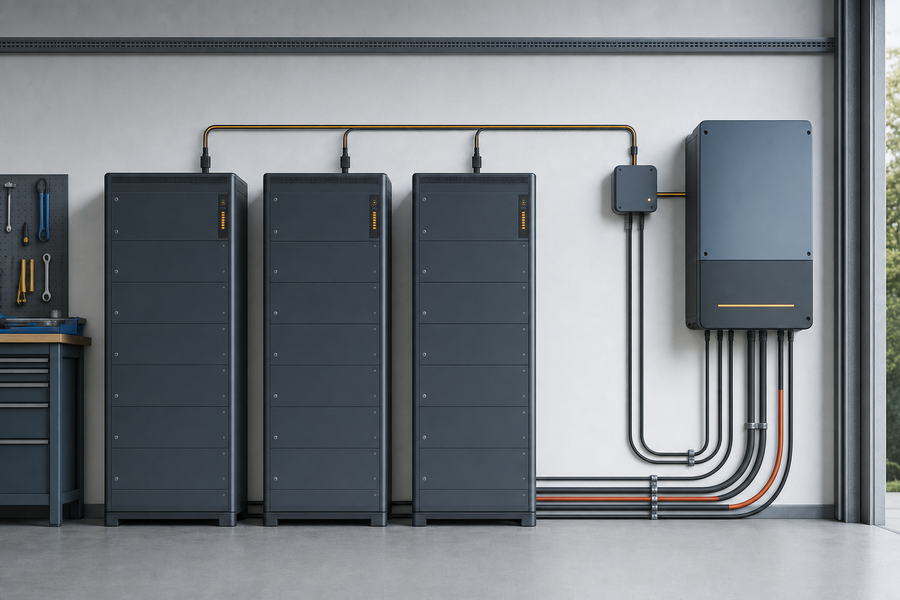

Dropping a wrench across battery terminals is more likely to create a dangerous fire and destroy wiring than to quietly "kill" the battery—and in a serious pack, it can unleash thousands of amps in a split second.
What Actually Happens When You Drop the Wrench
In battery terms, a short circuit is a very low-resistance path between positive and negative terminals. A steel wrench laid across the posts becomes an almost perfect low-resistance bridge.
Current doesn't ramp up politely; it slams to an enormous value limited only by battery chemistry, internal resistance, the wrench, and your cabling. In a 12 V bank that normally feeds 100 A loads, a hard short can push well into the thousands of amps.
That much current turns the wrench into a heating element.

Expect violent arcing, molten metal, and the very real chance the wrench welds to the terminals before a fuse, breaker, or battery management system (BMS) reacts—if you've installed them at all.
Will the Battery Die, or Something Worse?
From the lab data I work with on off‑grid banks, external shorts do not always "instantly kill" the battery. Sometimes the main fuse opens and the cells hardly notice. Other times, the short scars the electrodes, spikes internal resistance, and silently shortens life.
In EV incident statistics, short circuits are the dominant battery failure trigger, responsible for a large fraction of fire events. That's with engineered packs, current sensors, and contactors; your DIY power wall or RV bank is rarely that sophisticated.
State of charge is the big multiplier. At 80–100% charge, test cells in harsh shorts have reached well over 500°F internally, and internal-short tests have recorded peaks above 800°F.

You may not see flames immediately, but you may have just pushed the cell close to thermal runaway territory. For more on thermal runaway risks and what actually causes lithium battery fires, the reality is more nuanced than the dramatic headlines suggest.
Why Labs Short Batteries on Purpose
In safety labs, "dropping the wrench" is not random—it's tightly controlled. Formal short circuit testing assesses how batteries behave under deliberate low-resistance faults to meet standards like UN 38.3 and IEC 62133.
Engineers fully charge the cell, then connect the terminals with a calibrated low-resistance link for a set time while logging current, voltage, and temperature. They're looking for overheating, swelling, venting, or fire—and proving that protection devices operate in time.
These tests sit alongside other abuse and safety standards described in battery safety standards and testing, so a certified cell or pack has at least demonstrated it can survive "wrench-like" faults better than a bare cell on your workbench.
Off-Grid & Retrofit Reality Check: How to Stay Out of Short-Circuit Trouble
In real lithium retrofits and off‑grid banks I design, the goal is simple: no tool ever sees a live bus bar.
Practical rules that help prevent short circuits:
- Use terminal boots and bus bar covers everywhere a metal tool could land.
- Put a correctly sized fuse or breaker within a few inches of every battery positive.
- Open your main battery disconnect and solar input before you touch any wiring.
- Keep the bank at roughly 30–60% charge when building or reconfiguring.
- Use insulated tools and remove rings, watches, and necklaces before working.
Remember: even a "modest" 48 V bank can drive tens of thousands of amps into a sub‑milliohm wrench contact. No BMS algorithm can react fast enough if you don't give it fuses and contactors to work with.
If You Already Had a Wrench Short
If the accident already happened, treat the system as damaged until proven otherwise.
- Inspect terminals, bus bars, and lugs for pitting, discoloration, or melted plastic.
- Replace any fuse, breaker, or cable that got hot, even if it still "looks okay."
- Watch the pack for hours afterward for any smell, swelling, hissing, or abnormal warmth.
- Run a controlled charge/discharge test later to confirm capacity and behavior.
A dropped wrench is not a harmless "stress test." It's an uncontrolled short-circuit experiment that labs only perform behind blast shields—and the smart move in your rig or cabin is to design so it simply cannot happen.