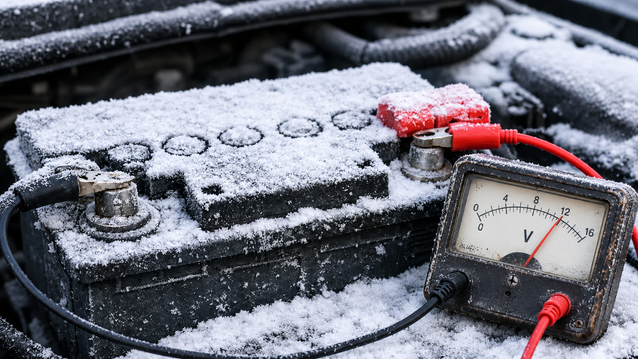

Lithium battery voltage often drops in cold weather because slower electrochemical reactions increase internal impedance: under the same load, more voltage is lost inside the battery. This is mainly voltage sag under load, not proof that the battery has lost the same amount of stored energy. Voltage can recover as the battery warms, though cold can also reduce usable power and capacity and make a low-voltage cutoff occur sooner.
Why cold causes voltage sag

A battery’s terminal voltage under load is lower than its open-circuit voltage—the voltage measured when no current is being drawn—because current flowing through the battery encounters internal resistance and other impedance. As temperature falls, lithium-ion reactions at electrode interfaces slow, increasing polarization and impedance. The resulting voltage drop is larger when the battery supplies current.
In a study of the lithium-ion cells it examined, Argonne reported a 20-fold impedance increase at −30 °C and linked low-temperature power loss primarily to temperature-sensitive interfacial kinetics. That is a study-specific impedance result, not a universal voltage-versus-temperature curve or a measurement of every lithium battery. The Argonne study presented through the U.S. Department of Energy provides the experimental context.
What the voltage change means in use
- Voltage falls mainly while current is flowing: A high load can make the terminal voltage dip more noticeably in the cold. If the load is removed and the battery warms, the voltage may rise again; that recovery does not mean the battery has gained stored energy.
- Usable output can be reduced: Greater impedance limits how much power the battery can deliver, and cold can reduce usable capacity. A device or battery-management system may reach its low-voltage cutoff sooner under load.
- Charging protection is a separate issue: Cold-weather discharge sag describes the voltage response while supplying power. Charging protection concerns whether charging is allowed at low temperature. For example, the Vipboss 12V 105Ah Bluetooth LiFePO4 battery has low-temperature charge protection.
The key distinction is that cold can make voltage under load look lower because the battery has more difficulty delivering current. That reading alone does not tell you exactly how much energy remains.