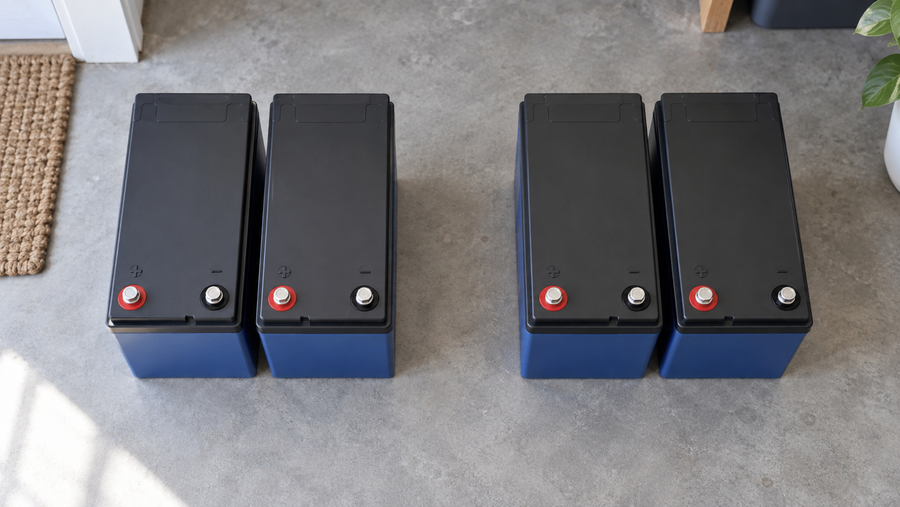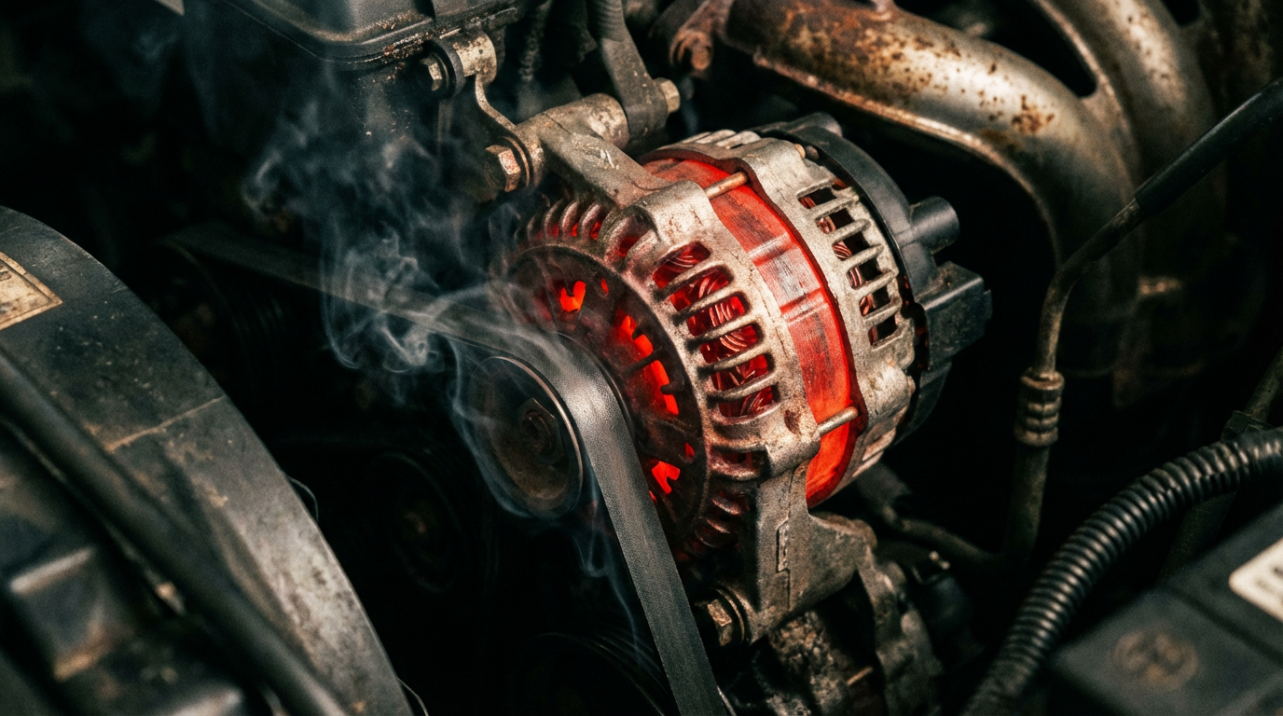

If you catch a whiff of hot rubber or plastic after a long drive with your new lithium battery setup, especially when the cabin fans, lights, and fridge are running, take it seriously. That smell is an under‑hood warning that the alternator and belt are working far beyond what they were built for. This article explains why lithium loads can cook a stock alternator and what practical changes keep your rig charging hard without burning anything up.
What Really Changed When You Switched to Lithium
Dropping in lithium does more than save weight and add usable amp‑hours. It fundamentally changes how hard your charging system gets hammered.
Traditional automotive charging systems were designed around a modest lead‑acid starter battery whose main job is cranking the engine and running a few accessories. The alternator brings that battery back from a shallow discharge and then mostly idles along feeding lights, ignition, pumps, and electronics rather than bulk‑charging a large house bank alternator charging of lithium house banks. Lead‑acid itself limits the abuse because it has relatively poor dynamic charge acceptance in real driving; once voltage rises, it simply will not accept huge current for very long lead–acid charge acceptance in automotive systems.
Modern vehicles with smart alternator systems further complicate this equation by actively managing output for emissions compliance rather than maximum charging power.
Lithium batteries behave very differently. Modern lithium chemistries built for vehicles accept much higher charge power and hold voltage more steadily than lead‑acid, which is a major reason they dominate new electrified drivetrains and vehicle upgrades. That same eagerness to charge turns a comfortable alternator life into a heat‑soaked sprint. Understanding how alternator charging fits into a complete RV lithium upgrade helps you design a system that protects both the battery and the vehicle's electrical components.
"High Acceptance Rate" in Plain Language
Acceptance rate is simply how many amps a battery will willingly take at a given voltage. A half‑charged lead‑acid might accept a healthy boost initially, but its internal chemistry pushes back quickly; charge current tapers on its own. A lithium house battery with low internal resistance behaves more like a powerful magnet for amps and will happily try to pull everything the alternator can produce until it is close to full.
Good lithium manufacturers typically recommend continuous charge currents around 0.2–0.5C. That means a 200 Ah bank is comfortable with roughly 40–100 A for extended periods. If you bolt that bank straight to a 130 A alternator with fat, low‑loss cable and then add vehicle loads on top, you have effectively asked a component sized for short bursts to run a marathon at a sprint pace.
How Overload Shows Up: From Hot Belts to Fried Diodes
When a lithium bank is low and well connected, the alternator is driven toward full output. Internally, a modern automotive alternator is a compact three‑phase machine that rectifies AC to DC, with voltage regulated by varying the rotor field current. In normal use, that regulation keeps system voltage around 14.2–14.6 V with controlled ripple and limits current because the regulator reduces field current as system voltage approaches its set point alternator behavior with LiFePO4 starter batteries.
The problem is duty cycle, not raw capability. Alternators are often rated for a high peak current but have a lower continuous rating at under‑hood temperatures. A large lithium house bank, especially in an RV or van, can pull near that peak output for hours if you let it. EarthX highlights a simple example: a 300 Ah deep‑cycle bank discharged 80 percent needs about 240 Ah; a 60 A alternator would run near full output for roughly four hours to refill it, which is enough to overheat many small‑case units in hot compartments.
That overload shows up in the real world long before the alternator actually dies. You may notice a faint burning rubber smell from the drive belt as tensioners and pulleys struggle with the extra mechanical load. The alternator case runs too hot to touch for more than a split second. At idle in traffic with the fridge, lights, and air‑conditioning on, your voltage may sag and the belt may chirp, because alternator output falls at low RPM while demand stays high. Similar voltage sag under heavy loads affects golf carts climbing hills when their battery packs can't deliver enough current.

The takeaway is that good wiring can be bad news when you do not deliberately control alternator load.
When Lithium Is Actually Safe for Your Alternator
Not every lithium upgrade is a grenade under the hood. Small starter‑battery replacements are a very different situation from big off‑grid house banks.
For a typical 12 V starter application, swapping an 18–25 Ah lead‑acid for a roughly 16 Ah LiFePO4 starter battery looks scary on paper because the lithium unit can gulp higher current when recharging. Practical testing, however, shows that after a normal engine start and a shallow discharge of only around 20 percent, a 60 A alternator might deliver roughly 60 A to the lithium battery for just over three minutes, versus about 40 A for under five minutes into the original lead‑acid starter battery. Both scenarios sit comfortably within alternator capabilities and do not materially change alternator life, because the alternator is not forced to run at full output for hours.
That safety margin depends on staying close to the original capacity and use pattern. A lithium starter pack that mirrors the lead‑acid battery's amp‑hours and sees only shallow cycling after each start rarely stresses the alternator. The electrical architecture helps you here: alternators in cars and light aircraft are generally multi‑pole, three‑phase machines with DC ripple well under 1.5 V at typical engine speeds, and their regulators manage rotor field strength so excess potential power is not simply burned as heat.
The risk spikes when you bolt a large auxiliary bank directly across the alternator or add an aggressive high‑amp DC‑DC charger without checking the alternator's true continuous rating. That is where burnt belts, melted insulation, and cooked diodes start to appear.
Designing a Lithium Charging System That Won't Cook Anything
The cure is not to abandon alternator charging; it is to turn an uncontrolled situation into a controlled one. That means consciously budgeting alternator output and choosing the right protective hardware.
A practical rule of thumb from both field experience and cautious installers is to keep alternator load for house charging to a modest fraction of its rating, often around 30 percent for older or small‑case units, with some systems safely running nearer 50 percent when cooling and hardware are robust. If you have a 120 A alternator in a hot engine bay and a 200 Ah lithium house bank, designing for roughly 30–60 A of sustained charging current is a reasonable target. That happens to line up well with the 0.2–0.5C guidance for LiFePO4 longevity and safety.
At the same time, your vehicle loads are not negotiable. In a common van scenario, a 180 A alternator might already feed about 20 A of engine and control loads, 20 A for exterior lights, 10 A for a cabin blower, and 40–50 A for cooling fans cycling in summer traffic. That leaves surprisingly little real headroom for a 60 A DC‑DC charger before you are effectively at or above the alternator's full rating, especially at idle where output drops sharply.
Because of that, serious lithium builds lean on purpose‑built current‑limiting and temperature‑aware hardware instead of hoping for the best.
Comparing Protection Strategies
A few approaches show up again and again in reliable lithium retrofits.
|
Strategy |
How it protects the alternator |
Main advantages |
Main drawbacks |
|
Direct alternator to lithium with deliberate cable resistance |
Uses smaller or longer cable to limit current via voltage drop |
Simple and cheap; no extra electronics |
Crude control, wasted energy as heat in cables, voltage at lithium bank may be too low for a full charge |
|
DC‑DC (battery‑to‑battery) charger |
Alternator charges a starter battery; DC‑DC pulls a controlled current and outputs a proper lithium profile |
Clean charge profile, built‑in current limit, isolates starter and house systems |
Adds cost and wiring complexity; charger itself can run hot at full output |
|
External regulator with alternator temperature sensor |
Regulator cuts or reduces field current when alternator case temperature climbs |
Lets you use high‑output alternators efficiently while actively avoiding overheat |
Requires compatible alternator and careful setup; more tuning and diagnostics |
|
Inverter‑based alternator replacement |
Replaces conventional alternator with an electronic generator that only produces demanded power |
Much higher efficiency, excellent low‑RPM output, fast recharge and precise control SmartPower alternator replacements |
Highest upfront cost; platform‑specific options; usually overkill for small systems |
In marine and RV installations, a robust design pairs a high‑output alternator with an external regulator that monitors alternator temperature and sometimes also listens to the lithium battery's BMS. When case temperature or communicated limits are exceeded, the regulator gracefully backs off rotor field current instead of driving the machine until something fails. Many of these systems also incorporate dedicated over‑voltage protection that disconnects or clamps alternator output if voltage spikes above about 16 V, guarding both the battery and sensitive electronics from rare but destructive faults.
For demanding builds where alternator output is the primary energy source, inverter‑based replacements. That kind of system can recharge deeply discharged batteries dramatically faster while keeping both alternator and wiring within safe temperature limits.
Example: Alternator Budget for a 200 Ah Lithium House Bank
Imagine a van with a 150 A alternator and a 200 Ah LiFePO4 house bank. The bank is at 20 percent state of charge after a night off‑grid, so it is ready to accept charge aggressively. You are driving on a summer evening with headlights, blower, and a few other loads active.
Reasonable estimates might put total vehicle loads around 50 A. If you design the house side to charge at 50 A via a DC‑DC charger, the alternator sees about 100 A of steady demand. That is roughly two‑thirds of its rating in cool weather and maybe closer to its effective continuous rating once under‑hood temperatures climb. It also aligns nicely with a 0.25C charge rate for the 200 Ah bank, which is right in the sweet spot for both lithium longevity and alternator survival.
At that 50 A rate, bringing the bank from 20 percent to near full would take on the order of three hours of driving, which is a typical leg for many van and RV users.

You get dependable daily recharge without forcing the alternator into a red‑line thermal regime, and you avoid the belt‑burning smells and early alternator failures that come from chasing maximum charge rates.
If, instead, you connected the bank directly with heavy cable and allowed it to pull 120 A whenever the engine spun fast enough, the alternator would be close to its rating before you even added vehicle loads. At highway speeds on a cool day it might tolerate that for a while, but the moment you crawl into a traffic jam on a hot evening, output at idle would drop, cooling airflow would fall, and both alternator and belt would cook.
FAQ: Common "Burning Rubber" Questions
Can I charge lithium directly from my stock alternator?
You can, but you should be choosy about when that is a good idea. A one‑for‑one lithium starter battery replacement of similar size, used only for cranking and normal accessory loads, is generally fine because the alternator only has to replace a small amount of energy after each start and lithium's high acceptance rate matters for minutes, not hours. Direct charging becomes risky when you add a large lithium house bank that can demand high current for extended periods. In that case, you want either a DC‑DC charger, an external regulator with current and temperature limits, or an alternator upgrade sized for the job.
Why does the burning smell show up more in traffic than on the highway?
At highway speeds, your alternator spins faster and cooling airflow through the engine bay is strong. When lithium is charging hard, the alternator still runs hot, but it can shed more heat and stay closer to its design envelope. In stop‑and‑go traffic, alternator RPM falls while your lithium bank continues to pull heavy current and engine‑bay temperatures climb. The belt has to transfer a lot of torque at low speed, which increases slip and friction; the first thing your nose notices is hot rubber, but the alternator case and internal diodes are heating up as well. That combination of low RPM, high electrical load, and poor cooling is exactly the scenario that shortens alternator life.
Do I need special protections besides a DC‑DC charger?
A properly sized DC‑DC charger with conservative current settings goes a long way toward protecting the alternator and making lithium happy. For larger systems or critical applications, it is worth adding alternator temperature monitoring and over‑voltage protection so that a failed regulator, broken belt, or abrupt battery disconnect does not send voltage spikes into your lithium battery and electronics. On high‑value rigs with big banks and heavy loads, an external regulator or an inverter‑based alternator replacement provides an extra layer of control and safety that can prevent a single catastrophic failure.
Closing Charge
The smell of burning rubber after a lithium upgrade is not just how it is; it is your alternator and belt asking for mercy. Lithium's high acceptance rate is a powerful tool when you harness it with deliberate current limits, thermal protection, and, where appropriate, smarter alternator hardware. Treat your alternator as part of the upgrade, not an afterthought, and you will get fast, reliable charging without sacrificing components every season.