
Metal or abrasive scrapers can scratch solar glass and coatings, so the safest strategy is to use soft, purpose-built snow rakes and smart winter design instead of brute force. Done right, you protect both your cold-season power output and your panel warranties.
Fresh snow has your solar panels buried, your monitor shows almost no production, and you are wondering if a roof rake or car ice scraper will save the day or ruin an expensive array. On real winter systems that back up refrigerators, well pumps, and lithium batteries, that moment often decides whether you glide through the storm or spend the night listening to a generator. Here you will get a clear plan for when snow really needs to come off, which tools will not scratch the glass, and how to keep winter output high without risking your roof, your panels, or yourself. Understanding solar panel temperature and performance helps explain why cold, clear winter days can still deliver excellent output once the snow is removed.
Why Snow On Panels Is More Than A Cosmetic Problem
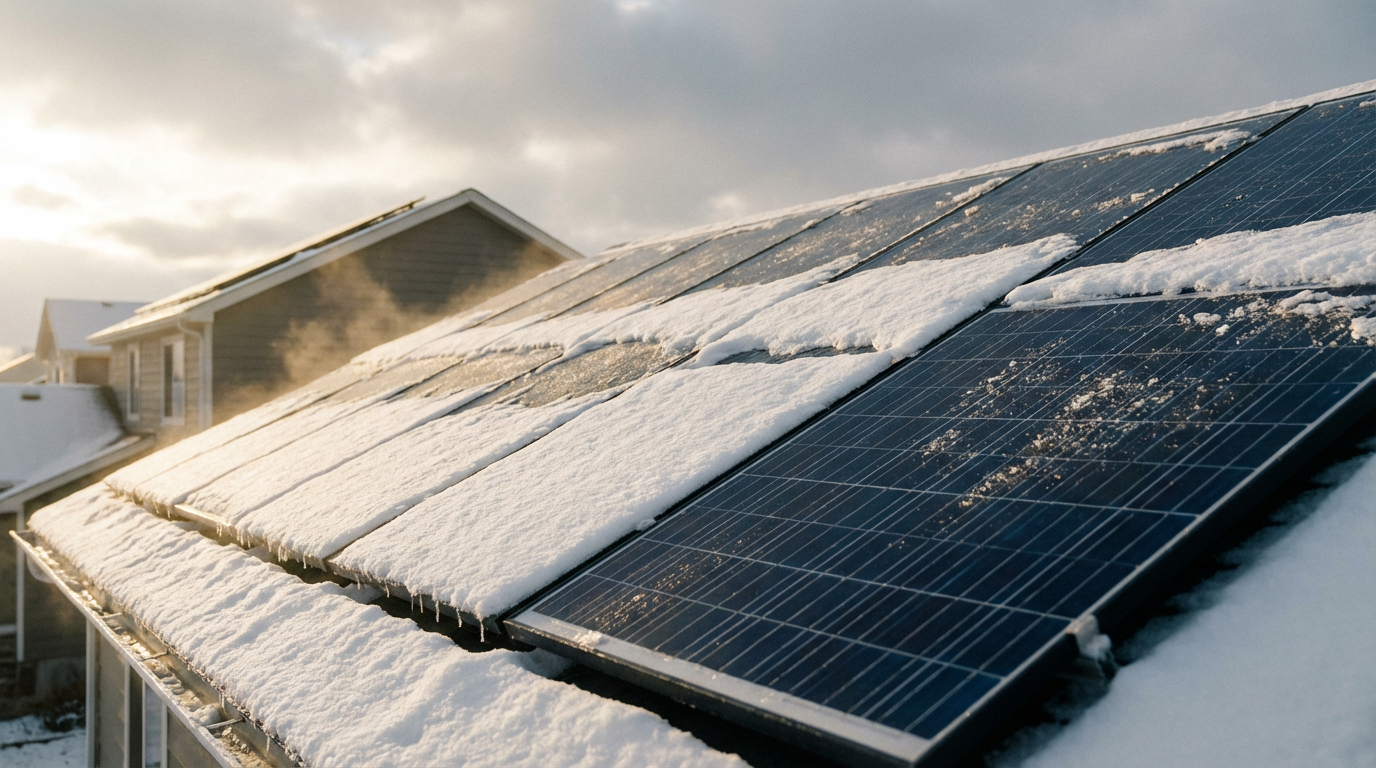
When snow fully covers a panel, it blocks light and the module essentially goes into hibernation until the cover melts or slides off. Early field work on flat-plate arrays found that light snow that sheds quickly causes negligible loss, while heavy snow that lingers on the glass can cause serious energy losses until it clears, especially at larger sites where nobody is going to brush thousands of panels by hand heavy snow that lingers. Cold-climate research in Michigan shows that this "snow shading" is one of the defining challenges for winter performance and has to be considered alongside wind, temperature, and sunlight when you design a system to ride through long winters snow shading.
For a typical grid-tied suburban home, a day or two of lost winter production rarely justifies dangerous roof work. In contrast, for an off-grid cabin or a home that leans hard on a lithium battery bank during storms, several days of buried panels means you run down stored energy with almost nothing going back in. Owners in these situations quickly learn that either the array needs to be designed to shed snow aggressively, or snow management becomes part of the winter operating routine.
Snow also adds weight and structural stress. Even though panels are engineered for substantial snow load, compressed or long-standing snow and ice can crack glass, stress mounting hardware, and contribute to leaks or other roof issues over time. On pitched roofs, the panels can create snow banks that later slide off as heavy sheets, threatening gutters, parked vehicles, and walkways below.
The practical takeaway is simple: you do not need to obsess over every light dusting, but you do need a plan for repeated or deep snow, especially when your winter resilience depends on those panels.

The Real Question: Will Scrapers Scratch The Glass?
Solar modules are covered with tempered glass and usually a thin anti-reflective coating. That glass is tougher than most people think, but it is not invincible, and long-term performance depends on keeping that surface clear and unscratched. Hard or metal-edged tools that are perfectly fine on a driveway can scratch delicate panel surfaces and may even void warranties. Cleaning guidance for solar glass also stresses staying away from abrasive pads or harsh chemicals, because they can permanently mark the surface and reduce light transmission non-abrasive tools.
Micro-scratches are the hidden problem. One hard scrape with a metal shovel might not shatter the glass, but repeated abrasion creates fine lines that scatter light and collect dirt. Over years, that can turn into a measurable drop in output. For off-grid owners who already fight for every winter watt, that is the wrong place to sacrifice performance.
There is also a mechanical risk. Panels are mounted in frames and often held by clips or rails that stand slightly proud of the glass. Aggressive scraping, especially when you are trying to pry up crusted snow or ice, increases the chance of cracking a corner, chipping the edge, or catching those clips. When you add in the risk of slipping on an icy roof, the case for "just grabbing a shovel" gets worse, not better.
Tools That Do More Harm Than Good
Several tool types consistently show up in damage reports and manufacturer warnings. Metal snow shovels and traditional roof rakes with steel edges can gouge the glass or the panel frames with a single sloppy pull. Automotive ice scrapers with hard plastic blades are designed to bite into windshield frost, which is exactly the kind of edge you do not want on a coated solar surface. Stiff-bristled brushes or scouring pads behave almost like sandpaper when you grind them across dirt and ice.
Harsh cleaning chemicals belong in the same "avoid" category. Acidic or ammonia-based products can attack sealants and coatings, which is why professional cleaning recommendations focus on pH-neutral cleaners and soft tools rather than "stronger" chemicals. If you would not use it on a new car's clearcoat, do not use it on a panel that is supposed to deliver power for decades.
The rule of thumb is clear: if the tool relies on sharp edges, high pressure, or abrasion to get the job done, it does not belong on your solar glass.
Scratch-Safe Options That Actually Work
The good news is that there are tools built specifically for snow on sensitive surfaces, and they are proven in the field. One of the most effective designs is the foam-headed snow broom: a light head made from non-abrasive cross-link polyethylene foam on a long extension pole. These heads have been used for years on vehicles and other delicate "Class A finishes," and they are recommended precisely because they do not scratch. Products such as Snow Pro and Roof Brum use this kind of foam, sized and mounted for roofs, solar panels, and other elevated surfaces Snow Pro and Roof Brum.
For most homeowners, the best DIY choice is a purpose-built solar panel snow rake: essentially a lightweight, extendable pole with a foam or rubber head that lets you work from the ground, keeps metal away from the glass, and reaches one- or two-story roofs. Typical rakes in this category cost in the tens to low hundreds of dollars depending on length and materials, which is modest compared with the price of even a single replacement panel.
Ground-mounted arrays or low roofs can often be cleared with the same soft tools recommended for warm-weather cleaning, such as a soft-bristled brush or sponge used with mild, well-diluted soap. In winter, the key is to use these tools to push or pull loose snow, not to scrub frozen chunks.
Here is a quick comparison to frame the choice:
Tool type |
Scratch risk on glass |
Best use case |
Key note |
Metal shovel / metal roof rake |
High |
Driveways, ground |
Keep completely off panels and frames |
Hard plastic ice scraper |
High |
Car windows only |
Too aggressive for coated solar glass |
Stiff broom / scouring pad |
Medium to high |
None on panels |
Can create micro-scratches with trapped grit |
Foam-headed snow broom / rake |
Low |
Roof-mounted and ground arrays |
Designed for delicate finishes, use with light pressure |
Soft brush / sponge + soap |
Low |
Cleaning once snow is gone |
Use diluted mild soap and thorough rinse |
Technique: Clearing Snow Without Killing Your Output Or Yourself
The tool is only half the equation; the way you use it matters just as much. Guidance for winter maintenance emphasizes working from the ground whenever possible and treating roof access as a last resort. Safe practice is to use a long extension pole, wear non-slip boots, stand to the side of the fall line so sliding snow does not bury you, and keep people and pets out of the drop zone below the array. Before you start, take a moment to confirm where overhead power lines and service drops run so flexing poles cannot swing into them.
Timing is critical. Foam or rubber-headed rakes shine on fresh, soft snow; they let you skim snow off the glass before it compacts or freezes hard. Advisories from both snow-removal and cleaning perspectives point out that you should not try to chisel off iced or crusted layers, because that is when people start pounding or prying and panels are most vulnerable. A better pattern is to remove what comes off easily, expose some glass so sunlight can reach the cells, and then let solar heating finish the job.
For many grid-tied arrays, especially on steep, south-facing roofs with decent sun, it is often smarter to let panels clear themselves when you know temperatures will rise above freezing later in the day. In one rooftop test with 240 V heater strips, the heaters drew roughly hundreds of watts, opened small holes in the frost after tens of minutes, and still did not meaningfully boost panel output compared with unheated modules once the sun climbed and temperatures edged above freezing. In those conditions, snow and frost melted off naturally and the extra power gained from heating did not justify the energy spent.
Off-grid owners have a tougher trade-off. If a system is sized so that a couple of dark winter days already stress the battery bank, then allowing panels to stay buried for several more days can force deep discharges or generator use. In that scenario, a short, careful snow-clearing session with a foam rake after each storm can be a better use of your time and money than constantly hauling fuel or upsizing the battery bank later.
Once the snow season ends, a gentle cleaning pass with mild, diluted dish soap and a soft brush can remove leftover dust and grime without harming the glass, particularly if you wash early or late in the day when panels are cool. That combination of winter snow control and seasonal cleaning keeps the system delivering close to its designed output.

Design And Automation Upgrades For Snowy Sites
The most powerful snow-removal tool is a good design. Panel tilt and orientation strongly influence how fast snow slides off. Experience from snowy regions shows that steeper tilts and south-facing, well-exposed roofs shed snow faster than low-tilt, shaded, or north-facing layouts, which tend to trap snow and ice. Recommendations for snowy climates also include avoiding roof valleys where drifting snow builds up and leaving space beneath panels so air can circulate and warm the underside.
Snow guards are another design layer to consider. These are small devices mounted near roof edges or between panel rows that hold snow in place so it melts or breaks up gradually, rather than sliding off in large, dangerous sheets. By managing how snow sheds, snow guards protect gutters, decks, and driveways and can reduce the need for repeated manual clearing in high-traffic areas beneath the array.
For systems where manual clearing is impractical or risky—long rows, high roofs, or commercial sites—automation is becoming more attractive. Research in northern test centers is developing control algorithms that use snow sensors and real-time data on panel position, wind, irradiance, and temperature to reposition modules before, during, and after storms so snow sheds more reliably. On the hardware side, there are all-weather heated modules and retrofit heating systems that activate when snowfall is detected, trading a slice of energy for increased winter uptime.
Automation is not a free lunch, especially for off-grid users. Heating systems consume energy, moving parts can ice up, and sensors add complexity. However, in locations with frequent, heavy snow and critical loads—remote cabins, telecom sites, or battery-backed homes trying to avoid generator use—the combination of steeper tilts, snow guards, and selective automation can pay off by keeping panels producing during weeks when they would otherwise sit buried.
FAQ
Do you always need to remove snow from solar panels?
Not always. Light, powdery snow that melts or slides off within hours or a day usually causes little long-term loss, particularly on steep, sun-exposed roofs. In many grid-tied setups, it is reasonable to let gravity and sunshine handle minor storms, especially if roof access is sketchy. If you rely heavily on solar through winter, see repeated multi-day snow cover, or run off-grid, active snow management with safe tools becomes much more important.
Can you use hot water or de-icer to clear panels faster?
You should not. Rapid temperature shocks from hot water on cold glass can introduce stress that risks cracking, and chemical de-icers can leave residues or damage seals and coatings over time. A better approach is to clear loose snow with a foam or rubber-headed rake, expose some glass, and let solar heating and mild outdoor temperatures finish the melt.
Are foam snow brooms strong enough for heavy snow?
Foam-headed brooms designed for roofs and panels are built from dense, hard but non-abrasive polyethylene foam that is rugged enough for substantial snow while still safe for shingles, metal roofs, and glass. Used with reasonable pressure and a telescoping pole, they are more than capable of handling the typical 1–2 ft storms encountered on residential roofs, and they do it without scraping the glass.
Clearing snow from solar panels is about protecting uptime without sacrificing the hardware that makes that power possible. Choose soft, purpose-built tools, use them early and gently, and pair them with smart design choices like tilt, snow guards, and, where justified, automation. That way your panels keep feeding your lithium storage through winter, and the only thing taking a beating in a storm is the snow—not your glass, your roof, or your energy resilience.