
You finally wire up that big lithium battery wall in your van, cabin, or garage, then realize your favorite chair or pillow is only a couple of feet away and your brain jumps straight to "am I soaking in radiation?" After upgrading power systems in tight spaces for years, the same pattern keeps showing up: the real risks are specific, manageable, and usually much smaller than online panic suggests. Here is how to judge whether your setup is safe, what the science actually says about fields around big batteries, and the layout tweaks that let you sit nearby without worry.
What Is Really Coming Off That Battery Bank?
Once your system is energized, what surrounds it are electric and magnetic fields created wherever electricity is present or flowing. These fields from power systems and wireless devices sit on the non-ionizing side of the spectrum, meaning they do not have enough energy to break chemical bonds the way X-rays and gamma rays do, as summarized in the National Cancer Institute's overview of non-ionizing radiation generated by electricity and wireless technologies. In plain language, this is not nuclear radiation.
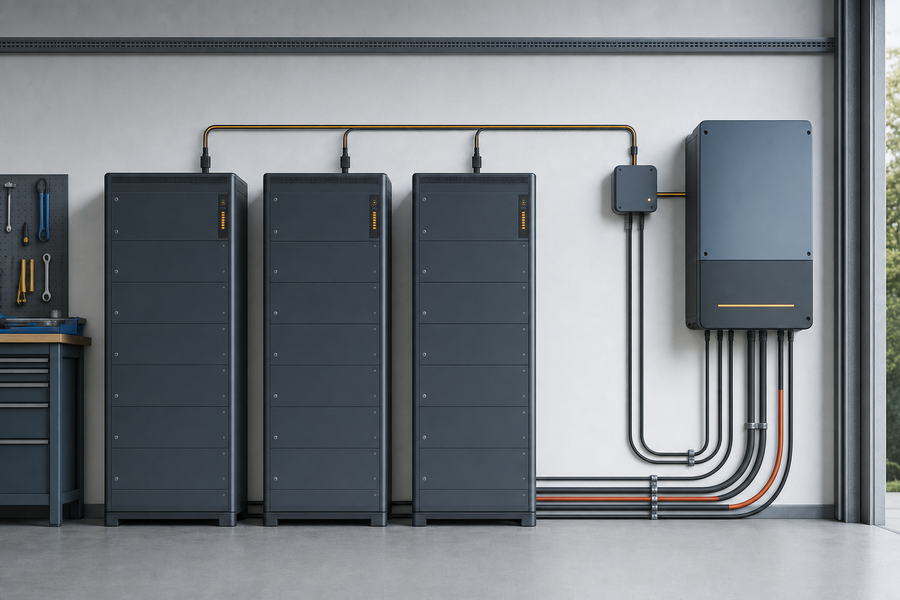
For a stationary battery bank, there are three main pieces. The battery modules and busbars mostly carry direct current, so they create steady magnetic fields that rise and fall with the amount of current but do not oscillate at radio frequencies. The inverter, charger, and AC wiring create low-frequency fields linked to the grid or your internal 50/60 Hz system, which fall into the category of low-frequency, non-ionizing radiation associated with electricity. Finally, any wireless modules in a battery management system or monitoring gateway add radiofrequency signals similar to a low-power Wi-Fi or Bluetooth device.
Engineers worry about one more dimension: electromagnetic interference. A CDC/NIOSH report on a lithium-ion battery pack used in mining wearables describes how battery electronics can emit unwanted high-frequency noise that upsets nearby radios or sensors, and how careful wiring, filtering, and shielding can cut that down while keeping emissions within electromagnetic-compatibility limits for safety systems in the pit. That work is mainly about protecting electronics, not human health, but the same design practices also reduce stray fields in your van or power room.

What the Research Actually Says About EMF Risk
The scientific question is not whether these electric and magnetic fields exist; it is whether levels typical of homes, vehicles, and small power systems cause harm. Both extremely low-frequency fields from power systems and radiofrequency fields from wireless devices are classified as "possibly carcinogenic to humans" (Group 2B) based on limited human evidence, according to the National Cancer Institute's electromagnetic fields and cancer fact sheet. "Possibly" here reflects uncertainty, not a confirmed hazard.
For low-frequency fields like those around inverters and wiring, pooled studies of children living in homes with higher-than-usual magnetic fields find about a 1.5- to 2-fold increase in childhood leukemia risk only when average long-term exposure is above roughly 3-4 milligauss (about 0.3-0.4 microtesla), and even then the data are hard to interpret. Those levels are rare in typical buildings and are usually associated with unusual wiring or very close proximity to high-current conductors.
For adults and for other cancers, large residential and occupational studies of electrical workers, communications staff, and heavy users of radios and mobile devices have not found consistent increases in overall cancer that can be pinned on EMF exposure. Major reviews conclude that everyday exposure from power lines, home wiring, Wi-Fi, and base stations is not a proven cause of cancer, a position echoed in Healthline's review of danger levels, symptoms, and protection for EMF. That does not prove the risk is zero, but it strongly suggests that if any effect exists at room-level exposures, it is small compared with established risks like smoking or air pollution.

Some researchers argue for a more cautious design approach, especially for children. A review of home and school environments by the Environmental Health Trust notes that Europe's precautionary policies often aim to keep long-term indoor magnetic fields in "sensitive" spaces like classrooms and bedrooms around 3-4 milligauss, far below the 2,000 milligauss public limit recommended by international guidelines, and emphasizes reducing magnetic field exposure in homes and schools through distance and wiring fixes. That precautionary benchmark offers a practical target when you decide how close to sit or sleep to your power hardware.
Health agencies also acknowledge that non-specific symptoms like headaches, fatigue, and sleep problems are sometimes attributed to EMF, yet double-blind experiments generally do not find a consistent link between exposure and symptoms. Healthline summarizes this state of play by noting that "electromagnetic hypersensitivity" is not a recognized diagnosis and that studies have not shown a reliable causal connection between low-level fields and reported complaints in people who identify as sensitive, even while emphasizing that the symptoms themselves are real and deserve clinical attention for people reporting EMF-related symptoms and hypersensitivity.
How Close Is Too Close to a Battery Bank?
The most important physical fact for practical design is that field strength drops fast with distance. The Wisconsin Department of Health Services illustrates this with a simple example: an electric can opener can measure around 600 milligauss at 6 inches, but only about 2 milligauss at 4 feet, demonstrating that magnetic field strength drops sharply with distance. That is roughly a 300-fold drop over a few feet.

Your off-grid system behaves similarly. The strongest low-frequency fields cluster around high-current paths: the short cables between batteries and inverter, the inverter case itself, the main AC panel, and any big transformers or chargers. When you are pulling serious power for tools, air conditioning, or an induction cooktop, currents and fields rise; when the system is idling, they fall. But move even a couple of feet away from those cables and housings and the field fades quickly, just as it does around that can opener.
Studies of school and home environments show that desks and beds near electrical panels, distribution boxes, or densely wired walls see higher magnetic fields than spots a few feet away, and that moving furniture is often enough to bring levels down, a pattern discussed in the Environmental Health Trust's work on exposure patterns in classrooms and homes. Translating that into off-grid practice, you get a simple rule of thumb: avoid putting your head or torso directly against the wall that carries the inverter, main panel, or tight bundles of high-current cable.
There is no EMF-based code clearance that says "you must be exactly this many feet from a battery bank," because compliant electrical gear is expected to stay below public exposure limits even at close range. Regulators instead focus on ensuring that typical fields around power lines and indoor wiring remain below guideline levels for the general population, as described in the EPA's discussion of field strength and distance around power lines. In real installations, aiming for roughly 3 feet or more between routine sitting or sleeping positions and the inverter, panel, or heavy cable runs is a pragmatic target that keeps you well away from hotspots without forcing awkward layouts, and stretching that to 6 to 10 feet for pillows and cribs is an easy extra margin when space allows.
Real-World Benchmarks for Context
To get a sense of scale, it helps to compare your battery room or van with other electrified environments. Urban transport and electric-vehicle research shows that trams, trains, buses, and battery-electric cars create complex low-frequency fields from traction motors, inverters, and overhead lines, with dominant components in the tens of hertz and measurable harmonics up to a few hundred hertz inside passenger cabins, as summarized in a review of complex electromagnetic issues in electric vehicles. On top of that, the cabin hosts Wi-Fi, Bluetooth, and multiple cellular radios.
Measurements in European electric cars and buses, including studies referenced in regulatory reviews, generally find that passengers and drivers experience fields that are below international public exposure limits, often well below a fifth of the limit even when sitting directly above traction batteries or in the footwell near power electronics. That matters for your off-grid system because electric-vehicle traction chains routinely move tens or hundreds of kilowatts through dense wiring under the seat. Most stationary battery banks for homes, cabins, and vans operate at lower currents and with shorter duty cycles, so there is no reason to expect higher fields at the same distances.
Power lines are another useful comparison. The EPA notes that fields around high-voltage lines are strongest directly under the wires and fall rapidly as you move away, and that everyday exposure in homes not located right next to major transmission lines is typically well below international limits, as described in their overview of field strength from power lines and household electricity. That is why setback distances for new schools and homes are usually based on staying out of the utility right-of-way, not on a belief that fields at normal residential distances are acutely dangerous.
Finally, consider ordinary appliances. Healthline points out that at about 1 foot from most household devices, magnetic fields are more than 100 times lower than international public limits, and that exposure can be reduced further simply by not lingering against devices while they run, based on measurements of magnetic field levels around household appliances. Add that to the Wisconsin can-opener example and you get a practical sanity check: if your daily routine already includes sitting within a couple of feet of a running fridge, computer, or TV, then spending time a few feet from a well-wired battery bank and inverter in a ventilated enclosure is not a step into a radically different exposure situation.

Designing a Low-EMF, High-Performance Battery Space
The most effective moves are built into layout and wiring, not expensive shielding gadgets. EMF inspections in homes repeatedly find that indoor sources such as wiring errors, panels, power strips, and chargers often contribute more to exposure than distant towers or power lines, a pattern echoed in the Environmental Health Trust's advice on managing internal magnetic and electric field sources. In battery rooms and vans, that means your inverter wall, combiner boxes, and cable routing deserve more attention than the labels on the battery cases.
From an engineering standpoint, one of the best ways to shrink fields is to keep opposing conductors close together and loops small. The NIOSH report on lithium battery packs for mine wearables highlights standard EMI-control tactics such as minimizing loop area, using twisted-pair wiring, and enclosing high-frequency circuitry in grounded metal housings to cut down on radiated and conducted emissions from battery-powered systems. The same principles translate directly to an off-grid room: run positive and negative cables together, avoid big open loops or sprawling wire bundles, and keep busbars compact and tidy.
Placement is your next big lever. In practice, robust designs put the inverter, main DC disconnects, and AC panel on a utility wall that is not shared with a headboard, work desk, or kids' play area. In vans and small cabins, that might mean clustering the battery system along the side of the vehicle and using a short run of conduit to reach a separate living wall, rather than tucking everything under the bed where your torso sits inches above the wiring. This also tends to be better for serviceability, thermal management, and fire response.
Daily habits can trim exposure further without sacrificing performance. Healthline notes that practical reduction strategies for everyday EMF include limiting time right next to active sources and keeping devices away from the body during sleep in its discussion of simple ways to reduce low-level EMF exposure. Translated to your battery system, that can look like scheduling heavy charging when you are not sitting directly beside the hardware, letting the inverter idle instead of staying under full load through the night, and avoiding the habit of building a couch or bunk directly against a hot inverter wall just because it saves a little cable.
It is also worth keeping perspective on other hazards. Environmental and safety analyses of lithium-ion batteries emphasize that they are flammable, can start difficult-to-control fires, and can release toxic metals and gases if abused, leading one lifecycle assessment to flag landfill fires and groundwater contamination as real end-of-life risks for poorly managed packs environmental impacts of lithium-ion batteries, including fire and toxic leakage. In a home or vehicle, proper fusing, clearances, ventilation, and fire-safe construction usually deserve more design time than incremental tweaks to already low EMF levels. For those concerned about battery safety beyond EMF, understanding the real fire and thermal runaway risks of LiFePO4 chemistry provides context for where genuine hazards lie versus theoretical concerns.
So, Is It Dangerous to Sit Next to Your Battery Bank?
Pulled together, the evidence is much calmer than the phrase "radiation from batteries" suggests. Low-frequency and radiofrequency fields from electrical systems are categorized as non-ionizing, and major reviews covering homes, workplaces, and highly electrified environments like trains and electric vehicles do not find strong, consistent proof that everyday exposure within guideline levels causes cancer, as reflected in the National Cancer Institute's summary of electromagnetic fields and cancer evidence. At the same time, research on subtle long-term effects continues, and some regions choose to keep long-term indoor exposures as low as reasonably achievable.
For a properly wired battery bank and inverter that meet electrical code and manufacturer instructions, sitting a few feet away is unlikely to represent a major EMF hazard, especially compared with more immediate risks like fire, shock, and poor ventilation. Distance and time remain your simplest control knobs: avoid pressing your body right against the inverter wall, keep beds and desks a comfortable arm's length or more from panels and big cable runs, and, where space allows, favor layouts that put your main living zone on the other side of the room from the power wall.
If you are still uneasy, it is reasonable to treat EMF like any other low-grade environmental factor. You can measure fields with a simple magnetic-field meter, move furniture or reroute a cable bundle if readings right at your pillow are unusually high, and favor daytime heavy loads over all-night blasts. That way you keep your cables short, your system efficient, and your living space calm, without letting radiation panic derail a solid power upgrade.