
This guide explains when tinned copper wire is worth paying more for on boats, and where bare copper is still an acceptable compromise.
For boats that live around saltwater, tinned copper wire is usually worth the extra cost because it dramatically slows corrosion, stabilizes voltage, and cuts the odds of power failures over time. Bare copper still has a place in very dry, protected spaces, but it is a compromise in most real-world marine installations.
Picture chasing a stubborn power drop to your chartplotter or lithium battery monitor, only to find green, crumbly wire hidden behind the panel and damp connections in the bilge. That scenario shows up again and again in survey reports and post-mortems on electrical fires, because salt, moisture, and vibration are relentless around boats. Side-by-side tests of different wire types in warm, salty conditions have repeatedly shown that properly crimped tinned marine wire keeps its integrity far longer than standard bare copper, even when both start out code-compliant. This guide walks through what actually changes when you pay for tinned copper, where bare copper can still be acceptable, and how to make a confident choice for your next upgrade or lithium retrofit.
Why Marine Wiring Fails So Quickly Around Saltwater
Boat wiring operates in one of the harshest electrical environments you can design: salt spray, damp bilges, temperature swings, engine heat, and constant vibration. Marine-focused manufacturers and standards bodies emphasize that reliability offshore is directly tied to how well your conductors handle that punishment, not just how they perform on day one.
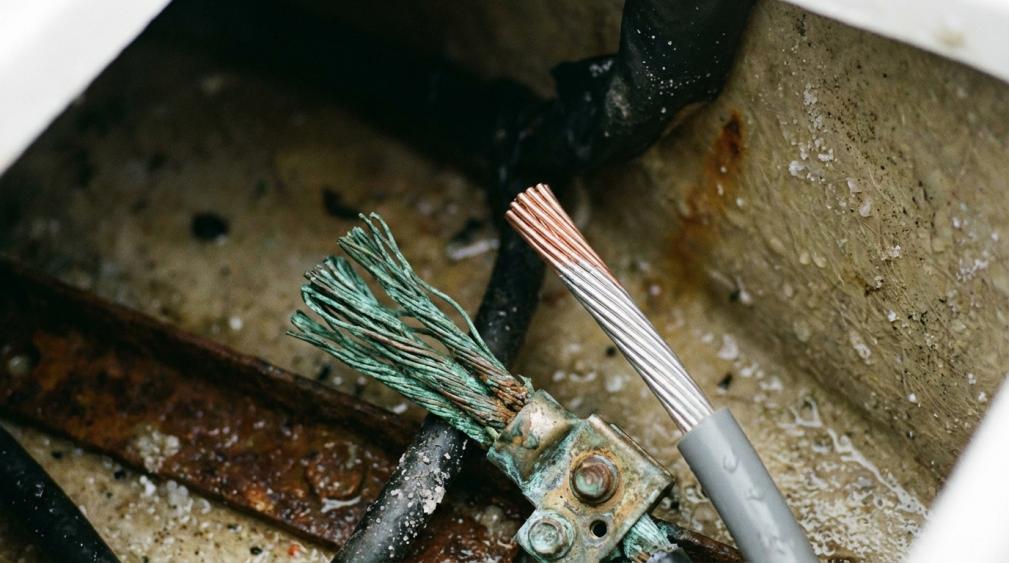
Copper itself is a good conductor and reasonably durable, but any copper exposed to water and oxygen begins to oxidize. In saltwater or areas with de-icing salts, that oxidation accelerates, turning bright copper into the familiar dull or green surface layer. Technical guidance on copper conductors notes that this process gradually weakens the metal, makes strands brittle, and raises resistance, which in turn drives voltage drop and heat in your wiring.
On boats, this effect is amplified by moisture intrusion through wicking, spray, or condensation. Articles focused on marine-grade wiring point out that bilges, lazarettes, deck conduits, and engine rooms are all zones where humidity and contamination are almost guaranteed. Add vibration from hull slap and engine harmonics, and solid or coarse-stranded wire can start losing strands or cracking insulation, opening the door for even faster deterioration and potential arcing.
This is why marine-grade wiring guidance consistently insists on stranded, flexible conductors, insulation rated for oil, fuel, and high temperature, and corrosion-resistant metals. When you combine salt, damp, and movement, the weak point is almost always exposed bare copper and marginal connections.
What Actually Changes When You "Tin" Copper
At its core, tinned copper is simply copper wire coated with a thin layer of tin along each strand. Bare copper is uncoated, pure copper.
Tin is far more resistant to the kind of surface oxidation that attacks exposed copper in damp, salty air. Metallurgical explanations of tinned conductors describe the tin as a sacrificial barrier that shields the copper underneath from oxygen and chloride-rich films. Where bare copper quickly tarnishes and forms oxides and salts that build resistance, the tin layer stays much more stable, delaying that process.
Industrial and marine wire manufacturers agree on the practical effects: tinned copper resists corrosion and oxidation in wet or salt-rich locations, which keeps resistance lower for longer; it maintains better solderability and cleaner connections because the surface does not form heavy oxide scale as quickly; and it extends overall conductor life in harsh atmospheres, cutting the frequency of rewires in hard-to-reach raceways and bilges.
Bare copper still has strengths. It offers slightly higher raw conductivity and typically lower initial cost, which is why it remains standard for many indoor power and grounding applications in dry, controlled environments. Comparisons emphasize that when conditions are benign, bare copper performs very well and is easy to source.
However, those same comparisons stress that in marine, offshore, or high-humidity work, the corrosion resistance of tinned copper is the major differentiator. When you step onto a boat, you are choosing between a conductor designed to survive in salt and one that fundamentally is not.

Side-by-Side Feature Snapshot
Feature |
Tinned Copper |
Bare Copper |
Surface protection |
Tin coating resists oxidation and salt attack |
Exposed copper oxidizes and forms green deposits |
Corrosion behavior |
Slower degradation, longer service life in damp air |
Faster attack in wet, salty, or contaminated locations |
Electrical performance |
Very good; stays low-resistance over time |
Excellent initially; resistance rises as corrosion grows |
Typical marine use |
Battery cables, primary wire, panels, bus bars |
Dry, protected zones if used at all on boats |
Upfront cost |
Higher |
Lower |
Does Tinned Copper Really Last Longer? What Testing Shows
The durability advantage of tinned copper in marine environments is not just theory. Comparative work by wire manufacturers and corrosion specialists has put both conductor types through accelerated tests meant to mimic hot, salty bilge conditions.
One industrial source that focuses specifically on tinned versus bare copper reports that a 12-gauge tinned copper wire can last up to ten times longer than the same gauge of bare copper when both are exposed to aggressive conditions. That "up to" language is important: lifetime depends on temperature, wetting and drying cycles, and contamination. But it gives a sense of scale for what the tin layer can do.
Detailed marine corrosion testing of wiring systems has reached similar qualitative conclusions. In controlled experiments using bilge-like conditions, tinned marine wire behaved as a sacrificial system over time, with the tin slowly consumed while the underlying copper and conductor structure stayed intact significantly longer than bare copper in equivalent setups. The same work highlighted that no surface coating or spray alone could fully protect exposed conductor ends; sealing the connection and limiting bare metal exposure mattered as much as the choice of metal.
Broader corrosion studies on copper and copper alloys in marine atmospheres reinforce the basic physics behind these results. Tests that track copper and its alloys at different distances from shoreline show corrosion rates dropping as salt deposition falls, and rising sharply closer to the sea where chloride loading is higher. Once you move from a dry warehouse to salt-laden air, the demand for a corrosion-resistant surface treatment like tinning jumps dramatically.

For a boat owner or refit planner, the takeaway is straightforward. In dry, climate-controlled service, bare copper can deliver a long, trouble-free life. In spaces that ever smell like the sea, tinned copper will usually stay electrically and mechanically sound for much longer.
Where Tinned Copper Is Worth Every Dollar on Your Boat
The question boat owners really care about is not "Is tinned copper better in a lab?" but "Where on my boat does it actually pay off?"
Marine electrical guides and ABYC-aligned resources converge strongly in a few critical zones.
Any wiring that can smell salt or bilge water should be tinned copper by default. That includes bilge pump circuits, livewell and washdown pumps, deck lighting, windlass feeds, and any conductors running low in the hull. These are precisely the high-moisture, high-contamination areas where bare copper tarnishes fast and where failure is often discovered only when you most need the system.
High-current battery and charging circuits are another non-negotiable area for tinned copper. Manufacturer literature on heavy tinned marine battery cable emphasizes that the tin layer is there specifically to keep resistance low and reliability high under continuous exposure to humidity, salt spray, and engine-room heat. These cables are routinely used to power navigation, communication, and other critical systems over long saltwater trips without interruption, where ordinary bare copper would see more rapid degradation.
When you begin upgrading to lithium house banks, alternator-to-battery chargers, and higher-output solar or wind charging, the stakes rise again. Lithium systems routinely sustain higher charge and discharge currents than legacy flooded banks. For the main DC bus, battery interconnects, and feeds to inverters, wind generators, and powerful DC loads, marine-grade, finely stranded, tinned copper cable with robust insulation is strongly recommended by wire manufacturers and marine wiring specialists. Products built to standards such as UL 1426, ABYC E-11, and U.S. Coast Guard regulations are specifically rated to carry high currents in hot, cramped compartments while resisting oil, fuel, and moisture.
Even for lighter-duty circuits like LED navigation lights or electronics, marine-grade tinned wire still brings value. Guides on choosing wire gauge for boat systems stress that these loads often run through long, tortuous paths to the bow. Over time, bare copper in those runs is vulnerable to moisture from deck leaks or condensation. Tinned copper, combined with quality heat-shrink terminals and proper support, helps keep voltage drop and unexpected dimming or reboots at bay.
In practice, the more of your system that is tinned, the more consistent and predictable your electrical behavior will be, especially once the boat has seen a few seasons of real use rather than living on the trailer.

Are There Places Bare Copper Still Makes Sense?
Bare copper is not banned from boats, and comparisons do acknowledge situations where it remains a rational choice.
Bare copper offers slightly better conductivity and lower material cost. For wiring that will live in genuinely dry, protected enclosures well above the bilge, with no realistic exposure to salt spray, washdown, or condensation, bare copper can perform well. Industrial guidance points to dry, indoor power distribution, panel wiring in climate-controlled spaces, and grounding systems in non-corrosive environments as typical bare-copper domains.
On a boat, that might translate to very short runs inside a sealed, dry cabinet in an air-conditioned interior, provided that cable entries are well-glanded and there is no path for moist air or leaks. In these rare cases, you can sometimes justify bare copper for budget reasons, especially on older vessels where partial upgrades must respect tight cost ceilings.
However, both marine-specific wiring articles and corrosion-focused discussions warn that it is easy to underestimate how moisture moves on a boat. Condensation, hull sweating, and slow leaks can turn a "dry" space into a damp one over a few seasons. Once ambient conditions cross that line, bare copper's corrosion rate climbs while tinned copper's advantage becomes pronounced.
The practical result is that, for most marine retrofits and any system you truly depend on, bare copper belongs in the "exception, not the rule" category. It is the option you choose only after confirming that the environment really behaves like a shore-side electrical room, not like the inside of a hull.
Cost vs Risk: A Simple Way to Decide
Since tinned copper almost always costs more per foot, the real decision is whether that premium is justified by the risk profile of each circuit.
One way to think about it is to compare the cost of wire against the potential cost of failure. Assessments of marine electrical fires and failures consistently highlight wiring and connections as a primary cause. A corroded bilge pump feed that fails when the boat is left in the water, or a high-resistance battery cable that overheats near fuel lines, can do damage that dwarfs any savings from cheaper conductors.
There is also the hidden cost of labor and access. Replacing a few feet of cable buried behind cabinetry, under cabin soles, or inside conduit often demands many hours of disassembly and reassembly. Technical briefs on tinned wire underline that one of the key reasons to specify tinned copper up front is to avoid tearing the boat apart later to replace prematurely corroded bare copper.
For lithium and off-grid-style upgrades, there is a performance dimension as well. Lithium battery systems shine when they can move large amounts of energy efficiently: high-output alternators, big inverters, solar arrays, and DC-DC chargers all rely on low-resistance paths. Corrosion-driven resistance increases in bare copper show up as heat, voltage sag under load, and chargers that never quite reach their target settings. Tinned copper's ability to hold low resistance over time keeps the entire system closer to its design performance.
If you frame the decision this way, the pattern is clear. For any circuit where failure would threaten safety, damage expensive electronics, compromise your lithium system, or demand major labor to access later, tinned copper is worth the premium. Bare copper should be reserved for short, easily replaced, low-risk runs in genuinely dry, controlled spaces.
FAQ
Can I mix tinned and bare copper on the same boat? Yes, as long as every run and connection still meets marine standards for gauge, insulation, and overcurrent protection. Many real-world boats have a mix of original bare copper and newer tinned wiring. The key is to avoid bare copper in damp or salt-prone areas and to use fully tinned terminals and sealed connections wherever dissimilar metals meet, which reduces galvanic mismatch and moisture ingress.
Is tinned copper enough, or do I still need special terminals and grease? Testing focused on bilge-like environments found that even tinned wire ends corrode if they are left exposed and unsealed. The best results came from a system approach: finely stranded tinned conductors, proper ratcheting crimps on tinned marine-grade terminals, heat-shrink or sealed connectors in damp zones, and a thin film of quality dielectric grease on bolted joints. Tinned copper is the foundation, but connection quality and sealing are just as important.

For a lithium house bank retrofit, should everything be tinned copper? For the high-current side of a lithium system—battery links, bus bars, feeds to inverters, large DC-DC chargers, and charge sources like solar or wind—the safest and most robust choice is marine-grade, tinned copper cable and tinned lugs that meet ABYC and marine standards. On the low-current side, you have a bit more flexibility, but using tinned primary wire throughout keeps monitoring, controls, and auxiliary loads stable as the installation ages.
A good rule of thumb is simple: anywhere salt, spray, or bilge mist can reach, let tinned copper carry the current. Do that, pair it with disciplined crimping and sealing, and your wiring will quietly match the reliability of the lithium and off-grid hardware you are upgrading to.
References
- https://en.wikipedia.org/wiki/Marine_grade_stainless
- https://copper.org/applications/marine/seawater/seawater_corrosion.php
- https://www.marineelectricsystems.net/best-practices-for-marine-electrical-wiring/
- https://www.pacergroup.net/pacer-news/tinned-copper-vs-bare-copper/?srsltid=AfmBOoqtZUvXW7L6R-ZdMPSOKIJ_tFES5gABowwU-y6HDIHlu3eSdPOk
- https://www.boatoutfitters.com/choosing-the-right-size-boat-wiring-learn-content
- https://defender.com/en_us/wiring-tips
- https://store.marinebeam.com/8-awg-marine-battery-wire-for-wind-generator-installation/
- https://knowhow.napaonline.com/the-benefits-of-using-marine-grade-wire-on-your-boat/
- https://www.practical-sailor.com/boat-maintenance/marine-wiring-are-the-pricey-options-worth-the-cost
- https://www.sherco-auto.com/collections/marine-primary-wire?srsltid=AfmBOoqPM8fWvyzbv_kbux6FjXSTLDmR_I1yFVh18hmA98Knl4RE5o4d