There is no single reliable amp figure for each speed across all 24V trolling motors. Exact current depends on the motor and operating conditions. The model-specific test example below shows how draw can change by setting. For your own motor, use its published table, if available, or measure it at each setting; a maximum-current rating is not a speed-by-speed chart.
Maximum rating is not speed-setting draw
A motor’s maximum-current rating describes its draw at the stated maximum, not what it draws at every speed. Actual draw can vary with load, water conditions, hull, wind, and other operating conditions, so speed settings alone do not establish a universal current value. Voltage multiplied by current gives electrical power in watts, but voltage and wattage alone cannot reveal current at a particular speed unless the relevant power at that setting is also known.
Published test example by speed setting
Garmin's Force Current manual reports the following current draw at selected forward propeller speed settings with a 25.6 V DC power source:
| Propeller speed setting | Reported current draw |
|---|---|
| 1 | 0.2 A |
| 5 | 1.8 A |
| 10 | 6.3 A |
| 15 | 15.8 A |
| 20 | 32.8 A |
These are readings for that motor under the manual's ISO13342 test setup, using a high-efficiency propeller in relatively calm water with the motor deployed deeply enough to avoid ventilation. The manual gives a current tolerance of ±5 A and measures voltage at the motor power-cable terminals. See the full Force Current speed and current table. Do not apply these readings to a different motor or treat them as guaranteed draw in your conditions.
Measure your motor at each setting

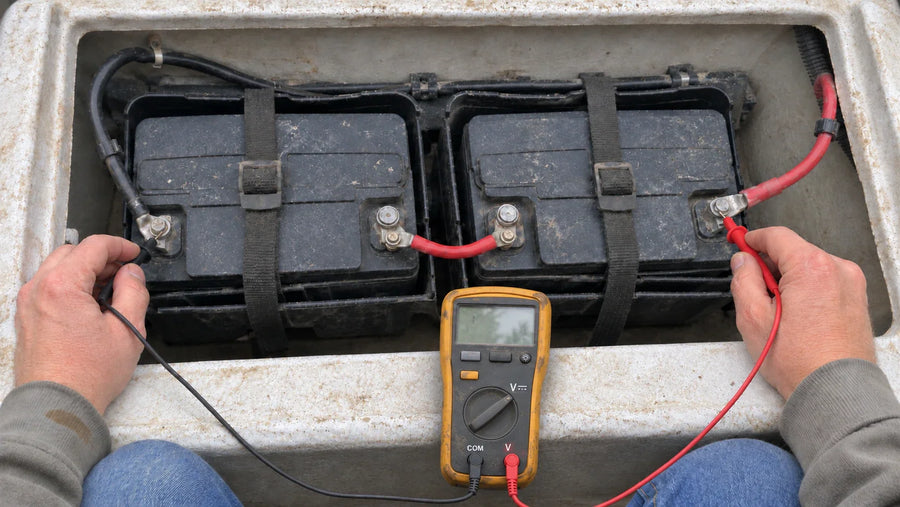
If the manufacturer does not publish a speed-specific table, a DC-capable clamp meter can measure current while the motor is operating. Select a meter whose range covers the anticipated current. Follow the motor and meter instructions for operating the motor and accessing a conductor for measurement.
At the selected setting, clamp around one individual supply conductor with the jaws fully closed, then read the display. For a DC reading, zero the meter first with its jaws closed and no conductor inside, if the meter provides that function. Repeat at each setting and record the conditions, such as load and water conditions, so you know what each reading represents. These clamp-meter measurement steps cover the single-conductor method; each reading applies only to that motor under those test conditions.
Speed-specific current can also help estimate operating time: use the current for the speed you expect to run, along with usable battery capacity and other loads, in a runtime estimate. To calculate that estimate, see how to estimate trolling-motor runtime.
If there is no per-speed table and you cannot make an applicable measurement, the exact current at each speed cannot be determined from the motor’s voltage or maximum-current rating alone.
FAQs
How can I find the amp draw of a 24V trolling motor at each speed?
Use a speed-specific current table published for your motor, if available, or measure current at each setting with a DC-capable clamp meter around one supply conductor. Record the operating conditions with each reading because the results apply to that motor under those conditions.
Does a 24V trolling motor’s maximum amp rating show its draw at every speed?
No. The maximum-current rating describes draw at the stated maximum, not at each speed setting.
Can voltage and wattage tell me the current draw at a particular trolling-motor speed?
Not by themselves: current at a particular speed can be determined from voltage and the power at that setting, but voltage alone or a general wattage figure does not provide that speed-specific draw.