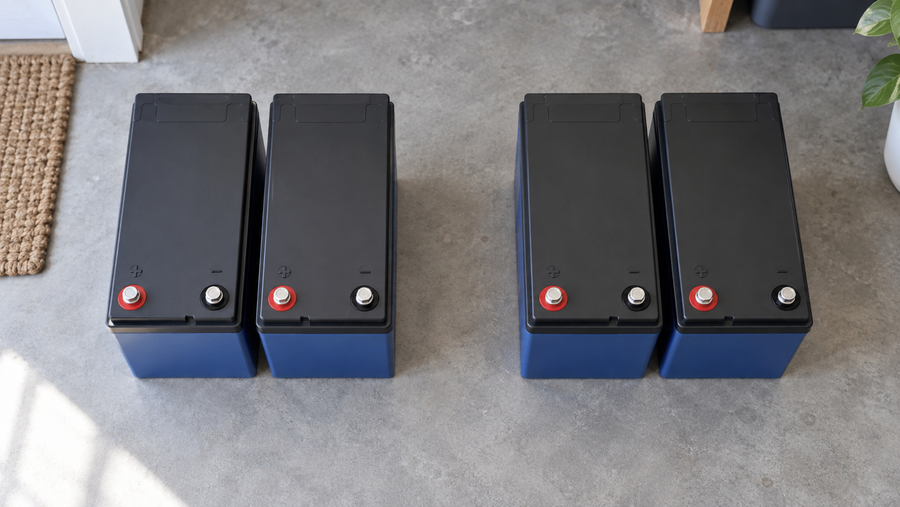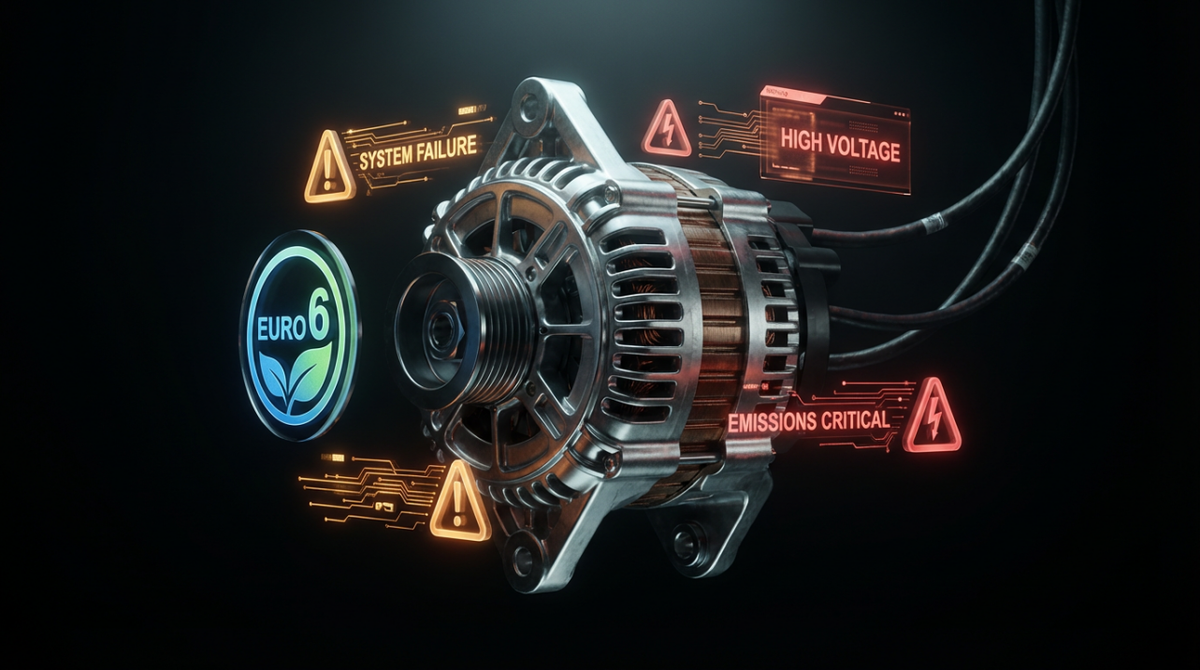

You pull into camp after a long drive, fire up the lights and fridge, and your “house” battery monitor still stubbornly reads almost the same as it did that morning. The engine started fine, yet the expensive lithium bank or deep‑cycle battery that should carry you off‑grid barely gained a percent. This guide explains why modern emission‑controlled vehicles behave that way, how to prove what your alternator is really doing, and the upgrades that turn that wasted drive time into reliable charging power.
Why New Emissions Rules Broke Old-School Charging
The Euro 6 emission standard tightened limits on nitrogen oxides and fine particulate matter compared with earlier rules, forcing diesel engines to rely on complex exhaust treatments like diesel particulate filters (DPF) and selective catalytic reduction (SCR) to stay legal in real traffic conditions Euro 6 emission challenges. These systems trap soot in a filter and inject urea-based fluid into the exhaust to convert NOx into harmless gases, which is great for city air but adds cost, heat, and a lot of computer control under the hood.
Even with these technologies, many real-world tests still find a chunk of Euro 6 diesel cars emitting more NOx on the road than the official lab limits, especially older or high‑mileage vehicles that predate the latest RDE sub‑standards post‑RDE Euro 6 diesel cars still over‑emitting. That gap between lab and street pushes engineers to squeeze every extra bit of efficiency out of the drivetrain so engines stay clean and efficient over a far wider range of conditions.

One of the easiest places to claw back fuel economy is the alternator. To meet strict fuel‑consumption goals under Euro 5 and Euro 6, manufacturers adopted “smart alternators” that deliberately reduce alternator output once the starter battery is recovered, often shifting more charging to braking and deceleration instead of constantly loading the engine during cruise. That strategy is good for CO₂ numbers, but it is exactly why your auxiliary or lithium bank often seems invisible to the vehicle.
How Smart Alternators Behave – And Why Aux Batteries Hate Them
At their core, modern charging systems still revolve around three pieces: the battery, the alternator, and control modules that supervise voltage regulation across the whole vehicle smart charging system elements. The alternator is a three‑phase AC generator whose output is rectified into DC; the regulator and engine computer decide how much magnetic field to feed it, and therefore how much current and voltage it can deliver.
Traditional fixed‑voltage alternators behave in a fairly simple way. They push high current after startup and then settle into a roughly steady system voltage around 14 V while driving, as long as the alternator is healthy and sized correctly how to test an alternator. That constant voltage is far from a perfect multi‑stage charger, but it is usually high enough to bring a secondary lead‑acid battery up into a decent state of charge if you simply parallel it with the starter battery.
Smart alternators are different by design. On many late‑model vehicles, the control module monitors battery current, calculated battery temperature, and system voltage, and may choose charging strategies that sometimes run as low as about 13.0 V during cruise while targeting a state of charge only slightly above 80% instead of keeping the battery completely full. Extra charging is pushed into deceleration and high‑load moments, trimming parasitic drag on the engine the rest of the time.
On the dashboard voltmeter or a plug‑in meter, you can often see this behavior. Many owners log roughly 14–14.5 V right after startup, then watch voltage sag toward about 12.1–12.5 V at the end of a short local trip, even though there are no warning lights and the vehicle starts crisply. On longer highway runs with lights, heater fan, and navigation running, the same vehicle may hold near 14.5 V the entire time because the electrical load is high enough that the computer keeps the alternator fully engaged.

This pattern becomes painful as soon as you ask the vehicle to feed something outside its original design envelope, such as a caravan battery bank or a campervan house battery. Caravan and RV owners routinely report that their tow vehicle or base van will hold healthy voltage on the starter battery, then drop alternator output toward 12–13 V under light load, which is simply not high enough to properly charge an auxiliary battery through a long cable run. Old tricks like switching on headlights sometimes nudge voltage up briefly, but as more vehicles adopt low‑draw LED lighting, even that workaround is unreliable.
The Euro 6 Lithium Upgrade Trap
The alternator’s first job is to keep the starter battery charged and power all of the vehicle’s electrical systems while the engine runs; when it cannot, you see dim lights, strange electrical behavior, or get stranded with a dead battery recognize alternator issues early. What the alternator is not, especially on modern vehicles, is a purpose‑built multi‑stage charger for a second battery somewhere else in the vehicle.
On Euro 6 platforms with smart alternators, the control system focuses almost entirely on the starter battery’s needs. Once that battery is judged “good enough” for repeated starts, the computer pulls alternator voltage down to reduce engine load, leaving any paralleled auxiliary battery starved at the far end of the wiring. That is why simply connecting a house battery with a split‑charge relay that closes when the engine is running is no longer a reliable solution; alternator voltage is low and constantly changing, so the auxiliary battery sees only a weak push most of the time.
You can see this clearly in real motorhome case studies. A late‑model A‑class coach built on a Euro 6 van chassis was upgraded from lead‑acid to lithium, with solar, an inverter, and an existing DC‑DC unit still in the circuit. After a two‑hour drive, the lithium “habitation” battery state of charge barely moved and rarely dropped below about 80% in use, indicating that it was hardly being used or recharged at all. Workshop measurements found alternator output hovering near 12.6 V at the engine bay under typical conditions, which is perfectly acceptable for the starter battery but nowhere near enough to drive a lithium charger into proper bulk mode.

Lithium house batteries generally want charging voltages in the neighborhood of 14–14.4 V with a charger profile that respects their battery management system, so an alternator loafing at 12.6–13.2 V will do little more than slow the discharge curve. Even if you parallel the batteries directly, the lithium bank will mostly sit at whatever the alternator and cabling can maintain, rather than being driven toward a true full charge.
Lead‑acid house batteries do not escape unscathed either. Intelligent charging strategies that keep the starter battery at a partial state of charge around 80% and avoid long periods at higher voltage are great for starter battery longevity and fuel economy, but they often leave deep‑cycle auxiliary banks chronically undercharged. Over time, that habit encourages sulfation, loss of capacity, and the familiar pattern of batteries that test “OK” on a simple voltage check yet sag badly under load well before their expected service life.
Diagnosing Smart Alternator Charging Problems
A basic digital multimeter is enough to capture most of what you need to know. With the engine running and accessories on, a healthy fixed‑voltage alternator will typically show about 13.9–14.3 V at the battery terminals; readings significantly below that, or readings that match the engine‑off voltage, point toward a charging problem rather than just a tired battery. If you see that sort of low reading even with lights, blower, and defroster on, suspect either a failing alternator or a control issue.
First, establish the basics. With the engine off and the vehicle rested, measure the starter battery. Around 12.6 V suggests a healthy, fully charged lead‑acid battery; values in the low 12s point toward lower state of charge. Then start the engine, allow it to settle, and recheck at idle and at a fast idle. If voltage climbs toward 14 V and holds with some load, the alternator itself is probably sound, and your issue lies in control logic or wiring. If you also see dim or flickering headlights, odd electrical behavior, or a charging warning light, take that as confirmation that the alternator and its circuits need professional attention.
To identify whether you have a smart alternator at all, watch voltage while driving with a meter plugged into a 12 V outlet. If system voltage stays near a steady 14 V over varied conditions, you likely have a traditional fixed‑voltage alternator. If instead you see voltage climb toward 14–14.5 V shortly after startup and then relax down toward a band somewhere between about 12 and 15 V as loads and driving conditions change, you are almost certainly looking at a smart alternator system.
Next, compare what the starter battery sees with what reaches the auxiliary or lithium bank. Measure voltage at the starter battery posts while driving, then measure at the house battery terminals through the existing charging path. Owners of tow vehicles and motorhomes often find that the starting battery sits around 12.4–12.7 V once the vehicle has settled, while the auxiliary bank, many feet of cable away, barely reaches that level even after hours on the road. Any additional voltage drop in undersized or corroded wiring just makes things worse.
On many smart‑charge platforms, the engine computer uses a current sensor on the negative side of the starter battery to decide how much charging the system “needs.” If you connect a DC‑DC charger, inverters, or other large loads directly to the battery negative instead of to the chassis side of that sensor, the computer may simply not notice the extra load and will keep alternator voltage low. A quick under‑hood inspection and a wiring diagram check can confirm whether any aftermarket gear is bypassing that critical sensor.
If, with major loads turned on and correct wiring confirmed, system voltage never climbs much above the resting level of the battery, the alternator or its control circuits may be at fault. In that case, the same early warning signs still apply: repeated flat batteries, dimming lights, strange noises from the alternator area, or a persistent charge warning are all strong reasons to have the charging system tested properly before chasing more complex smart‑charge behavior.
Smart Fixes: Making Euro 6 Work For Off-Grid Power
The most robust fix is to stop asking the alternator to do a job it was never designed for and insert hardware that can translate its erratic output into clean, battery‑friendly charging. A dedicated DC‑DC charger or “booster” between the starter and auxiliary batteries will accept alternator input that wanders with driving conditions and convert it into a controlled multi‑stage charge tailored to the chemistry and location of your house bank. That means your off‑grid system behaves like a proper charger, not a loose extension of the vehicle harness.
A quick comparison of common approaches helps clarify the trade‑offs:
Approach |
How it works |
Pros |
Risks / Cons |
Best for |
DC‑DC charger / booster |
Takes variable alternator voltage and delivers a fixed, multi‑stage output to the house battery |
Reliable charging even with smart alternators; supports different chemistries including lithium; protects starter battery |
Added cost and installation complexity; must be sized and wired correctly |
Euro 6 vans, caravans, and RVs with serious house loads or lithium banks |
Simple split‑charge relay |
Connects starter and auxiliary batteries in parallel when engine runs |
Cheap and simple when used with fixed‑voltage alternators |
Unreliable charging on smart alternators; voltage drop over long cables; no chemistry‑specific control |
Older vehicles with fixed‑voltage alternators and modest lead‑acid auxiliary banks |
Disabling smart‑charge / forcing fixed mode |
Adjusts or bypasses ECU control so the alternator behaves like a traditional unit |
Restores steady ~14 V output; can be cheaper than a full DC‑DC system |
Vehicle‑specific; potential warranty, emissions, and electronics risks; usually unsuitable for mixed or lithium chemistries |
Select platforms where manufacturers/auto electricians explicitly support this change |
For lithium, a DC‑DC charger with a dedicated LiFePO₄ program or configurable voltage settings is the cleanest path. Some in‑vehicle chargers offer multiple programs, including support for lithium and conventional batteries, and can keep the auxiliary bank fully charged while simultaneously protecting the starter battery from over‑discharge. That mix‑and‑match capability is particularly useful when you keep an AGM or EFB starter battery but switch the house bank to lithium.
It is tempting to “fool” a smart alternator instead, for example by running with headlights or additional loads on to keep it awake, or by adding marine‑style external regulators. Caravan and 4x4 owners who have tried this report that these tricks are at best inconsistent and at worst risky, especially when external regulation can push the starter battery and sensitive electronics above safe voltage if you target ideal charging levels at a distant house bank. The consensus from experienced installers is to avoid ad‑hoc hacks and either use a proper DC‑DC solution or, where the manufacturer allows it, have smart‑charge functions disabled professionally.
Good cabling is the quiet partner in all of this. At the low voltages automotive systems use, even modest current across undersized or long cables can cause enough voltage drop that your carefully chosen DC‑DC charger or fridge never sees the voltage it expects. Specifying cable sizes and fuse ratings based on the actual run length and current, not just what happened to be on the workshop shelf, is as important as choosing the right charger and batteries.
Finally, remember that no alternator strategy compensates for chronic undercharging. For lead‑acid house banks, regular sessions on a quality mains or solar charger that can hold absorption voltage long enough to complete the charge will dramatically slow sulfation and capacity loss. Lithium banks are more tolerant of partial state of charge but still benefit from a system that can bring them to full when needed, and from a battery management system configured to the realities of your alternator, DC‑DC charger, and real‑world loads.
FAQ: Smart Alternators and Lithium Upgrades
Is my alternator bad if I see around 12.4 V while driving?
Not necessarily. On vehicles with intelligent charging, it is normal for system voltage to climb toward 14 V right after startup and later settle close to the battery’s resting voltage under light load, with higher voltage only during deceleration or heavy electrical use. If the vehicle starts well and shows about 13.9–14.3 V with multiple accessories on, your alternator is probably working as designed.
Can I charge lithium batteries directly from a Euro 6 alternator?
You can physically connect them, but you should not rely on that as your main charging method. Smart alternators often run at voltages too low for a lithium bank to charge properly, and they offer no control over charge profile or battery management, so they can leave lithium packs undercharged or stressed. A DC‑DC charger with a lithium‑specific program between the starter and house batteries is the safer, more effective solution.
Why does my caravan or camper fridge warm up on the road even though the engine is running?
On Euro 6 tow vehicles and vans, the alternator may drop voltage soon after startup, so a fridge running through long, thin wiring from the starter battery sees low voltage and reduced power just when you expect maximum support. A properly wired DC‑DC charger near the house battery, with correctly sized cabling from the vehicle, usually fixes this by boosting voltage at the load end.
A smart alternator is not your enemy; it is just following orders that were never written with off‑grid living in mind. Once you understand how that system thinks and give it the right partner in a DC‑DC charger, appropriate wiring, and chemistry‑appropriate settings, every mile you drive turns back into the charging power you expected when you invested in that lithium or deep‑cycle upgrade.