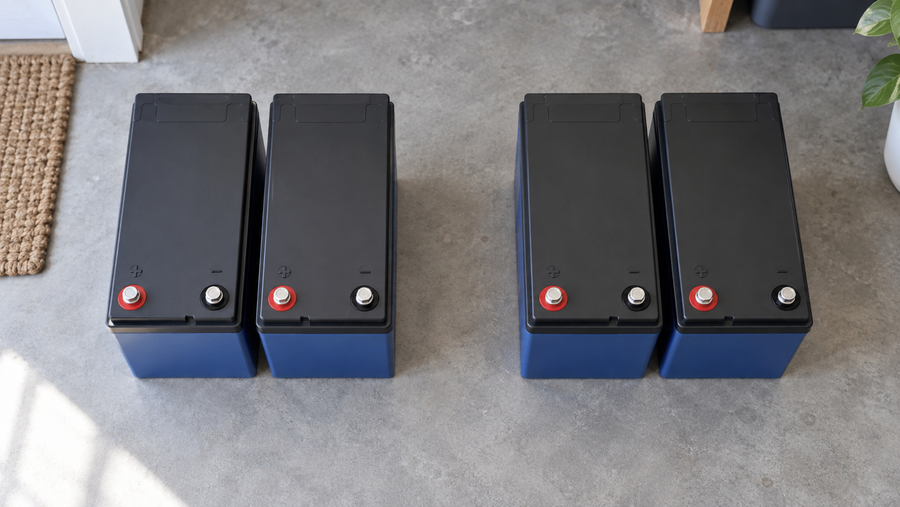

Looping an inverter’s AC output into its own charger cannot recharge the battery for free; it always wastes energy, so real extra runtime must come from external sources and smarter system design.
You stare at your lithium battery bank and shiny new inverter and wonder whether there is a simple trick to make it all run forever by “feeding itself.” When every watt-hour feels precious, that little loophole is tempting, but the hard truth is that the loop quietly drains your battery faster while warming up electronics for no gain. What you can do instead is use a few simple numbers to kill the myth once and for all and then reconfigure your system for real, dependable extra runtime.
Perpetual Motion, Inverters, and the Laws That Do Not Bend
In physics, a perpetual motion machine is any device that keeps moving or delivering useful work forever without any new energy coming in, which directly collides with the first and second laws of thermodynamics/24%3A_The_Ideal_Gas_and_Heat_Engines/24.03%3A_Perpetual_Motion_Machines). Those laws say, in plain terms, that you cannot create energy from nothing and you cannot turn all heat or disorder back into perfectly useful power. Every real process leaks something as heat, sound, electromagnetic noise, or other losses, so efficiency never reaches 100 percent.
The first law is conservation of energy: if you track all forms of energy crossing a system boundary and all the ways energy can be stored, the total stays constant. That means no machine can output more energy than it receives over time. That bookkeeping view of energy is central in both engineering practice and high-level theory, from simple weight-lifting devices to modern engines, and it is one reason physicists treat conservation of energy as universal rather than a rule with rare exceptions conservation of energy. The second law adds direction: usable, low-entropy energy inevitably degrades as it is converted and spread out, so you always pay a tax in wasted heat.
When people talk about “free energy,” they are usually asking for a perpetual motion machine of the first kind, one that produces work with no net energy input, or of the second kind, one that magically converts ambient heat into pure work with no waste. Modern thermodynamics shows that both categories are impossible in real, macroscopic setups, which is why serious treatments of “free energy” devices conclude that the idea would require overturning well-tested physics rather than clever engineering tweaks physics of perpetual motion machines.
That makes your inverter–charger loop more than just a wiring oddity.

The moment you ask the system to charge its own battery without any genuine external source, you have stepped into perpetual motion territory, and the same hard limits that killed centuries of overbalanced wheels and self-pumping waterwheels apply just as brutally to electronics.
The Inverter–Charger Self‑Loop: Simple Numbers, Hard Stop
The beginner fantasy goes like this: the battery feeds DC into the inverter; the inverter produces AC; a charger (sometimes built into the inverter, sometimes a separate unit) plugs into that AC and pushes power back into the same battery. At first glance, the loop looks neat and closed. If the charger is “stronger” than the inverter’s draw, you might hope the battery charges; if they match, maybe it holds steady.
Run the numbers and the illusion collapses. As a thought experiment, say the battery sends 100 units of energy into the inverter. Real inverters are pretty efficient but not perfect, so assume a very generous 95 percent efficiency; now there are 95 units on the AC side. The charger also has losses; give it the same optimistic 95 percent and you get 95 percent of 95, which is about 90 units, back into the battery. One loop took 100 out and put only 90 back. Even if you push the thought experiment to wildly unrealistic 99 percent for both devices, 0.99 multiplied by 0.99 still gives only 98 percent; you never get back to 100.
You can think of the loop in a compact way:
Setup |
Energy in from battery |
Energy back after one loop |
What happens |
Battery → inverter → normal loads |
100 units |
Less than 100 to the loads |
You get useful work and losses |
Battery → inverter → its own charger → battery |
100 units |
Less than 100 to battery |
You only get losses |
This is just conservation of energy with efficiency multipliers less than one. If you had a loop where the product of all efficiencies came out above one, you would have built a perpetual motion machine of the first kind, the exact device that thermodynamics and symmetry arguments rule out (perpetual motion machines and thermodynamic limits/24%3A_The_Ideal_Gas_and_Heat_Engines/24.03%3A_Perpetual_Motion_Machines), symmetry and conservation).
On top of these clean numbers, you still have wiring resistance, idle draw, internal fans, and control electronics consuming their share. All of that extra heat and hum is your stored energy quietly disappearing while the battery voltage ratchets downward. There is no knob you can turn on the charger or inverter that suddenly flips those multipliers above one without breaking the most basic energy bookkeeping that underpins everything from grid design to spacecraft.

What Actually Happens When You Try It
In the field, what you see from a self-looped system is not magic; it is mundane. The instant the charger starts drawing AC, the inverter sees a load, pulls harder on the battery, and its internal losses climb. The charger then feeds part of that power back, but because less returns than left, the battery still discharges. Depending on firmware and protections, the charger or inverter may also become confused by the circular reference and either hunt, surge, or shut down on error.
This pattern mirrors simple mechanical examples used to explain why perpetual motion fails, like pendulums that eventually stop or wheels that cease spinning once friction and drag have bled away their initial push why perpetual motion is impossible in practice. The difference in your power system is that silicon and copper hide those losses inside chips, transformers, and heat sinks rather than in visible bearings and air resistance. The outcome is identical: the motion or current fades unless you feed in fresh energy.

Manufacturers design inverter–chargers assuming power comes from outside the DC bank—grid, generator, or solar—not from their own AC outlet. When you wire around that assumption, the best case is a stable but pointless loop that converts battery energy into warmth and fan noise; the worst case is nuisance tripping, fault codes, or long-term stress on components that were never intended to see that feedback pattern. There is no scenario where the battery state of charge improves without a real source joining the system.
Why Some Gadgets Look “Perpetual” Anyway
Part of what keeps this fantasy alive is that some devices really do look like they are running forever. Old mechanical clocks with weights or sealed “weather” clocks seem to tick endlessly, just as certain desk toys send balls looping around tracks again and again. When teachers and students put one of these “perpetual motion” toys under a camera and analyze it carefully, they find that there is always an external energy feed somewhere hidden in the base or environment, such as an electromagnet and controller buried under the track in a steel-ball gadget powered by regular electrical supply (electromagnetic perpetual motion toy analysis).
Other long-running devices take tiny sips from their surroundings. Extremely low-power clocks and mechanisms have been built that harvest minute daily swings in temperature or pressure, turning those fluctuations into a little bit of mechanical motion over and over. The crucial point is that they are not closed systems at all; the environment is their fuel tank, so they are long-lived engines, not true perpetual motion machines (long-lived but not perpetual devices). Your inverter–charger loop, by contrast, is fully closed if you do not bring in solar, grid, or generator power, so there is nothing outside it to tap.
Better Ways to Stretch Your Lithium Off‑Grid Power
Once you stop chasing self-loop ideas, the game becomes straightforward: maximize what comes in, minimize what goes out, and reduce how many times you pay conversion losses on the same watt-hour. Conservation of energy guarantees that you cannot create more energy inside your system, but it also guarantees that every joule you do bring in must go somewhere you can track, whether as useful work or waste (conservation of energy).
One lever is to cut unnecessary conversions. Every time you go battery DC to inverter AC and then back down into DC chargers or DC supplies, you multiply efficiencies less than one. Instead of running DC loads through the inverter and then back through a charger, feed as many of them as practical directly from the DC bus with appropriate protection and wiring. On a hypothetical 48 V, 200 Ah lithium bank holding about 9,600 watt-hours, trimming even 10 percent of avoidable conversion loss can mean hundreds of watt-hours preserved for actual loads instead of heat.
Another lever is genuine new energy. Solar, a right-sized generator, or intermittent grid connection are all valid ways to refill the tank. The key is to route that energy through chargers designed to use it efficiently and to let the inverter focus on its real job: converting power to serve AC loads. A solar charge controller feeding the battery bank directly, with the inverter simply drawing what it needs, beats any scheme that tries to “boost” the bank by running a charger on the inverter’s own output. In design terms, the loop should always start outside the battery and end in your loads, not circle inside the electronics.

The last lever is load discipline. Track what your cabin, van, or shop actually pulls hour by hour, then prioritize high-impact cuts: swap inefficient resistive heaters for better insulation and targeted heating strategies, use LED lighting, and avoid phantom loads that quietly drain power 24/7. Because every watt-hour you avoid burning at the far end of the chain saves more than a watt-hour at the battery (once you factor in inverter and wiring losses), these cuts buy you more than they first appear.
A Mindset Upgrade: From Perpetual Motion Dreams to Solid Power Planning
The obsession with “getting something for nothing” is not new. Early inventors sketched gravity wheels with shifting weights or fluid-filled spokes, such as medieval designs like Bhāskara’s wheel, hoping that clever geometry would keep one side heavier and drive endless rotation. Modern analysis shows that over a full turn the torque balances out and friction finishes the job; the wheel eventually settles and stops. Your inverter–charger loop is the same story written in silicon: once you count the entire cycle, there is no surplus waiting to be harvested, only losses.
Even the more exotic edges of physics, like quantum time crystals, which exhibit motion that repeats in time without obvious damping, do not rescue the dream. These engineered states cannot yield usable work in a macroscopic engine and do not violate thermodynamics, so they are fascinating for physicists but useless for powering cabins or RVs. On the practical side of the fence, major physics communities treat perpetual motion and unlimited free-energy claims as nonstarters, reinforcing that design energy is better spent working within the laws than trying to beat them (modern impossibility of perpetual motion machines).
Short FAQ
Can I at least run a charger on the inverter while solar is also charging the battery? You can wire many combinations that technically run, but if the charger’s only source is the inverter’s own AC, it adds no net energy; it just cycles power through extra losses while your solar does the real work. A cleaner design is to send solar into the bank through a proper controller, let the inverter serve AC loads, and avoid internal loops that turn voltage into heat.
Is there any corner case where a self-loop could help stabilize the system? No arrangement that only shuffles energy around inside a closed inverter–charger–battery loop can improve state of charge or long-term stability. Any apparent benefit is either measurement error, a hidden energy source, or short-term behavior before the inevitable drain asserts itself, because the energy balance over time must still honor conservation and the efficiency losses in each device.
A well-optimized lithium retrofit treats physics as the hard boundary and creativity as everything inside that fence. Nail your energy flows, remove pointless loops, and size real inputs correctly, and your off-grid system will feel less like a desperate hunt for “free power” and more like a quiet, predictable upgrade that just works.