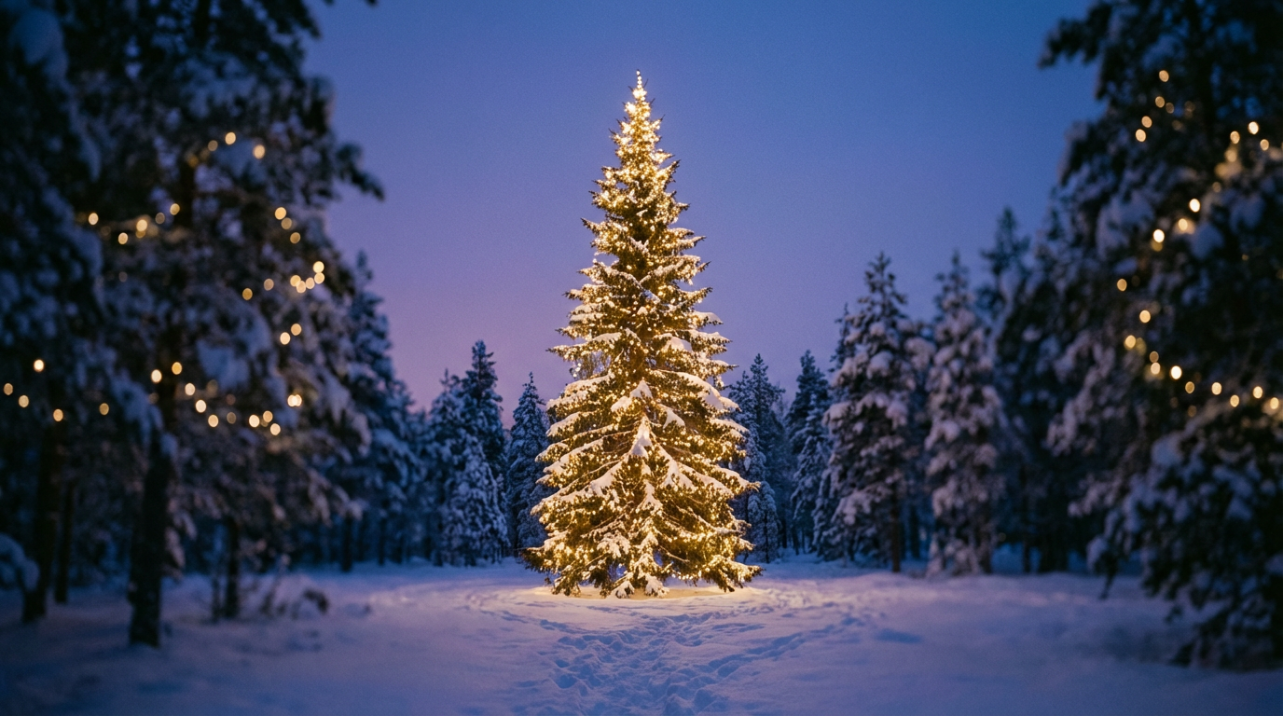

Picture hiking out after dark to a favorite spruce in the woods, only to find your lights dead, the extension cord icing over, and the magic gone by 7:00 PM. With a simple solar-powered setup and a right-sized battery, you can keep that tree glowing every night of the holidays without noticing it on your power bill. This guide walks through the key choices, numbers, and practical steps to build a glowing tree in the woods that simply works.
Pick the Right Tree, Spot, and Footprint
If you already have a healthy evergreen on your land, turning it into your glowing tree is often lower impact than cutting and hauling a new one every year. That is especially true when you avoid long drives to distant tree lots and choose a locally grown real tree. Real trees can support local farms and store carbon while they grow, which helps offset the fuel used for planting, mowing, and harvest when you keep transport distances short. Fresh-cut trees are generally better for the environment than plastic ones, and using a live tree with roots that can be replanted later pushes the footprint down further when space and climate allow, as highlighted for fresh-cut and live trees.
Out in the woods, the “right” tree is about more than looks. A sturdy, well-rooted tree away from erosion-prone banks or delicate wetlands avoids damage when you visit it repeatedly. If your favorite spruce is a 10-minute walk from your cabin, that distance is long enough for a ritual walk yet close enough that hauling a small panel, battery box, and lights is realistic even in snow. When the tree stands under very heavy canopy, you may be better off lighting a nearby clearing tree and leaving deep-shade specimens dark so your solar panel is not starved of winter sun.

Why Lighting Choices Matter More Than the Tree Itself
From a power and carbon standpoint, the tree is rarely the main issue. One season of old-school incandescent holiday strands can use more electricity than the entire production, transport, and disposal of a single tree, so the real footprint often comes from your bulbs rather than your branches. Swapping those hot glass filaments for efficient LEDs is the single biggest upgrade you can make before worrying about panels and batteries.
LED string lights typically use about 80% less electricity than traditional incandescent bulbs and can last roughly 25 times longer. That means far fewer replacements and less waste headed to landfills when you choose LED string lights. Sustainability programs also recommend putting lights on timers so they are not burning all night while nobody is in the woods, trimming both your bill and your overall footprint with simple LED strands and timers.
If you love the classic warm, vintage look, you do not have to go backward in power use. Modern LED sets are designed to mimic the glow of old incandescent C7 and C9 bulbs while keeping LED efficiency, matching the nostalgic aesthetic that enthusiasts look for in “retro” strings. There are even solar-powered strings with large, vintage-style bulbs that pair that look with built-in panels and batteries, as shown by the variety of solar Christmas lights now on the market.
Three Ways to Power a Glowing Tree Without the Grid
The moment you drag lights away from the nearest outlet, you have to choose a power strategy. Solar-powered LED strings use small panels and internal batteries to run outdoor strands without extension cords, which makes them an ideal starting point for a glowing tree in the woods that cuts grid use and clutter. For larger or more demanding displays, you scale up to dedicated panels, charge controllers, and external batteries.
Designers and installers typically think in three system types, each with a different sweet spot:
System type |
Best use case |
Typical scale |
Key strengths |
Main limitations |
Integrated solar string (panel + battery on the strand) |
Single small tree near a sunny edge or field |
About 5–10 W of LEDs, roughly one modest tree |
Plug-and-play, no extra wiring, low cost |
Limited runtime and brightness in cloudy winters, hard to service batteries |
One “hero” tree or a small group near a cabin or path |
Around 10–30 W of LEDs, 20–50 W panel, 10–30 Ah battery |
Flexible sizing, better winter runtime, can use lithium batteries |
Higher upfront cost and more components to protect from weather |
|
Multi-tree “grove” or community entrance display |
Roughly 50–200 W of LEDs, 100–400 W panels, 50–200 Ah bank |
Powers multiple trees reliably with one well-protected core system |
Requires planning, trenching or careful cable routing, and basic electrical design skills |
These ranges and system types match the way off-grid lighting manufacturers describe solar and low-voltage tree setups, where integrated strings are treated as low-cost, low-power kits and modular systems scale from single trees to multi-tree displays using MPPT or PWM charge controllers, 12 or 24 V LEDs, and battery banks sized for several nights of autonomy.

For context on durability, outdoor solar strands built with weather- and UV-resistant cable and sealed LED heads at about an IP65 rating are designed to handle rain, snow, and low-pressure water jets, as shown IP65-rated solar strands used in gardens and seasonal displays.
On the price side, many outdoor solar light sets fall in the roughly 30.00 range, with larger or more intricate systems climbing into the 70.00 band for multi-strand kits. Dedicated off-grid tree systems that use standalone panels, charge controllers, and AGM or lithium iron phosphate (LiFePO4) batteries step up to roughly 700.00 for a medium tree and can reach 5,000.00 or more for multi-tree community displays once you factor in quality mounting hardware, outdoor enclosures, wiring, and labor for a full season of nighttime runtime.
Sizing Your Glowing Tree: A Simple Example
Every reliable glowing tree starts with one question: how many watt-hours per night do the lights need? A common 100-LED string often draws around 3–7 W, so two strings on a mid-size tree might sit in the 6–14 W range under typical conditions, which aligns with manufacturer guidance that places a 100-light set in the low single-digit watts. A practical design method multiplies the total wattage by your planned nightly runtime, so a 10 W load for 6 hours translates to about 60 Wh per night.
Once you have a nightly energy number, divide it by your winter “peak sun hours” to estimate the panel size. In many temperate locations, a conservative winter design uses about 4 peak sun hours, so 60 Wh divided by 4 suggests a 15 W panel as a bare minimum. Designers then oversize the array by roughly 30–50% to account for snow, clouds, and short days, so you would step that up into the 20–25 W range to keep your real-world charging aligned with the 60 Wh-per-night example.
Battery sizing follows the same logic. If your tree uses 60 Wh per night and you want two nights of autonomy, design for roughly 120 Wh of stored energy. At 12 V, that is 10 Ah of usable capacity when you plan to use most of a LiFePO4 battery’s depth of discharge. If you instead use a lead-acid battery and limit it to about half its capacity to preserve life, you would roughly double the amp-hours, which is exactly why lithium iron phosphate is often favored in frequently cycled winter displays: you get more usable energy out of the same rated size with better cold-weather performance.
Putting this together in real terms, imagine a standing pine about 15 ft tall visible from your cabin window.

Two 100-count warm white LED strings at around 5 W total, run for 8 hours per night, would use about 40 Wh. Following the method above, you would use a 15–20 W panel angled for winter sun and design a battery bank around 80–120 Wh for two to three nights of autonomy. That sizing is still compact enough to live in a small weatherproof box at the base of the tree, yet large enough that you can hike out at 9:00 PM after a cloudy day and still find the tree glowing.
Installation Details That Keep the Tree Glowing All Season
Power is only half the battle; the way you hang and wire lights on a live tree outdoors determines whether the system survives real weather. Net-style trunk wrap lights are one of the fastest ways to get even coverage, because they are preformed into a grid that hugs the bark instead of drooping like a loose string, a pattern used in tree wrap lights for professional-looking trunks. Common trunk wraps come in sizes around 2 ft by 6 ft or 2 ft by 8 ft, which fit small trunks and can be gently secured with matching wire or zip ties, with any small gap hidden at the back of the tree so the front view is uniformly bright.
On a real tree in the woods, you want every electrical component to be as weatherproof as your lights. IP65-rated strands with UV-resistant cable and sealed LED heads are designed to keep dust and rain out in outdoor holiday displays, which is why many off-grid kits emphasize an IP65 rating and UV-resistant cable. Locate the panel where it gets clear southern exposure, tilt it steeply enough that snow sheds off, and route the cable down the back side of the tree or along branches so wind cannot turn it into a sail. Batteries and charge controllers belong in a vented, weather-rated box a little above ground level, with drain holes to keep meltwater from pooling around terminals.
For safety, treat even low-voltage systems with respect. A dedicated charge controller between the panel and battery is non-negotiable to prevent overcharging and control current. Fuse the battery positive close to the terminals and consider a second fuse or breaker on the panel line so that a shorted cable in the woods does not turn into a melted wire. When runs are long, use heavier-gauge cable to keep voltage drop to a few percent; for a 12 V system feeding trees 50–100 ft away, stepping up wire size helps avoid dim strands and uneven brightness across a grove.
Timers and light sensors are your maintenance crew in the dark. Many solar strands include dusk-to-dawn sensors that turn lights on automatically, but you can stretch runtime and reduce battery size by using shorter fixed windows, a tactic sustainability offices recommend for building-mounted LED light strands on timers. A practical pattern for a woodland tree is to run from sunset until about 10:00 PM, when most people are still awake to enjoy the display but the tree is not burning energy into the early morning emptiness.
Getting the Look: Warm Glow Without the Grid Hassle
The emotional payoff of a glowing tree in the woods is all about the light quality. If you want the nostalgic, storybook glow, choose warm white or soft multicolor LEDs instead of harsh cool white, a preference reflected in both vintage-style LED strands described by enthusiasts and the large-bulb, warm-hued solar sets highlighted among solar Christmas lights. Modern “retro” LEDs are tuned to resemble the color of incandescent filaments, so you can wrap a trunk and lower branches and see the familiar cozy halo on the snow without the heat and power draw of glass filament bulbs.
You can also borrow design cues from minimalist and alternative tree trends to keep your forest centerpiece tasteful instead of cluttered. Many minimalist Christmas tree alternatives rely on restrained palettes, a few statement ornaments, and plenty of negative space, principles that translate well to a single tree viewed across a dark clearing, as discussed in minimalist Christmas tree alternatives. Decorating just the trunk and one or two main tiers of branches with a single warm color creates a strong, readable silhouette at a distance, and you can always add a slightly brighter, higher-color-temperature string closer to the cabin to mark the path while keeping the forest tree itself gentle and inviting.
If you find that your chosen tree spot gets less sun than expected or the forest canopy is simply too tight, consider shifting the “glowing tree” idea closer to your buildings while keeping the design spirit intact. Pairing one of these sculptural trees near your cabin with a modest solar-lit tree just outside can give you both reliable light and a low-footprint, design-forward anchor for gatherings.
When a Glowing Tree in the Woods Is Not the Right Move
There are real situations where the best “power upgrade” is to walk away from a remote glowing tree idea altogether. If the only suitable trees are far enough from your home that every visit means a long drive or a risky hike on ice, the travel footprint and safety concerns can outweigh the joy, echoing research that long trips to distant tree farms can erase the footprint advantage of real trees compared with artificial ones, especially beyond about a 25-mile round trip. In those cases, it can be smarter to light a tree closer to home or focus on an indoor or porch-based display powered directly from a small solar array or high-efficiency outlet.
Space-saving and minimalist tree concepts also offer a way to get the “glowing tree” moment without putting equipment deep in the woods. Wall-mounted trees made from branches and warm-white fairy lights, or simple string-light outlines on walls, are especially effective in small cabins and apartments. Because these designs consume less material and reuse structures year after year, they can cut both physical and electrical footprints, and they can easily be powered from a small plug-in solar battery pack or high-efficiency indoor outlet timer while still saving your main off-grid battery bank for heat and essentials.
FAQ: Practical Questions about Off-Grid Glowing Trees
Will solar Christmas lights work under dense forest canopy?
Solar light strings can struggle under heavy shade because their small panels need several hours of direct or strong indirect sun to charge internal batteries, a limitation acknowledged in reviews that note solar lights may not be worthwhile in heavily shaded areas despite their benefits in open yards and gardens, as described for solar Christmas lights. In a dense forest, you will often get better, more predictable performance by using a separate roof- or pole-mounted panel in a sunny patch and running low-voltage cable back to the tree, following the same logic that larger off-grid holiday displays use when they centralize panels and batteries for better exposure and then feed multiple trees via low-voltage outdoor lighting runs.
How many hours can I expect my off-grid tree to stay lit each night?
Runtime depends on the balance between panel size, battery capacity, and LED load, but real-world examples provide solid starting points. Small integrated solar tree lights in the roughly 5–10 W range typically run about 4–8 hours per night when panels get clear sun, which matches consumer kit descriptions where a single-tree DIY setup under $100.00 delivers several hours of nightly light through the holidays. As you scale up to dedicated panels and external batteries, medium systems in the 10–30 W load range paired with 20–50 W of solar and 10–30 Ah batteries are commonly designed for 6–10 hours of runtime with one to two nights of autonomy, similar to community displays that use larger arrays and 100 Ah lithium batteries to power multiple trees for around 8 hours nightly over multiweek seasons.
A glowing tree in the woods becomes more than decor when you design it like a small off-grid power project: efficient LEDs, right-sized solar and batteries, weatherproof hardware, and a layout that respects your land. Build it once with the numbers on your side, and every time you step into the winter dark and see that quiet tree shining back at you, you will know your holiday upgrade is working as reliably and cleanly as the rest of your off-grid system.