


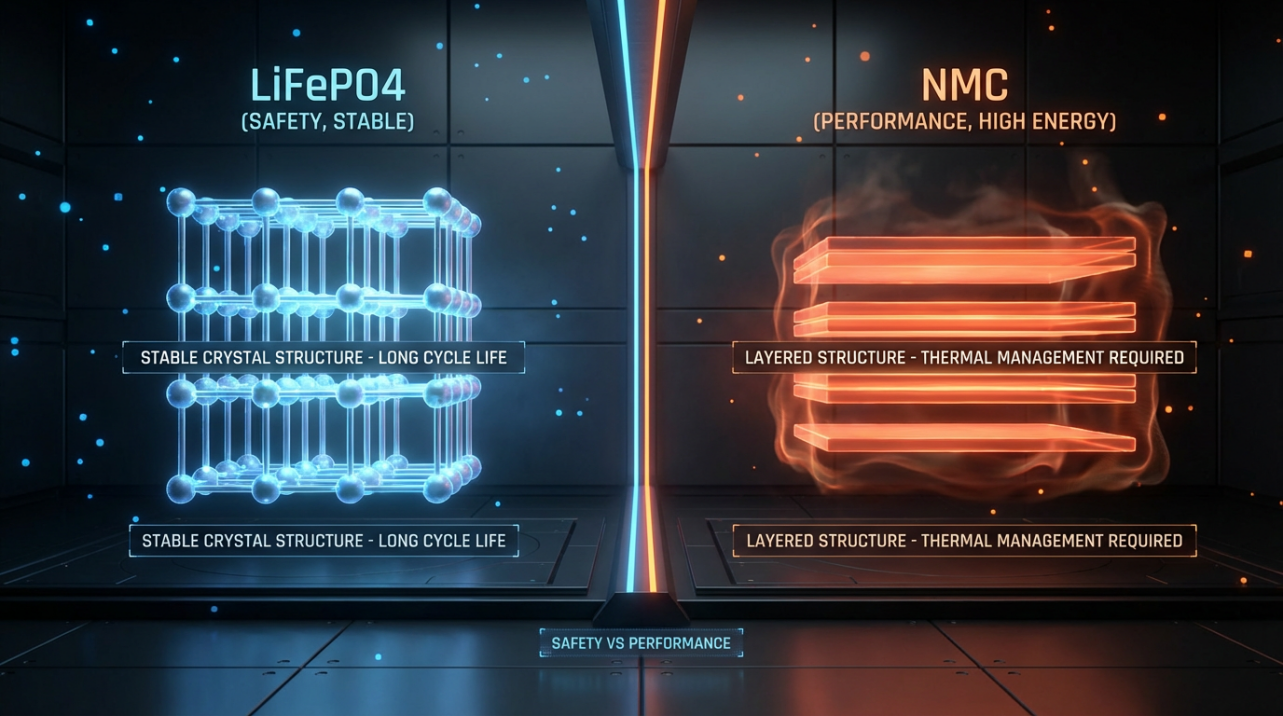
For DIY home batteries, LiFePO4 is usually safer, more forgiving, and more economical over time than NMC, which is better suited to professionally engineered, weight-sensitive systems.
Chemistry Tradeoffs in a Real House, Not a Lab
LiFePO4 is a lithium chemistry optimized for safety, longevity, and stability, not just energy density, which is why it’s become the backbone of modern solar-plus-storage systems. Trusted manufacturers highlight its safety, longevity, and stability in residential and commercial storage.
NMC (nickel–manganese–cobalt) is tuned for maximum energy per pound, which is valuable in an electric vehicle where every pound matters and the pack sits inside a tested, cooled enclosure. In a DIY rack bolted to your garage wall, that same high energy density means more heat, tighter safety margins, and much harsher consequences when something goes wrong.
In short, LiFePO4 trades a bit of energy density for a massive upgrade in safety margin and usable life—exactly the trade you want in a house full of wood, drywall, and family.

Safety Margin: Thermal Runaway and Fire Risk
In the off-grid retrofits I design, safety is non-negotiable. LiFePO4’s chemistry is inherently resistant to thermal runaway. Its structure stays stable until around 518°F, while NMC cells can start to run away around 410°F or even lower in abuse conditions.
That difference matters because DIY systems see imperfect airflow, cluttered garages, and inexact wiring. LiFePO4 packs in reputable systems use a phosphate-based cathode with high thermal stability and resistance to overheating, so they are far less likely to vent, flare, or propagate fire.
NMC, by contrast, releases more energy and oxygen if a cell is punctured, overcharged, or overheated. In a commercial product, layers of metal, sensors, and active cooling manage that risk; in a DIY build, those layers are rarely as robust, turning an electrical mistake into a potential structure fire.
Well-engineered commercial NMC home batteries can be safe, but they rely on their enclosures and controls—not on NMC being DIY-friendly.

Lifetime Economics: Why NMC Costs You More per kWh
A home battery isn’t a weekend gadget; it’s a system you’ll cycle almost every day for a decade or more. LiFePO4 routinely delivers thousands of deep cycles—often about 4,000–7,000 charge cycles in stationary storage—while many NMC packs are in the 1,000–2,000 cycle range at similar depth of discharge.
For a 10 kWh DIY system cycled once per day at 80% usable capacity, a LiFePO4 bank rated for 4,000 cycles delivers about 32,000 kWh over its life, while an NMC bank rated for 1,500 cycles delivers about 12,000 kWh.
Even if the NMC pack were a bit cheaper up front, your cost per kWh delivered is roughly 2–3 times higher once you factor in earlier replacement.

That’s before counting the labor and downtime to rebuild or reprogram your system.
LiFePO4’s long life and stable performance over 10–15 years of use are why many vendors position it as a long-term energy storage solution instead of a short-lived upgrade.
DIY Practicalities: Tolerance for Mistakes and Harsh Conditions
Real-world DIY installs are rarely “perfect”: mismatched charge controllers, firmware quirks, cluttered wiring, hot garages, and winter basements all show up in field photos. LiFePO4 simply handles this messiness better.
Many LiFePO4 products keep working across roughly -4°F to 140°F with less heat-driven degradation than NMC. They also tolerate deep discharge—often 80–100% usable capacity—with slower aging, so a slightly undersized bank does not destroy them in a few years. Integrated BMS units in LiFePO4 modules are built for stationary abuse, with overcharge, over-discharge, and short-circuit protection treated as standard features rather than add-ons.
NMC expects tighter thermal management and narrower voltage windows.

Get the BMS settings, inverter profile, or cooling wrong, and you’re stressing a chemistry that fails harder and hotter. That’s the opposite of what you want in a DIY context where the “engineer” is also the homeowner.
When, If Ever, NMC Makes Sense
NMC still has a place where its strengths really matter: weight-constrained, professionally engineered systems like EVs and some portable tools. There, the pack is designed, tested, and monitored by teams with thermal chambers and failure-analysis labs.
For fixed home storage—especially DIY or lightly engineered retrofits—the calculus flips:
- Safety margin beats energy density.
- Cost per kWh over 10–15 years beats sticker price.
- Abuse tolerance beats “race car” performance.
If you’re upgrading an off-grid cabin, backing up a suburban home, or squeezing more value from rooftop solar, the smartest “power upgrade” is to standardize on LiFePO4 and leave NMC to applications where a full engineering stack can babysit it.




Leave a comment
This site is protected by hCaptcha and the hCaptcha Privacy Policy and Terms of Service apply.