


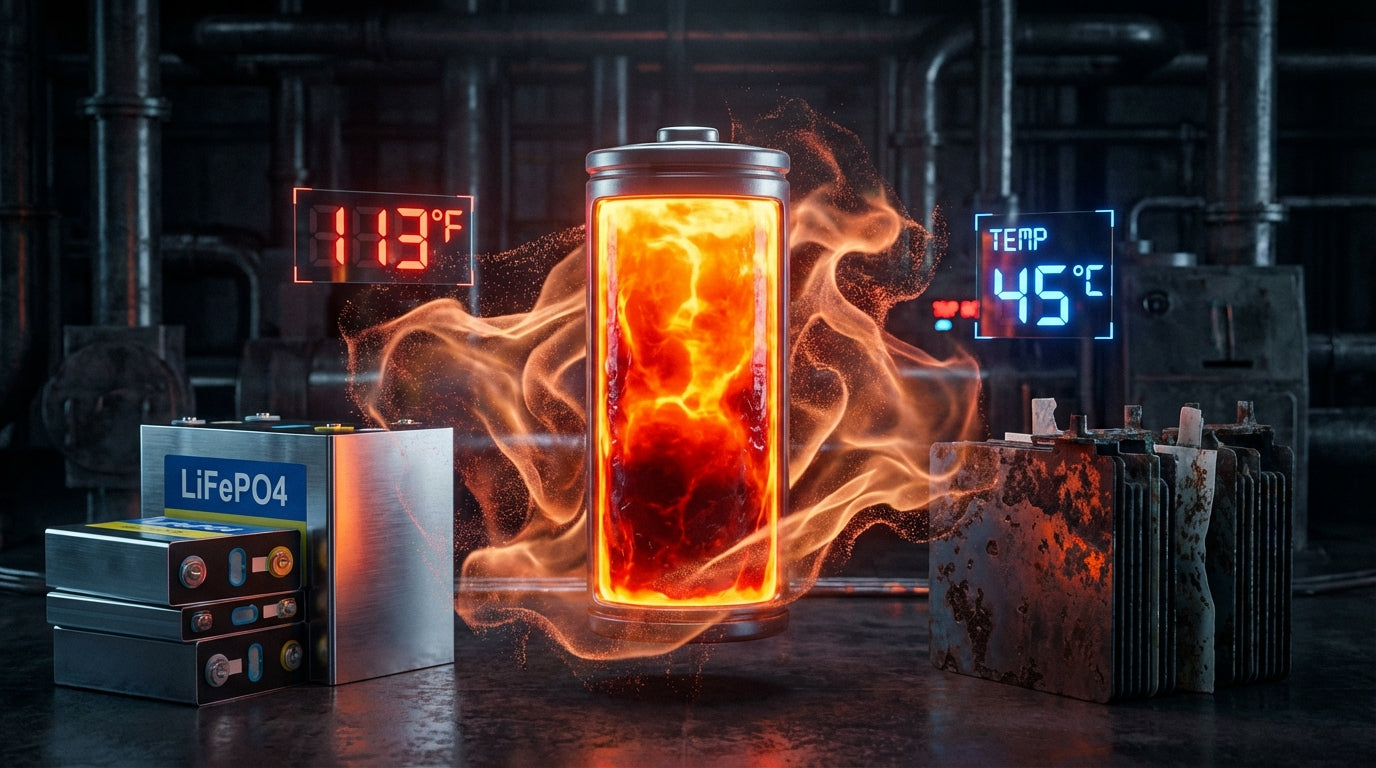
At around 113°F, a well-designed LiFePO4 bank is generally more stable and heat-tolerant than a comparable lead-acid bank, but either chemistry can fail if you neglect thermal management and state of charge.
Is your battery room turning into an oven every afternoon, with inverters throwing high-temperature warnings just when you need power most? In real-world data and lab work on lithium packs, heat shows up as the single most severe stressor, cutting range, capacity, and lifespan unless you actively control it. This guide walks through what really happens around 113°F, how LiFePO4 and lead-acid differ, and what you should change in your system design and daily operation to keep performance and safety on your side.
Why Heat Is the Silent Battery Killer Around 113°F
Battery cells are happiest in a relatively narrow band; many lithium systems are engineered to work best when cells sit roughly in the upper 60s°F to mid-80s°F, with aging and safety risks rising fast as you go hotter, as detailed in this battery thermal management system overview. Push far above that sweet spot and the same chemistry that lets you store energy efficiently starts to accelerate internal reactions, build pressure, and chew away at long-term capacity.
We can see the impact clearly in on-road data: an analysis of nearly 30,000 EVs found that once ambient temperatures climb past about 100°F, average usable driving range drops by a high-teens percentage compared with mild conditions, largely due to extra cooling and heat stress inside the pack, as shown in this study of hot summer weather and EV range. Stationary batteries are not running air conditioning for passengers, but the chemistry inside their cells faces the same physics: high temperature speeds up side reactions that permanently reduce capacity.
Engineers treat that risk seriously. Modern packs surround cells with coolant channels, sensors, and smart controllers so thermal management can keep temperatures near the target window and react before they climb toward the 150–200°F zone where thermal runaway becomes a real concern, as highlighted in this discussion of the critical role of battery thermal management. Your off-grid system usually lacks that level of hardware, which makes basic design choices—location, ventilation, shielding from sun—do much of the heavy lifting.
Imagine a metal battery shed sitting in full sun where the outside air is 100°F. It is common for the interior to run 10–20°F hotter, which means your cells can sit around or above 113°F for hours on end. In that regime, multiple studies of EV packs show noticeably faster degradation over the years compared with similar packs kept closer to the 80°F range, a pattern echoed in hot-climate guidance on EV batteries and heat. Treat 113°F as a red-flag condition to manage, not a normal operating point.

How LiFePO4 Handles Extreme Heat
Within the lithium family, lithium iron phosphate stands out for its ability to tolerate heat and abusive conditions better than many nickel-rich chemistries. Real fleet data shows that lithium iron phosphate packs generally lose less capacity in hot-climate use and are especially attractive when vehicles sit in the sun or at low state of charge in hot weather, as noted in this analysis of how hot summer weather affects EV range. That heat resilience is a big reason LiFePO4 has become the go-to retrofit chemistry for cabins, vans, and remote sites in harsh climates.
Even so, LiFePO4 is still a lithium-ion chemistry and obeys the same basic thermal rules. As cell temperature rises, internal resistance drops slightly, which can feel like “good performance” in the moment but comes with faster chemical wear and, in the extreme, some risk of thermal runaway if temperatures are ever allowed to approach the 150–200°F range highlighted in EV thermal safety discussions. The safety margin is wider than many other lithium chemistries, but it is not infinite.
The real strength of LiFePO4 in the heat is how well it pairs with smart control. Battery management systems continuously watch temperature, current, and voltage, then throttle charging or discharging when limits are approached, mirroring the sensor-driven strategies used to protect traction packs in modern thermal management designs. In practice, that means a LiFePO4 bank with a decent BMS will automatically reduce charging current on a hot summer afternoon instead of quietly cooking itself.
Heat also amplifies the benefits of operating LiFePO4 in a mid-range state of charge. Multiple EV studies and charging guides converge on a simple rule: keeping lithium packs mostly between about 20% and 80% state of charge significantly slows long-term degradation, as summarized in this explanation of the 80/20 rule of EV charging. Combine that with the observation that heat, high voltage, and extreme states of charge are the trio most strongly linked to faster capacity loss in long-term data sets on EV batteries in hot weather, and the operating pattern for LiFePO4 in a hot off-grid shed is clear: keep it cool, keep it mid-charged, and let the BMS enforce current limits.
Picture a 10 kWh LiFePO4 bank in a desert workshop. If you size your solar and loads so the pack usually cycles between roughly 30% before sunrise and 80% by late morning, then floats in that band while fans keep the room close to outside shade temperature, you are using the chemistry in the way long-term data says will survive heat the best. The same pack jammed into an unventilated metal box, charged hard to 100% every day at peak sun, will age much more like the worst-case curves from hot-climate fleet studies.

Lead-Acid in the Heat: Pros and Pain Points
Lead-acid behaves differently. In the short term, a hot lead-acid bank can actually deliver a bit more capacity and cranking power, which is why older specs sometimes quote rated capacity at higher temperatures. The tradeoff is severe: sustained heat dries out flooded cells, accelerates corrosion on plates, and makes sulfation harder to reverse, so the bank loses usable amp-hours and fails earlier than the same model kept cool.
Vented flooded batteries at 113°F need far more frequent watering and careful ventilation. Electrolyte can stratify and boil off, leaving plates exposed and inviting permanent damage. Sealed VRLA and AGM units avoid routine watering but can be stressed into outgassing and swelling if they are held at high float voltage in a hot room, especially when charging sources are not temperature-compensated. Those failure modes tend to be gradual, but when they arrive, they are terminal.
In practical terms, a lead-acid rack in a cramped, unventilated closet that hits 113°F day after day will usually show classic heat abuse symptoms: rising water consumption, sulfur smell near the vent caps, visible plate exposure, and falling capacity long before the calendar lifetime printed on the label. You can run lead-acid banks in hot climates, but doing so safely and economically demands just as much attention to temperature, airflow, and charging strategy as a lithium system.
Safety: Fire Risk and Failure Modes Compared
When people ask whether LiFePO4 is “safer” than lead-acid in extreme heat, they are usually worried about fire. Lithium cells carry a well-publicized risk of thermal runaway, an uncontrolled self-heating event that can escalate into venting, smoke, or fire if cells are pushed toward the 150–200°F internal range during abuse or failure, a scenario discussed in detail in this overview of battery thermal management and safety. That risk is one reason EV and large-storage packs are wrapped in sensors, coolant plates, and software limits.
LiFePO4 has an advantage here: its chemistry is more thermally stable than many nickel-rich lithium variants, with a higher onset temperature for runaway and a tendency to release less energy if something does go wrong. In real-world terms, that means a properly protected LiFePO4 bank is harder to push into a violent failure even when the battery room runs hot, especially if your BMS actively limits current, watches individual cell temperatures, and disconnects the pack when thresholds are exceeded, much like the strategies outlined in advanced EV battery thermal management.
Lead-acid rarely gives you dramatic thermal runaway, but it brings its own heat-linked hazards. Overcharging in a hot, poorly ventilated space can drive heavy hydrogen and oxygen gas release, and enclosed rooms with ignition sources have seen explosions from exactly that combination. Severely overheated lead-acid cells can warp cases, leak acid, and, in tight racks, damage neighboring batteries. These are less spectacular than a lithium fire, yet they are still serious system-wide safety concerns.

At 113°F, the honest takeaway is that chemistry alone does not guarantee safety. A LiFePO4 bank with no BMS, undersized cabling, no fusing, and zero airflow is more dangerous than a conservatively charged, well-ventilated lead-acid rack. However, if you install both to current best practices, LiFePO4 gives you more headroom in hot weather before you approach catastrophic failure modes, which is why hot-climate EV and storage designs increasingly lean on chemistries that tolerate heat better in long-term field data.
Heat-Hardening Your Off-Grid System
The first and biggest win is location. EV guidance in hot states repeatedly stresses parking and charging in the shade to keep packs cooler, which directly translates to placing stationary batteries in the coolest, most stable part of your site rather than in a baking metal container, as emphasized in advice for protecting EV batteries from heat. Even a simple move from a sun-exposed shed to a shaded ground-floor room can easily shave several degrees off peak battery temperature.
State of charge is your next lever. Charging guides and hot-weather studies consistently show that keeping lithium packs away from both 0% and 100% protects them, with many owners targeting something like the 20–80% band for day-to-day use, as outlined in the 80/20 charging rule. You can mimic that in an off-grid system by setting appropriate inverter and charge-controller limits so the pack normally floats in the mid-range and only goes closer to full when you truly need the extra reserve.
Charging speed and timing matter just as much as voltage. Fast charging is repeatedly flagged as a strong heat stressor for EV packs in hot weather because pushing high current into a warm battery generates extra heat and forces the system to throttle, a pattern described in practical guides on EV batteries versus heat. For stationary storage, that translates to avoiding very high charge currents at the hottest time of day and preferentially scheduling energy-intensive tasks so the heaviest charging and discharging happen in the cooler evening and night hours.
Instrumentation is the last piece many off-grid systems skip, and it is vital when you retrofit lithium into hot spaces. Automotive-grade packs rely on dense temperature sensing and high-resolution control logic to balance performance and safety, with data from cell tabs, coolant inlets, and busbars feeding the controller in real time, as described in this discussion of sensor-driven battery management. In your system, at minimum, that means multiple temperature probes in the battery room, per-cell or per-module monitoring for LiFePO4, and alarms that warn you before, not after, the room spends hours above your chosen limit.

Practical Verdict: LiFePO4 or Lead-Acid at 113°F?
If you are planning a new off-grid or retrofit build in a climate where 113°F heat waves are now a yearly event, LiFePO4 is usually the better long-term bet for both performance and safety—provided you commit to doing the BMS and thermal design correctly. It behaves more gracefully in heat, loses less capacity over time in hot conditions, and can use protective mid-range charging strategies that are backed by large-scale field data on lithium batteries in summer heat.
Lead-acid still has a place when budgets are tight, maintenance access is easy, and battery rooms can be kept genuinely cool and well-ventilated. In those conditions, its simpler failure modes and lower upfront cost can be attractive. However, in small, hot spaces where access is limited and lifetime matters, the combination of LiFePO4’s thermal tolerance, integrated protection electronics, and better cycle life under heat stress usually makes it the stronger power-upgrade choice.
Quick FAQ for Hot-Climate Retrofits
Can I mount LiFePO4 batteries in a metal container that hits 113°F?
You can, but you should not do it without upgrades. A metal container in direct sun can easily run well above 113°F inside, pushing your pack far outside the 60–90°F window that hot-climate EV guidance targets for healthy operation in discussions of EV batteries and heat. If a container is your only option, add shade structures, light-colored exterior paint, high-flow ventilation, and temperature-triggered fans, and configure your BMS so it scales back charge current or disconnects loads when cell temperatures drift too high.
Should I replace a healthy lead-acid bank just because summers are getting hotter?
Not automatically. If your existing bank is young, properly sized, and installed in a cool, ventilated space, it may be more cost-effective to improve the room’s thermal management and charging settings than to swap chemistry right away, especially if watering and inspections are easy to perform. Consider replacement when you see clear signs of heat-accelerated aging—rising water use, dropping capacity, and higher resting voltages—or when you are ready to redesign the room with the monitoring and protection that let LiFePO4 shine in the kind of heat conditions highlighted in hot-weather EV battery studies.
A battery bank that shrugs off 113°F is not a matter of luck; it is the product of chemistry choice, installation discipline, and daily operating habits. Decide how much heat your site faces, design the room so your batteries rarely see it, and then let LiFePO4—or carefully managed lead-acid—deliver the reliable power you built the system for.




Leave a comment
This site is protected by hCaptcha and the hCaptcha Privacy Policy and Terms of Service apply.