
Spring storms can still send damaging power surges through indoor battery systems, and this guide explains how layered surge and lightning protection keeps your equipment safer.
If your battery system is tied into your home's wiring, you still need surge protection, even if every battery and inverter lives safely indoors. Surges ride your conductors, not the rain.
You know the feeling: thunder rolls, lights flicker, and you find yourself staring at that expensive lithium battery and inverter, wondering if one bad strike could wipe out your upgrade. Homeowners who have been through even one surge strong enough to kill a fridge or entertainment system learn quickly that preventing damage is far cheaper than replacing electronics that look fine on the outside. This guide shows how spring storms actually threaten an indoor battery setup, when surge protectors are worth every dollar, and how to build a simple, layered protection plan you can put in place before the next storm watch turns into a warning.
How Spring Storms Threaten an Indoor Battery System
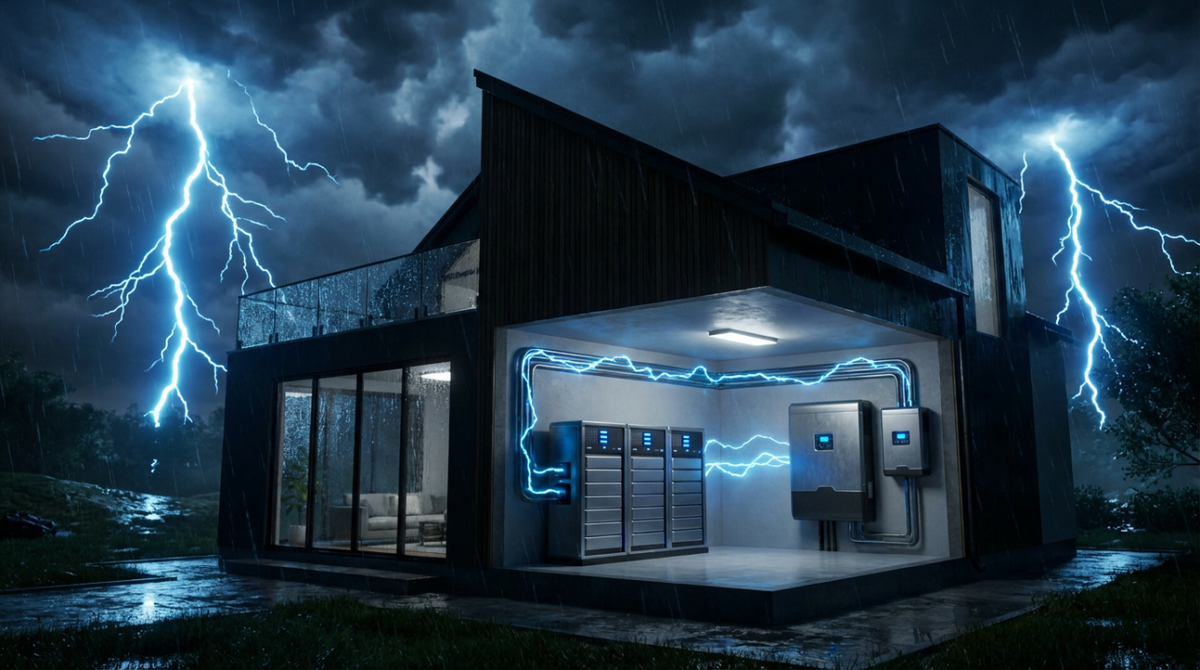
Spring storms are a double hit: lightning overhead and the grid or local lines reacting under your feet. Electrical safety resources such as Legrand and SouthWest Electric describe a power surge as a sudden spike above the normal 120-volt level in U.S. homes, often triggered by nearby lightning, wind damage to lines, or utility switching when power goes out and comes back. Those surges travel along wires, not through open air, which means indoor equipment connected to that wiring stays exposed.
Guidance from service providers in storm-prone regions such as South Carolina and Massachusetts emphasizes that even without a direct strike on the house, surges can ride in from distant lightning through utility lines and into your panel, where they can fry connected electronics and appliances. That is why sources like the FTC’s hurricane-preparedness advice and Legrand’s surge protection overview stress both the financial impact of replacing damaged equipment and the risk of losing irreplaceable digital data.
In an off-grid or hybrid setup, your inverter, charge controller, and indoor battery bank are just more sensitive electronics tied into that system. If they share a panel or subpanel with the rest of the house, a surge entering the wiring does not care whether it ends in a TV, a fridge, or a high-end inverter; it will push everywhere it can. That is why whole-home surge protection is now marketed alongside standby generators and smart-home upgrades by companies such as Absolute Electric and Pioneer Valley Environmental, not just as a nice-to-have but as a core storm-readiness measure.

Where Surges Actually Come From
Multiple independent sources line up on the major causes of storm-season surges. Pioneer Valley Environmental, SouthWest Electric, and Florida State University’s technology preparedness guidance all describe the same pattern. Lightning, either direct or nearby, is an obvious trigger. Power restoration after an outage is another, when the grid reconnects and voltage overshoots. Large appliances cycling on and off can create smaller, repeated spikes inside the home. Faulty wiring adds even more volatility.
Emergency-preparedness teams at the University of Miami and Florida State University highlight what those surges do in practice: they can corrupt data, destroy power supplies, and permanently damage computers and other electronics. Telecom and electrical co-ops in storm-prone states warn that repairing or replacing surge-damaged devices routinely runs into the thousands of dollars for a single home.
The same physics applies whether the device is a desktop PC or an inverter that converts DC from your lithium bank into AC for the house. The battery being indoors mainly reduces direct exposure to rain and flooding. It does nothing to change the way a voltage spike behaves once it is on the wiring that feeds your power electronics.
Do You Need a Surge Protector If the Battery Is Indoors?
For any system where your indoor battery and inverter are connected to household circuits or a utility service, the practical answer is yes. The risk you are managing is not weather touching the battery case; it is excess voltage riding conductors into the electronics that manage that battery.
Legrand, Lenovo, and safe-power specialists such as Quality Uptime all recommend surge protection for sensitive and high-value devices. Their lists always include computers, smart TVs, networking gear, and major appliances. In homes with backup power systems, storm-preparation articles from electrical contractors and generator providers consistently add the main panel, standby generator, and associated controls to the list of assets worth protecting.
A simple comparison helps. The FTC’s guidance on severe-weather surges notes that damage from a single storm can cost a homeowner thousands of dollars in electronics and wiring, even when the house exterior appears fine. Replacing one inverter-charger, one high-efficiency refrigerator, and a couple of smaller devices can easily land in that territory, while whole-home surge protection is sold precisely because it costs far less than that level of damage. That economic imbalance is why contractors in Texas, Massachusetts, and Virginia all promote panel-level surge devices as a first line of defense for homes in lightning-prone regions.
Whole-Home vs. Plug-In Surge Protectors
Several sources distinguish clearly between whole-home surge protection and point-of-use devices. Legrand and Call A Team Today describe whole-home units installed at or near the main electrical panel that intercept surges as they enter the building and divert excess voltage safely to ground. Pioneer Valley Environmental and SouthWest Electric both recommend pairing that panel-level protection with plug-in surge strips for especially sensitive electronics.
Companies such as Lenovo and Infosec explain what those plug-in surge protectors actually do. They look like power strips but contain components that clamp voltage at a safe level and shunt the excess to the ground wire. Specifications such as joule rating and clamping voltage indicate how much energy they can absorb and how quickly they react. For typical home electronics, Pioneer Valley Environmental recommends higher joule ratings and lower clamping voltages so protection kicks in quickly during a surge.
A simple way to think about their roles is shown here.
Protection type |
Where it lives |
What it primarily shields |
Whole-home surge device |
At main panel or service |
All circuits, hardwired loads, and branch circuits |
Plug-in surge protector |
At individual outlets |
Specific electronics plugged into that strip |
For an indoor battery setup that is tied to the panel, the whole-home device is what helps shield the inverter, charge controllers, and any hardwired loads from big incoming surges.

Plug-in units are still useful for computers, networking gear, and entertainment devices that sit on the AC side of your system.
What Surge Protectors Cannot Do
There is one important limit. Lenovo and other surge-protection manufacturers emphasize that standard surge protectors do not guarantee survival from a direct, high-energy lightning strike. They are designed to handle typical voltage spikes, not the raw energy of a bolt landing directly on your structure.
That is where classic lightning protection hardware matters. Legrand and Oncourse Home Solutions describe roof-mounted lightning rods bonded to dedicated ground paths that steer strike current into the soil instead of through your wiring and devices. Some South Carolina and regional telecom guidance couples that hardware with service-entrance surge devices between the meter and panel, creating a layered barrier that reduces both direct and induced surge risks.
If your retrofitted property is in a high-strike area, it is worth having a licensed electrician or lightning-protection specialist evaluate whether a full lightning protection system, not just plug-in surge strips, makes sense for your structure and roofline.

A Practical Storm Plan for Lithium and Off-Grid Power
Once surge protection is in place, spring storms are about behavior as much as hardware. Electrical safety organizations, universities, and consumer advocates all converge on a few habits that dramatically cut your risk.
Before Spring Storms Arrive
Storm-season guidance from SafeElectricity, Absolute Electric, and Call A Team Today recommends a pre-season electrical check. That visit often includes inspecting the main panel for rust or burn marks, verifying that any whole-home surge device is correctly installed and grounded, and confirming that outdoor circuits have proper ground fault protection and weather-resistant covers. For systems with generators or interlock kits, contractors stress regular testing so equipment will run safely when needed.
Technology-preparation advice from Florida State University and the University of Miami adds digital resilience to the list. Back up important data to cloud services so a surge that destroys local hardware does not take your documents, photos, and configuration files with it. Place computers and networking gear on higher shelves to reduce exposure to minor flooding and leaks.
Emergency-planning resources from SafeElectricity and Absolute Electric urge assembling a storm kit with flashlights, batteries, a battery-powered or hand-crank radio, phone power banks, nonperishable food, water, and necessary medications. For an off-grid property, that kit should also include any tools or instructions needed to safely shut down the inverter or open disconnects if an electrician advises it.
During Lightning and Outages
Several sources, including Fortec US, Titus Electricians, and Consumer Reports, are unusually blunt about the most reliable protection during a storm: unplug what you can. If a device is not plugged in, a surge through the wiring cannot reach it. That advice appears consistently for televisions, computers, gaming systems, and even large appliances in guidance aimed at storm-season homeowners.
Consumer Reports and storm-readiness articles from technology teams highlight another critical tool: your cell phone. They recommend fully charging phones and enabling battery-saver modes before the storm, then treating that power as a scarce emergency resource rather than streaming entertainment during the outage.
Safety organizations such as SafeElectricity and Schlage stress physical safety alongside device protection. Stay away from downed lines and any water that may conceal energized conductors. Never operate a generator indoors, and keep portable generators outside and away from doors and windows to prevent carbon monoxide buildup. Do not touch or restart any electronics or appliances that have been wet or submerged until a qualified professional has inspected them.
After the Storm Passes
Post-storm checklists from SafeElectricity, Absolute Electric, and Schlage all start with the same caution: do not re-enter flooded spaces or touch electrical panels while standing in water. If water has reached outlets, cords, or equipment, utilities and electricians should be involved before power is restored.
Once the structure is safe and dry, a licensed electrician can inspect for signs of surge damage such as scorched breakers, tripped protective devices that will not reset, or damaged outdoor wiring. Articles from SouthWest Electric and Call A Team Today recommend prompt repair of any frayed conductors or corroded connections to prevent shock and fire risks.
Lenovo notes that surge protectors themselves wear out as they absorb spikes. If you know your home has taken a hit or you see protection indicator lights go out on your strips or devices, plan on replacing them rather than assuming they still offer full protection.
Simple Decision Guide: Is Surge Protection Worth It for Your Setup?
The key decisions for an upgraded power system revolve around where your risk actually sits. If your indoor battery and inverter are connected to a main panel that also serves the utility or a standby generator, then your situation matches the storm-season scenarios described by Legrand, the FTC, and multiple regional electrical contractors. In that case, panel-level surge protection combined with good grounding is a logical baseline.
If your home uses plug-in electronics around that system, guidance from Lenovo, Pioneer Valley Environmental, and Quality Uptime supports adding plug-in surge protectors in front of computers, networking gear, and entertainment systems. For day-to-day use and minor grid fluctuations, those devices handle the burden, while unplugging before storms remains your most reliable fallback when time and circumstances allow.
If you live in a zone with frequent lightning and tall, exposed structures, the lightning-rod and ground-grid solutions described by Legrand and Oncourse Home Solutions offer another layer that targets the rare but catastrophic direct strike. These systems complement, rather than replace, surge protectors and are designed and installed by specialists.
For many lithium retrofits and off-grid optimizations, the pattern that emerges from these sources is straightforward. Use whole-home surge protection to shield the backbone of your system, use quality plug-in protectors for sensitive electronics, unplug what you can when storms are on the way, and let a trusted electrician verify that your grounding, generators, and panels are ready for the weather your property actually sees.
Quick FAQ
Can a surge protector keep my battery system safe from a direct lightning strike?
Manufacturers such as Lenovo make clear that standard surge protectors are not designed to handle the full energy of a direct strike. They are excellent at reducing damage from typical surges caused by nearby lightning, grid events, or appliance cycling, but they cannot guarantee survival if lightning hits your structure directly. In high-risk locations, combining surge protection with a properly grounded lightning protection system is the more complete strategy described by lightning-protection resources from Legrand and regional utilities.
If I install a whole-home surge protector, do I still need plug-in surge strips?
Yes, the two layers solve different parts of the problem. Whole-home devices at the panel focus on big surges entering the building, which helps protect hardwired loads and branch circuits. Plug-in surge strips at the outlet add another layer right in front of your most sensitive electronics, a combination endorsed by Pioneer Valley Environmental, SouthWest Electric, and several outdoor-electrical safety guides.
Does going off-grid remove my need for surge protection?
Storm-preparedness guidance from electricians and power-reliability specialists points out that not all surges come from the utility. Large appliances cycling, internal wiring issues, and nearby lightning coupling into any long conductors can all create damaging spikes inside a stand-alone system. Even in homes where the grid is absent or disconnected, protecting inverters, controls, and critical appliances with appropriate surge devices helps extend equipment life and avoid expensive storm-season failures.
A well-planned surge and lightning strategy turns your upgraded power system from “hope it survives” into “built to ride out spring storms.” Put the right protection at the panel, at the outlets, and in your habits, and you can enjoy the next thunderstorm with confidence instead of crossing your fingers over every rumble.
References
- https://its.fsu.edu/article/tech-tips-hurricane-season
- https://prepare.miami.edu/before-emergency/hurricane-preparedness/pc-and-data-protection/index.html
- https://www.consumerreports.org/electronics-computers/unplug-electronic-devices-before-a-thunderstorm-a4676728753/
- https://safeelectricity.org/safety-tips/be-prepared-for-severe-storms/
- https://www.ftc.net/blog/ways-to-protect-a-homes-electronic-devices-from-severe-weather/
- https://absolute-electric.com/preparing-for-storm-season-essential-electrical-safety-tips/
- https://callateamtoday.com/outdoor-electrical-safety-preparing-for-spring-storms/
- https://fortec.us/how-to-protect-your-electronics-during-a-storm/
- https://www.tnfrs.tn.gov.in/safety-tips-for-thunder-and-lightning/
- https://www.pvehvac.com/surge-protection-101-how-to-safeguard-your-home-from-spring-storms/