
The turkey is in the oven, the dryer is humming, the guest room mini-split is cranked up, and suddenly your quiet winter electric bill starts looking like a summer heatwave. In homes that plan ahead with smart energy timing and storage, those same holiday evenings turn into controlled, predictable power costs instead of bill shock later. This guide walks through how to use home storage and simple timing tweaks to shave expensive peaks, keep guests comfortable, and protect your holiday budget.
Why Holiday Guests Push Your Power Bill Over the Edge
Holiday budgets are already stretched by travel, groceries, and gifts, and many households struggle not to carry that holiday spending into the new year on a credit card. Your power bill is one of the few big-ticket items you can actually control during this season, but only if you understand when and why it spikes.
Most homes see their highest electricity use in the early morning and, especially, the early evening when everyone is home and using appliances at once. Typical peak electricity hours for households cluster between about 4:00 PM and 9:00 PM, when lights, heating or cooling, and cooking all overlap. Utilities often charge 30–40% more per kilowatt-hour in those windows than late at night or early in the morning, as outlined for residential peak electricity hours. Add a full house of guests, electric heaters or space heaters in spare rooms, plus extra loads of laundry and dishwashing, and you are stacking even more consumption onto the priciest hours of the day.
In many time-of-use rate plans, that 30–40% premium means your most expensive hours can hit about $0.30 per kWh while off-peak sits around $0.15 per kWh. Every kilowatt-hour you use during that peak window costs roughly double compared to shifting the same task to late evening or early morning, based on example rates shared for peak electricity hours. Some utilities, especially for larger customers, also apply separate demand charges based on the single highest power draw in a billing period, meaning even a short spike can inflate the entire month’s bill. While these structures are most common in commercial tariffs, the underlying logic is the same for homes on time-based pricing: your most intense short bursts of use are what hurt your wallet the most.
Peak Shaving 101 for Homes
On the grid side, peak demand is the short window when electricity use across a region hits its highest level, forcing utilities to bring on their most expensive power plants and pushing prices up for everyone, which is why states are leaning on energy storage to cut peak demand. Inside your home, the same idea applies on a smaller scale: your “peak” is that worst 15–60 minutes of the month when nearly everything is on at once.
Peak shaving is the strategy of cutting those peaks down by using less power from the grid exactly when it is most expensive and most strained, often by drawing on a battery instead. In both commercial and residential settings, battery energy storage systems are charged when rates are low and discharged when rates are high, allowing households to reduce electricity use during peak hours without sacrificing comfort. The result is a flatter demand profile and a smaller “spike” that your utility can charge you for.
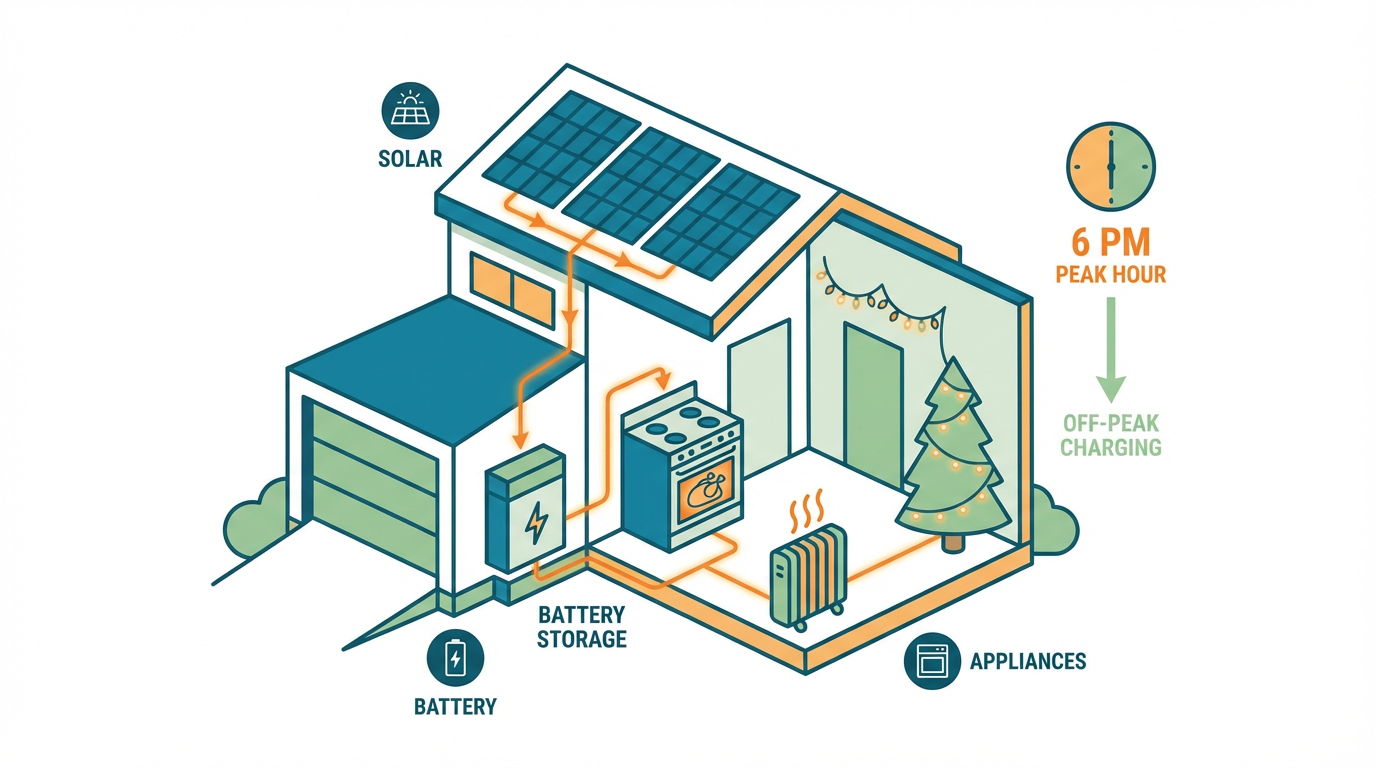
Home storage does this by charging from the grid or from solar panels during off-peak periods, then discharging into your home circuits when prices climb. Modern residential systems typically combine batteries with smart energy management that responds to time-of-use tariffs, price signals, or demand spikes, mirroring how commercial peak shaving energy storage works but scaled down to the home. Practically, that means your battery fills up overnight or in sunny midday hours, then quietly feeds your home in the late afternoon and evening while the meter spins much more slowly.

You can also “shave peaks” without any hardware by changing when you run energy-intensive tasks. Shifting dishwashing, laundry, drying, ironing, and power tools away from peak hours to off-peak times such as late night, early morning, or weekends is a core cost-saving recommendation for homes on time-of-use rates. A battery is not a replacement for these habits; it multiplies their impact by adding a reservoir of low-cost energy you can deploy when your lifestyle makes it difficult to avoid high-rate windows completely.
How Home Storage Handles Holiday Peaks
A Holiday Evening, With and Without Storage
To see how this plays out when guests show up, picture a simple example under a time-of-use plan that charges $0.30 per kWh during peak evening hours and $0.15 per kWh off-peak, similar to the day-night spread described for peak electricity hours. Say your home would normally use 10 kWh between 4:00 PM and 9:00 PM on a busy holiday evening.
Grid energy used 4–9 PM |
Price per kWh |
Cost for 4–9 PM |
|
Without storage |
10 kWh |
$0.30 |
$3.00 |
With storage covering 8 kWh |
2 kWh at peak, 8 kWh charged off-peak |
$0.30 peak, $0.15 off-peak |
$0.60 (peak) + $1.20 (charging) = $1.80 |
In this simplified scenario, a battery that charges earlier at the $0.15 off-peak rate and covers 8 kWh of your evening use cuts the peak window grid bill from $3.00 to $1.80, purely by buying and using electricity at different times.

The daily savings of $1.20 may not sound huge, but across a month of heavy cooking, heating, and hosting, that can add up to around $36, and in homes with higher usage or steeper time-of-use spreads it can be significantly more. The bigger gain shows up when those avoided peaks mean you stay below thresholds that trigger higher rate tiers or extra seasonal surcharges.
For larger customers, the same strategy also reduces monthly demand charges by lowering the single highest 15-minute spike that the utility uses to size its infrastructure and compute fees. Commercial case studies describe situations where dropping a facility’s peak by a few hundred kilowatts saves tens of thousands of dollars per year, and although residential tariffs use different numbers, the principle is identical: shaving your highest spikes reduces what the utility has to reserve for you and what it can justify charging.
If you have rooftop solar, the economics get even better. Solar panels tend to produce the most power around midday and early afternoon, and that generation can directly offset peak-time consumption or even earn credits in some net-metered systems, helping you beat peak electricity prices. When you add a home battery, you can store that surplus midday solar production instead of pushing it all back to the grid at lower rates, then run your evening holiday cooking, lighting, and entertainment off stored sunlight, a pattern that residential peak shaving energy storage is designed to support.
Is Home Storage Worth It for Holiday Hosts?
The key question is whether the investment pays off beyond a few big days each year. In commercial and industrial settings, well-designed peak-shaving battery systems regularly achieve payback times in the three- to five-year range, and when systems are paired with solar, homes can see even faster returns thanks to both time-of-use arbitrage and backup power value, per evaluations of peak shaving energy storage. Your exact numbers will depend on your rates, climate, and load profile, but the holiday season is when you feel the benefit most sharply.
Resilience is the second half of the value equation. Modern home battery backup systems are able to detect outages and restore power in under a second for critical loads, keeping lights, refrigeration, medical equipment, and heating or cooling online even if everyone else on the block is in the dark, as highlighted in practical guidance on pairing solar with home battery backup for reduced grid dependence. When you are hosting out-of-town guests in winter or during storm season, that combination of uninterrupted comfort and controlled costs can be more compelling than the raw dollars.

There are also emerging ways to let your battery earn money when you are not using it. State-level programs are experimenting with incentives, virtual power plants, and utility-owned batteries that reduce peak demand by dispatching fleets of customer-side systems during system-wide peaks instead of firing up peaker plants. In these models, you might receive an upfront rebate, ongoing performance payments, or even a subscription-style service where the utility owns and controls the battery on your wall while you enjoy backup power and bill credits, often with the right to opt out of individual dispatch events if you need full capacity for your own home.
Finally, you can attack the “holiday peak” on the space side as well as the power side. Renting a small storage unit to move seldom-used furniture, boxes, and off-season items away from living areas can be a low-cost alternative to upsizing, with storage units often costing around 150 per month for a typical 10 ft by 10 ft unit compared with an extra 1,000 per month to upgrade to a larger apartment. That means you maintain a more compact, efficient home most of the year, then open up floor space for guests during the holidays without committing to higher permanent housing costs.
Practical Holiday Playbook for Peak Shaving
Map Your Personal Peak
A good holiday energy plan starts with knowing exactly when your utility charges the most. Time-of-use tariffs usually spell out peak, mid-peak, and off-peak windows, with evenings between about 4:00 PM and 9:00 PM and, in some regions, winter mornings from about 6:00 AM to 9:00 AM marked as high-rate periods in peak electricity hours. Pull your last winter bill or log into your utility app, note the labeled peak windows and rate differences, and keep those times in mind as your “red zones” when guests are in town.
Next, sketch your own load pattern during a holiday. Make a quick list of what runs around those red-zone hours: oven, stove, air fryer, dishwasher, clothes dryer, extra space heaters, holiday lighting, and any electric vehicle charging. You do not need a detailed engineering model; just knowing that you often stack three or four heavy electrical loads into the same hour tells you there is room to flatten the spike.
Program the Battery Around Your Guests
Once you have a sense of your peaks, configure your storage system so it charges when energy is cheapest and discharges during your red zones. Residential energy storage offerings commonly include mobile apps or control panels that let you schedule charging from off-peak grid power or from solar, and then prioritize battery discharge during peak-rate periods, matching the way commercial battery storage responds to tariffs and demand spikes. For holiday hosting, a simple schedule is often best: charge fully before guests arrive, then let the system support your home through the evening.
As an example, if your peak period runs from 4:00 PM to 9:00 PM, you might set the battery to charge between midnight and 6:00 AM, top up again from solar around midday if you have panels, and then reserve most of its discharge for that five-hour window when cooking and heating are maxed out. Many systems also allow you to reserve a minimum state of charge—for instance, keeping 20–30% in reserve—so you retain backup power if a storm knocks out the grid while everyone is at the table.
Combine Storage with Smarter Appliances and Space Use
Storage is most powerful when paired with smart timing and good equipment choices. Shifting as many flexible tasks as possible to off-peak windows is still the first move, and that includes running dishwashers, washers, and dryers late at night or early in the morning, using delay-start functions where available, in line with recommendations to move energy-intensive tasks off-peak. This frees your battery to cover the loads that cannot easily move, like cooking and space conditioning when guests are present.
Upgrading to efficient appliances and lighting shrinks the entire load profile so that even your peaks are lower. In the vacation rental world, owners report that energy-efficient appliances such as ENERGY STAR refrigerators, modern low-water dishwashers, high-efficiency washers and dryers, and LED lighting can significantly cut operating costs while improving guest appeal. Translating that into your home, swapping out older incandescent holiday lighting for LEDs that use around 75% less energy not only trims the electricity feeding those festive displays but also moderates how hard your heating or cooling system has to work against wasted heat from inefficient bulbs.
Inside the house, avoid creating unnecessary electrical peaks by staggering heavy loads so they do not all run in the same 15-minute interval. That can be as simple as waiting until the oven cycle is finished before starting the dryer, or pausing a second space heater while the induction cooktop is on high. Building energy data shows that four large rooftop units running at once can double a building’s peak demand compared to running two at a time with no change in total energy consumed, and the same logic applies to your kitchen and laundry equipment when you are trying to manage the shape of your load rather than its total size.
Even physical organization plays a role. Packing and stacking belongings efficiently and storing rarely used items offsite allows you to live comfortably in a smaller, easier-to-condition home, and simple techniques like using sturdy, same-sized boxes and vertical shelving can help you fit more into a smaller storage unit, as suggested in guidance on smart tips for saving money on storage units. During the holidays, that translates to more open floor space, better airflow, and fewer blocked vents or radiators, all of which help your HVAC system keep guests comfortable with less effort.
Watch Carbon and Battery Wear
For many families, cutting emissions is just as important as cutting bills. Program designers warn that if batteries are charged primarily from fossil-fueled grid electricity and then discharged later with round-trip efficiency losses, they can sometimes slightly increase total greenhouse gas emissions even while they help reduce peak demand. To lean in the opposite direction, prioritize charging from rooftop solar where possible and, if your utility publishes hourly emissions data, use those low-emission hours for off-peak charging.
On the hardware side, well-built lithium-based storage systems are typically rated for thousands of full charge-discharge cycles, with some commercial offerings designed for more than 7,000 cycles, which translates to over a decade of operation when used daily, as described in long-life peak shaving energy storage. That means a few weeks of heavier cycling during the holidays are not a problem, but you still want to avoid habitually draining the battery to zero or keeping it at 100% for long periods when it is not needed. Most systems let you set a comfortable operating window, such as discharging down to 20–30% on normal days and allowing deeper discharge only when a storm is forecast or guests are in the house.
Key Benefits and Trade-Offs at a Glance
The main advantages and considerations of holiday peak shaving with home storage line up clearly.
Factor |
Upside |
Trade-off |
Holiday power bills |
Shifts usage from peak windows where rates can be 30–40% higher to off-peak hours, cutting costs during the most expensive evenings, in line with residential peak electricity hours. |
Requires upfront investment in storage hardware and some time spent learning your rate structure and configuring schedules. |
Comfort and reliability |
Keeps heating, cooling, and cooking steady even during grid stress or outages, as demonstrated by home battery backup systems that restore power in under a second for reduced dependence on the grid. |
You must decide how much capacity to reserve for outages versus everyday peak shaving, especially when hosting vulnerable guests. |
Long-term ROI |
Can deliver multi-year payback when combined with solar and time-of-use arbitrage, similar to the 3–5 year returns reported for peak shaving energy storage. |
Savings depend heavily on local tariffs, incentives, and usage patterns; in flat-rate regions the financial return may be slower. |
Grid and emissions impact |
Supports utility efforts to replace peaker plants and cut system-wide emissions through VPPs and targeted dispatch of distributed storage, as described in programs to reduce peak demand. |
If charged from high-emission grid power, can shift rather than reduce emissions; careful scheduling and solar integration are needed to maximize climate benefits. |
Short FAQ
Do you need solar panels to benefit from home storage during the holidays?
You can still benefit from a battery even without solar because the system can charge from the grid during cheaper off-peak hours and discharge during more expensive peak windows, following the same basic pattern used in commercial peak shaving energy storage. Adding solar, however, enhances the economics and resilience by letting you store your own midday generation and use it later, reinforcing the combined gains of rooftop solar and battery backup for reduced grid dependence.
What if your utility does not use time-of-use pricing?
If your utility charges the same rate for every hour and does not add separate demand charges, the direct bill savings from shifting usage in time are smaller than in the time-of-use examples for peak electricity hours. In that case, the primary financial benefits of storage come from backup power, potential participation in utility incentive programs that target peak demand, and the ability to consume more of your own solar production if you have panels.
Is joining a utility battery program safer than owning your own system?
Some customers prefer subscription-style programs where the utility owns and controls the battery installed behind the meter, providing reliability as a service rather than asking the homeowner to manage dispatch, a model explored in state-level peak demand reduction programs. Others prefer to own the asset and keep full control, sometimes enrolling in virtual power plant arrangements where aggregators pay performance-based incentives while still allowing customers to opt out of specific events. The safer option for you depends on your appetite for up-front capital costs versus predictable service fees and how comfortable you feel managing a technical asset over its life.
Home storage is not just a gadget on the wall; it is a way to take control of the most volatile part of your electric bill precisely when your home is under the most pressure. With a clear view of your utility’s peak windows, a smartly programmed battery, and a few well-timed habits, your house can stay bright, warm, and welcoming all season while your meter and your budget stay calm.