


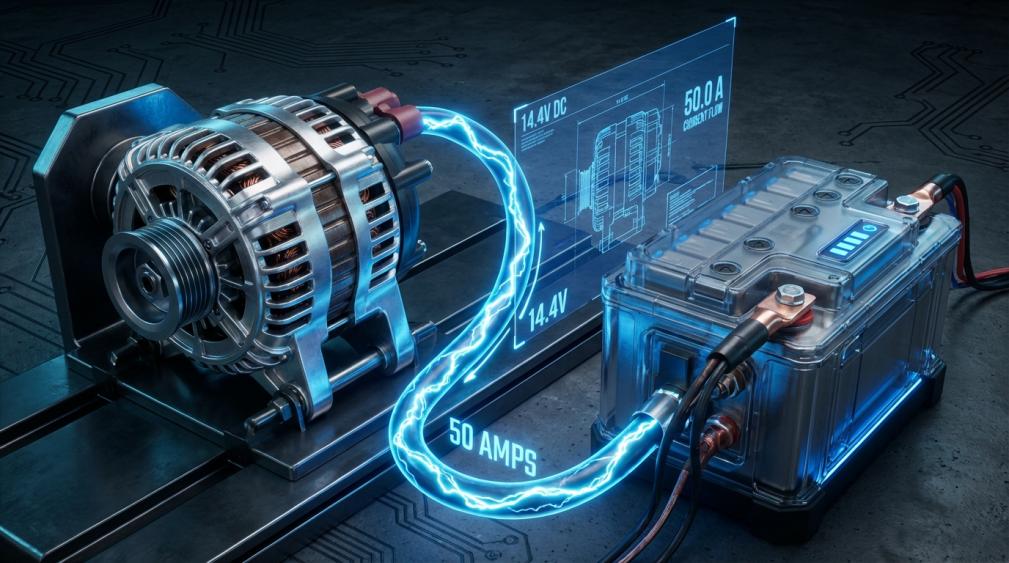
You can safely push about 50A into a lithium auxiliary battery from a single alternator when you size the battery bank correctly, use a proper DC‑DC charger, and set sane charge limits.
You know the feeling: you drive all day to camp, yet the fridge is creeping warm and the lights dim by evening even though the engine has been spinning for hours. When alternator charging is dialed in, a lithium house bank can recover a half‑drained battery bank in roughly a couple of hours of driving instead of limping along all weekend. This guide shows how to get there with one alternator, a 50A target, and a setup that protects both your batteries and your engine.
What 50A Alternator Charging Really Means
The key question is not “Is 50A too much?” but “What does 50A look like relative to my battery capacity?” Lithium iron phosphate banks can safely accept much higher charge current than sealed lead acid when paired with a charger that follows a proper constant‑current and constant‑voltage profile, and many manufacturers rate LiFePO4 for charge rates up to roughly 1C, or a charge current equal to the amp‑hour capacity of the battery bank, while still charging far faster than lead acid under the same conditions. Power‑Sonic’s LiFePO4 guidance explains that this chemistry shares the same two‑stage CC/CV pattern as SLA but can charge up to about four times faster thanks to higher permissible C‑rates.
Charge rate is often expressed as C‑rate: charging a 100Ah bank at 50A is a 0.5C charge, while charging a 200Ah bank at the same 50A is only 0.25C. Practical off‑grid systems often aim around 0.2–0.5C for long life and fast recovery, so a 50A target from your alternator is entirely reasonable for the 100–300Ah house banks common in RVs, vans, and overland rigs. One manufacturer example shows a 480Ah bank treated gently at about 0.2C, which works out to roughly 96A total charging current, underscoring that 50A is a conservative draw at typical capacities when the system is configured correctly. That example comes from a guide to lithium charging that uses C‑rate as the primary design tool and specifically highlights mobile DC‑to‑DC chargers with ratings in the 25–50A range for alternator charging while driving.

You can see that approach in Expion360’s lithium charging guide.
Why You Need a DC‑DC (Dual Battery) Charger, Not Just a Relay
The old recipe of a simple relay between starter and house battery was written for lead‑acid banks, not for lithium. Modern lithium banks want a controlled two‑stage charge with a specific voltage window and a clean shut‑off when full, while many newer vehicle alternators are smart, temperature‑managed devices designed around the starter battery’s needs, not a hungry house bank tethered at the back of the truck. A well‑designed lithium system uses a DC‑to‑DC charger between the starter and auxiliary batteries so the alternator only “sees” a controlled load and the house battery “sees” clean lithium‑appropriate charging. That pattern is the standard in modern lithium RV and off‑grid systems, where alternators sit alongside solar and AC chargers as just one of several inputs feeding a carefully managed battery bank. You can see this multi‑source, lithium‑centric view of charging in many modern lithium charging overviews.
Mobile DC‑to‑DC chargers are specifically built to draw power from a running alternator and push it into an auxiliary lithium bank at a controlled current, with typical units rated around 25–50A and the option to parallel two units when more current is justified. Many lithium charging guides note that these chargers should be mounted close to the auxiliary battery, use properly sized cabling and fusing, and always respect the alternator’s current rating so the engine’s charging system is not driven beyond its design limits. Integrated into many of these chargers is a dual‑battery function: they sense engine‑on conditions, prioritize the starter battery, and then divert surplus alternator output into the house bank while isolating the starter battery when the engine is off, the same behavior highlighted in dedicated dual‑battery charger discussions from off‑road and towing contexts.

Solar can be layered in as a second charging source tied into the same auxiliary bank. Roof‑mounted panels feeding a charge controller, or a DC‑DC unit with a dedicated solar input, allow alternator and solar to work together to maintain the aux battery, with the controller ensuring correct voltage and preventing overcharge. A concise explanation of charging solar batteries from alternator and solar sources emphasizes the importance of charge controllers and dedicated vehicle chargers rather than direct panel or alternator connections, as summarized in Bluetti’s guide to charging solar batteries.
Designing a 50A Single‑Alternator System
Choose the Right Battery Bank
At 50A, you want a lithium bank that keeps charge rate well inside its comfort zone. For a 100Ah LiFePO4 battery, 50A is about 0.5C, a solid fast‑charge rate that remains within typical specifications for lithium when temperature and voltage are held in range. For a 200Ah bank, 50A drops to 0.25C, which is very gentle and still gives fast recovery. Lithium banks are designed for thousands of cycles when charged in moderate temperature ranges and within chemistry‑appropriate voltage and current limits, and they return most of the input energy as usable capacity because their round‑trip efficiency is typically over about 95%. Those advantages are why LiFePO4 has become the default for RV, marine, and off‑grid storage in many modern systems.
Rather than babying the bank at very low C‑rates or keeping it permanently in a narrow middle state‑of‑charge window, it usually makes more sense to size the battery so your real energy use drives each overnight cycle into a practical depth of discharge and then replenish it aggressively but cleanly. Experienced off‑grid users often argue that if you paid for the capacity, you should actually use it instead of running a large battery at shallow 10–20% swings just for theoretical longevity, because that undercuts the value of the system. That perspective shows up clearly in a DIY solar forum discussion of battery longevity settings where owners balance depth of discharge, cycle life, and real‑world return on investment.
Size and Place the DC‑DC Charger
For a 50A target, select a DC‑DC or dual‑battery charger rated for roughly 40–50A output that offers a dedicated LiFePO4 profile. Universal chargers that support both sealed lead acid and lithium usually let you select the chemistry; on the lithium setting they use a higher full‑charge voltage and will turn off or reduce output once the bank is full instead of sitting at a float voltage the way they would for SLA. That behavior is important because LiFePO4 uses the same CC/CV pattern as SLA but does not want a long third float stage at full voltage, and manufacturers specifically recommend lithium‑tuned chargers or settings to avoid slowly degrading the packs over time. These differences between SLA and LiFePO4 profiles, including higher permissible charge current and the lack of a required float stage for lithium, are emphasized across detailed LiFePO4 charging guides.
Mobile DC‑to‑DC chargers are designed to be mounted close to the auxiliary battery so that the long run from the engine bay carries alternator‑level voltage into the rear of the vehicle, while the short run between charger and aux battery sees the tightly regulated lithium charging voltage and current. Detailed system‑level guides stress that these chargers should be matched to the alternator’s capabilities, wired with tight connections, and protected by appropriately rated fuses and disconnects to ensure safe operation at sustained currents in the 25–50A range. That system‑level view treats the alternator as one of several charging sources feeding a monitored, protected bank.
Wire, Fuse, and Protect for 50A
A 50A charge current is not exotic, but it is high enough that poor wiring or missing protection can turn a simple upgrade into a failure point. Heavy‑gauge cable sized for the current and run length, solid crimps or lugs, and vibration‑resistant mounting are non‑negotiable. The DC‑DC charger’s installation instructions will specify input and output fuse or breaker ratings; those over‑current devices belong as close to each battery’s positive terminal as practical so that any fault along the wire run is limited by a protective device near the energy source rather than by downstream components. Alternator‑fed systems are no different from any other high‑current battery wiring in that respect: large lead‑acid and lithium batteries can deliver enormous short‑circuit currents, so every added lead must be correctly fused close to the source, a point emphasized in automotive wiring discussions and echoed in general lithium safety literature such as Battery University’s overview of Li‑ion safety mechanisms.
The physical layout around the house battery matters too.

Lithium packs do not require the same venting and acid‑resistant containment as flooded lead‑acid, but they still benefit from clean surroundings, reasonable airflow, and protection from direct engine or exhaust heat. General solar battery maintenance advice encourages keeping the battery area free of dust and clutter and avoiding hot, enclosed spaces, since heat reduces both efficiency and lifespan over time. That broader view of battery environment and cleanliness is a common theme across battery maintenance guidance.
Dialing in Charge Settings for Speed and Longevity
Lithium charging is conceptually simple: a constant‑current bulk phase delivers most of the energy while voltage rises, followed by a constant‑voltage phase where current tapers toward zero. For LiFePO4, full‑charge voltage for a 12V bank is typically in the 14.2–14.6V range, with batteries considered full once current drops to a small fraction of capacity and the bank is allowed to relax back to a lower open‑circuit voltage. One detailed lithium charging article notes that lithium banks do not require a long float phase and that many modern chargers either stop charging when the absorption phase is complete or maintain only a light top‑off at roughly 13.4–13.6V instead of holding full voltage indefinitely. This two‑stage, low‑float pattern is standard in modern lithium charge profiles.
From a longevity standpoint, lithium does not need to reach 100% every cycle, and holding it at full voltage for long periods is actually harder on the cells than operating in a partial state of charge. A technical overview of Li‑ion chemistry points out that once the battery is full, charge current must stop because cells cannot absorb overcharge, and continuous trickle at peak voltage increases plating and thermal risk. It also notes that many devices deliberately avoid a maximum‑voltage saturation to reduce stress, and that partial charges in moderate temperature ranges are generally better for life than “always to 100%” habits. Those principles show up consistently in technical discussions of charge termination and voltage‑related aging in lithium‑ion charging.
At the same time, there is little value in designing a vehicle system so cautiously that the house battery almost never sees deep discharge or fast recharge. A practical approach is to let your energy use take the bank down into a sensible depth of discharge and then use the alternator and DC‑DC charger to recover quickly, avoiding full discharge and chronic low‑state storage rather than worrying about every short visit to full. Forum discussions on solar system longevity frequently warn that treating LiFePO4 like a delicate phone battery stuck between 30% and 80% wastes both time and money, and argue instead for using the capacity you paid for while staying within the chemistry’s safe envelope, a balance described in the DIY solar thread on system settings and ROI.
Temperature is non‑negotiable. LiFePO4 manufacturers typically specify a charging window from about 32°F up to around 113°F, with charging below freezing either prohibited or allowed only with integrated heaters or special low‑temperature designs. A LiFePO4 charging guide aimed at off‑grid users emphasizes that charging outside roughly 32–113°F can damage cells or trigger protective shutdowns, and that terminals and connections should be kept clean so resistance stays low and heat does not build unnecessarily during charging. Those recommendations are spelled out in LiFePO4Oz’s comprehensive charging guide.
Monitoring, Safety, and Alternator Stress
A lithium battery’s internal Battery Management System is your last line of defense, not your primary planning tool. The BMS is there to enforce hard limits on cell voltage, current, and temperature, and to balance cells in multi‑cell packs, which is crucial for lithium both during charging and heavy discharge. System‑level guides to lithium charging point out that the BMS works alongside the charger to maintain proper cell voltages and shut down charging if safe limits are exceeded, but they never treat it as an excuse to ignore charger settings. That partnership between BMS and external charging electronics is central to most system‑level guides to lithium charging.
To keep your alternator happy, your DC‑DC charger should present a capped, predictable load, and its rating must be chosen with the alternator’s output and real vehicle loads in mind. Guides to DC‑DC charging note that mobile chargers pulling 25–50A from the alternator must be matched to the alternator’s current rating and installed with appropriate cabling, fuses, and a disconnect switch. When that guidance is followed, the alternator is driving a load it was designed to handle, rather than being pinned at maximum output indefinitely, and the DC‑DC charger tapers current as the battery approaches full. That alternator‑friendly design is a core benefit of mobile DC‑to‑DC chargers.
A good battery monitor ties the whole system together. Voltage alone is a poor indicator of lithium state of charge while charging and under load, and simple “full/half/empty” indicators are misleading. Comprehensive maintenance guides for solar battery banks recommend amp‑hour meters or digital system monitors that measure in‑and‑out current, compute true state of charge, record history, and help you make informed decisions about both charging and consumption. That approach is common in battery maintenance guides, which treat a proper monitor as essential equipment, not a luxury.
Example: Refilling a Weekend‑Drained Bank at 50A
Consider a 200Ah LiFePO4 house bank feeding a 12V fridge, lights, and a few small loads through a weekend. By Sunday morning it sits at about 50% state of charge, roughly 100Ah down. You hit the road with a single alternator up front, a 50A DC‑DC charger near the aux battery, and the charger configured to a LiFePO4 profile with a bulk voltage around 14.4V and automatic tapering as the battery fills.
As you pull onto the highway, the alternator first tops the starter battery, then the DC‑DC charger wakes up and starts pulling close to its 50A rating. During the bulk phase, that 50A flows as a near‑constant current into the house bank, delivering roughly 50Ah per hour of driving, and thanks to the high charge acceptance and efficiency of LiFePO4, most of that current actually becomes stored energy rather than heat. Lithium charging references that compare chemistries note that LiFePO4 loses far less energy to inefficiency than lead‑acid and that the bulk phase restores the majority of capacity quickly, with absorption time shortened dramatically in comparison with sealed lead‑acid systems.
After about two hours, your 100Ah deficit is essentially gone in bulk, and the charger moves into a short absorption phase where it holds voltage and allows current to taper.

Because LiFePO4 does not require extended absorption or float, the tapering period is relatively brief, and by the time you reach the trailhead or driveway, the monitor shows a state of charge in the high nineties, ready for another night off‑grid. The alternator never had to work at its maximum output the entire time, and the charger protected both the engine’s charging system and the lithium bank from abusive voltages.
Quick FAQ
Do you need a second alternator to charge at 50A?
For typical 100–300Ah LiFePO4 house banks in RVs and overland rigs, a single healthy alternator feeding a 40–50A DC‑DC charger is usually sufficient, provided the alternator’s output and heat management are respected and the charger is correctly installed. Second alternators and smart external regulators are more common in very large systems where users want alternator‑only charge currents far beyond 50A, a configuration discussed in lithium charging overviews that treat dedicated alternators as primary charging sources for high‑demand van and marine installations.
Can you connect a lithium aux battery directly to the alternator without a DC‑DC charger?
Direct connections or simple relays are risky with lithium because alternator voltage and behavior are tuned for the starter battery and may not provide the correct charge profile or safe limits for LiFePO4, especially in vehicles with smart alternators. Modern lithium charging guides consistently recommend DC‑DC chargers or lithium‑specific charging electronics between alternator and house bank so voltage and current stay within the chemistry’s limits and charging stops or tapers correctly when full. That need for chemistry‑specific chargers is emphasized across manufacturer charger recommendations and DC‑to‑DC charger guidance.
Is 50A too hard on a lithium aux battery over time?
At realistic bank sizes, 50A is typically a moderate charge rate. For a 200Ah bank it is only 0.25C, well within the range that LiFePO4 manufacturers describe as comfortable when voltage and temperature stay in spec. Lithium charging and maintenance articles repeatedly highlight that avoiding deep discharges, extreme temperatures, and chronic over‑voltage is far more important than avoiding reasonable C‑rates, and they show that lithium banks can reach thousands of cycles when charged correctly in everyday use. That combination of high cycle life and fast, efficient charging is a recurring theme in lithium lifespan discussions and guides to extending battery life through proper charging.
A single alternator, a correctly sized DC‑DC charger, and a well‑planned lithium bank can turn every mile you drive into a controlled 50A fast‑charge session that gets you back to full power by the time the tires hit dirt again. Set the limits right, monitor the system, and your aux battery becomes a dependable, hard‑charging partner instead of a slow‑recharging bottleneck.


Leave a comment
This site is protected by hCaptcha and the hCaptcha Privacy Policy and Terms of Service apply.