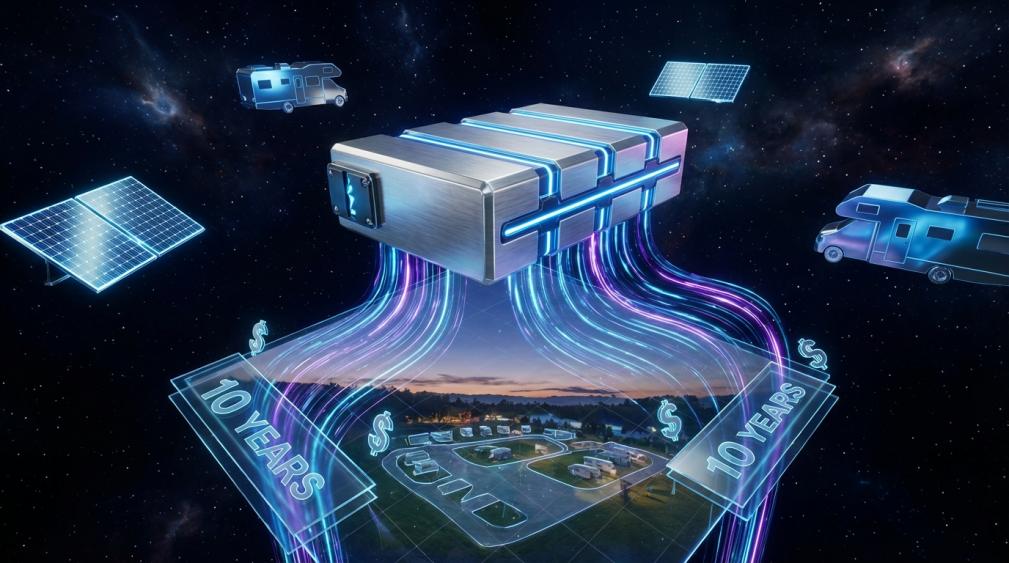

A properly sized LiFePO4 power system can turn campsite electricity from a recurring bill into a decade-long cost saver, especially if you like boondocking or primitive sites.
You pull into yet another RV park, check in for the night, and watch the total jump as soon as you add electric hookups to the reservation. After a few seasons, those extra fees add up to thousands of dollars, while campers who invested in modern battery systems quietly stretch free stays on public land for weeks at a time. This guide walks you through how to put real numbers to that difference so you can see what a LiFePO4 setup might save you in campsite fees over the next decade and what it takes to make that happen.
Why Campsite Electricity Quietly Eats Your Budget
Across the United States, nightly campsite prices range from free dispersed spots on public land to roughly 120 or more at private RV parks, according to Native Campervans and several RV cost breakdowns from Jackery and others. National and state park campgrounds often fall in the 60 range, while KOA and similar parks commonly sit around 90 per night. Electricity is either baked into those higher nightly rates or itemized on its own bill.
Some operators now meter electricity by actual usage. Wild Energy points out that smart meters charge campers only for the kilowatt‑hours they pull, which means running air conditioning, electric heaters, or hair dryers can spike your bill. SolarTech Online estimates typical RV electricity use at roughly 5–50+ kWh per day depending on rig size, weather, and camping style, and shows that heating and cooling can double or triple your usage. On a metered site, that difference shows up as a higher number on your card statement every month.
Even when electricity is a flat add‑on rather than metered, it is not trivial. Mom Goes Camping notes that powered sites or hookup add‑ons often run around 10 extra per night, and sometimes $20 or more. If you stay 30 nights a year and pay an $8 average electric premium, that is $240 per year, or $2,400 over 10 years, just for access to the pedestal. For full‑time RVers, Jackery reports that electricity alone for a small family often averages 90 per month; over a decade that is close to $10,000 in power bills before you pay for the campsite itself.

Now layer in how often you lean on hookups. SolarTech Online notes that boondockers commonly keep their usage around 5–15 kWh per day, while people plugged into 50‑amp service routinely consume several times that. The more you depend on campground power instead of your own system, the more you keep feeding that meter instead of paying off your own hardware.
What LiFePO4 Actually Does for Your Camping Costs
LiFePO4 (lithium iron phosphate) batteries are not just a trendy upgrade; they fundamentally change how far you can stretch each amp‑hour. Battle Born Batteries and Emerging Power both point out that typical lead‑acid house batteries dislike being discharged below roughly half their capacity and often last only 500–800 cycles, or about 3–5 years in real use. In contrast, LiFePO4 banks are routinely rated for around 3,500–5,000 cycles, can use most or even all of their rated capacity, and often ship with 8–10‑year warranties from brands like Battle Born, BougeRV, and many portable power station makers.
That deeper usable capacity and longer life are what unlock the savings.

Instead of hovering nervously around 50% state of charge, you can comfortably run lights, fans, the fridge, water pump, and electronics without racing back to hookups every second night. Bearfoot Theory shares a real‑world example of a van with a Lithionics lithium system that never dropped below 75% state of charge on a five‑week trip, which is exactly the kind of resilience that makes extended boondocking realistic instead of stressful.
LiFePO4 also charges faster and more efficiently than lead acid, which matters for off‑grid life. Battle Born and Emerging Power both emphasize that lithium can absorb charge quickly from solar panels, alternators, or generators. Portable solar generator systems built around LiFePO4, like the 5 kWh units discussed by Lanpwr and the 3.6 kWh systems highlighted by Jackery, can often recharge from a wall outlet in a few hours and can top up daily from rooftop or portable solar arrays. EcoFlow and CJE Group underline that pairing a solar‑compatible portable power station with panels creates a self‑sustaining loop: sunlight into the batteries by day, silent power out at night.
Upfront cost is real, but the range is wide. Mom Goes Camping notes that a capable camping power station suitable for phones, laptops, and light loads tends to start around $400. At the other end, 5 kWh LiFePO4 portable power stations commonly land in the roughly 5,000 range, according to Lanpwr’s market overview. Classic 12 V LiFePO4 house batteries with separate solar and inverters sit between those extremes depending on bank size and component quality. The key is that, unlike campsite fees, that money is spent once and then amortized over thousands of cycles.
Ten‑Year Savings: Two Realistic Camping Profiles
To see how "just an expense" turns into savings, it helps to run simple numbers. The examples below use mid‑range values pulled directly from the cost ranges reported by Mom Goes Camping, Native Campervans, Jackery, and others. Your own numbers will differ, but the pattern is what matters.
Example camper |
Nights per year needing power |
Typical electric fee per night (within 20 range) |
Ten‑year hookup cost |
Example LiFePO4 setup cost |
Potential ten‑year net gain* |
Weekend camper |
20 |
$8 |
$1,600 |
$400 entry‑level power station |
$1,200 |
Seasonal traveler |
60 |
$10 |
$6,000 |
$2,500 5 kWh LiFePO4 station |
$3,500 |
*Net gain here looks only at saved hookup fees, not at additional savings from switching some paid nights to free dispersed camping or from lower metered kWh usage.
For the weekend camper, Mom Goes Camping already did most of this math: a roughly $400 power station can pay for itself if you camp more than about 15 nights a year because you can stop paying 10 per night just for power. Over 10 years at 20 nights a year and an $8 electric charge, you avoid about $1,600 in hookup fees. Even if you never change where you camp, that is roughly triple your initial investment in a basic LiFePO4 power box that handles phones, laptops, lights, and a small fridge.
The seasonal traveler who is out 60 nights a year sees even bigger numbers.

Paying $10 per night for electricity, which sits comfortably inside the 20 range described by Mom Goes Camping and Twin Creek RV Park, adds up to $6,000 over a decade. If a solid 5 kWh LiFePO4 station costs around $2,500 at the low end of the Lanpwr range, you still come out roughly $3,500 ahead on hookups alone. Once that station and a solar kit are on board, you can start swapping some 90 full‑service RV park nights for free or nearly free dispersed sites on Bureau of Land Management or National Forest land, as highlighted by Battle Born Batteries and Native Campervans, which multiplies the savings further.
Full‑timers can add yet another layer. Jackery notes that solar generator setups can trim RV electricity expenses by up to about 40%. Using their own example monthly bill of roughly $80, 10 years of grid power at that rate is about $9,600. Cutting that by 40% purely by shifting more of your daily load onto a LiFePO4 solar generator or house bank is roughly $3,800 saved, again before counting cheaper campsites or free public‑land stays.
How to Calculate Your Own Ten‑Year Savings
Instead of guessing, you can use a simple process grounded in the same method SolarTech Online recommends for estimating RV power needs. First, decide how many nights per year you realistically expect to camp over the next decade. Be honest about growth; many people start around 10 nights and quickly push into the 20–60‑night range once they dial in their rig.
Next, separate those nights into two categories: nights where you truly need hookups and nights where you could manage with a good off‑grid setup plus water in your tanks. If you are only powering phones, laptops, lights, fans, and a 12 V fridge, a LiFePO4 bank plus solar often makes primitive or dispersed sites comfortable. High‑draw items like rooftop air conditioning and electric space heaters are the ones that may still tie you to shore power, as both SolarTech Online and Mom Goes Camping caution.
Then, attach dollars to each night. For each hookup night, use an electric fee that reflects your reality but sits within the ranges reported in the research: perhaps $8 if your park itemizes hookups, or the difference between a $40 powered site and a cheaper primitive option if that is how your campground prices things. Multiply that nightly power cost by your hookup nights per year, and then by 10. That number is your 10‑year electricity spend at campgrounds.
In parallel, tally the campsite fees you can outright avoid by moving a portion of your travel to dispersed or low‑cost primitive sites. Native Campervans, Battle Born Batteries, and others emphasize how many free or very low‑cost spots exist on Bureau of Land Management parcels, National Forest roads, and similar public lands, and they highlight tools such as Campendium, The Dyrt, iOverlander, and Free Roam that make finding these sites straightforward. If even 10 nights per year move from a $40 powered site to a free boondocking spot, that is another $4,000 saved over 10 years.
Finally, put that 10‑year savings total next to realistic LiFePO4 system costs. For some campers, a 1,000 portable power station is enough. For others, especially in larger rigs, a 3.5–5 kWh LiFePO4 station or a built‑in 12 V bank with inverter and solar, in the 5,000 range that Lanpwr and CNET describe, makes more sense. Even at the high end of those hardware costs, the combination of avoided hookups, lower metered bills, and the ability to use free public land for a portion of your year often delivers payback inside the battery’s warranty period and leaves several years of profit on top.
If numbers are not your favorite chore, the CampingElectricCalculator tool lets you drag and drop batteries, inverters, loads, and solar into a visual diagram, then checks whether your proposed system can actually cover your appliances. That gives you confidence that when you say you can skip hookups for four nights, the system underneath you is sized to deliver.

Practical Pros and Cons: LiFePO4 Versus Paid Hookups
From a cost‑optimization lens, LiFePO4 brings a long list of advantages, but it is not magic. On the positive side, you get thousands of cycles with little to no maintenance beyond keeping terminals clean, as Battle Born, BougeRV, Emerging Power, and Tennant Company all emphasize. No more checking water levels or nursing sulfated plates, and no more planning your days around long absorption charging sessions. Weight drops sharply as well; Battle Born notes that a typical 100 Ah lithium battery is roughly half the weight of an equivalent lead‑acid unit, which makes a big difference in RV cargo capacity.
You also gain quiet, flexible power. Portable stations and solar battery banks highlighted by Oupes, EcoFlow, CJE Group, and Litheli run silently and emission‑free at the campsite. That means you can chase cooler primitive sites at higher elevations, take advantage of free or low‑cost boondocking, and still keep fridges, fans, routers, and laptops humming without breaking campground generator rules or annoying neighbors. Wild Energy’s metering insights and SolarTech Online’s usage data both show that simply offloading your high‑draw appliances to your own battery can sharply reduce what the campground charges you per kWh.
The trade‑offs are real, though. Upfront cost is the obvious one; a quality LiFePO4 bank or portable station is a deliberate investment. High‑capacity units like the 3.5 kWh Mango Power E CNET tested weigh around 100 pounds, which makes it a two‑person lift despite helpful handles and wheels. Heat management matters as well. Mom Goes Camping warns that lithium batteries dislike being baked in a summer car interior where temperatures can soar far beyond 110°F, so you need a storage plan that keeps your power system in a reasonable temperature band. And finally, running everything electrically off‑grid, including air conditioning and resistance heaters, still requires a very large battery and solar array; in many cases, it is smarter to keep HVAC partly on propane and let the batteries handle everything else.
FAQ
How many years of camping does it take for LiFePO4 to pay for itself?
If your only savings come from avoiding $8 per night hookup fees on 20 nights a year, the math from Mom Goes Camping implies payback on a $400 LiFePO4 power station in about two to three seasons. At 60 nights a year and a $10 nightly power charge, the savings over 10 years reach about $6,000, which can comfortably cover even a quality 5 kWh station in the 5,000 range described by Lanpwr, with thousands of cycles still left in the battery.
Do I need solar as well, or is LiFePO4 alone enough?
LiFePO4 is the storage; you still need a way to refill it. Battle Born and Emerging Power both recommend pairing lithium banks with solar, alternator charging, or a generator. For frequent boondocking, rooftop or portable solar is the most economical long‑term choice, as BougeRV and EcoFlow stress, because once the panels are installed, sunlight is free. For occasional off‑grid weekends, alternator charging plus a modest solar panel or occasional generator use may be enough.
Can LiFePO4 really replace campground electricity for full‑time RV living?
For light and moderate loads, yes, especially when combined with good energy habits. SolarTech Online and Bearfoot Theory both show that with efficient fridges, LED lighting, smart ventilation instead of constant air conditioning, and careful appliance choices, daily consumption can stay in the 5–15 kWh range that a well‑designed LiFePO4 plus solar system can handle. You may still choose shore power in extreme heat or cold, but you will use it strategically instead of by default, which is where the long‑term savings come from.
A LiFePO4 upgrade is not just another line on the gear list; it is a lever that lets you trade recurring campsite power fees for long‑lived, flexible capacity you control. Run the 10‑year numbers for your own camping style, pick a system sized to your actual loads, and you will know exactly how many nights of quiet, independent power it takes before the expensive battery bank becomes one of the best values on your rig.
References
- https://www.rvforum.net/threads/park-manager-is-adding-a-charge-for-50-amp.876831/
- https://benandmichelle.com/the-basics-of-battery-power-for-camping
- https://battlebornbatteries.com/guide-to-free-camping/?srsltid=AfmBOopUbrhaSIeTGyzluI-9F4nY8wanwr59EtrXB3E759xv396uIVv8
- https://bearfoottheory.com/conserving-battery-power-camper-van/
- https://emergingpower.com/portable-power-how-lithium-ion-batteries-are-changing-off-grid-living/
- https://freegroup.github.io/CampingElectricCalculator/
- https://momgoescamping.com/power-stations-worth-it-camping/
- https://pknergypower.com/campsites-energy-solutions/
- https://www.twincreekstfl.com/blog/understanding-rv-park-prices-what-you-need-to-know
- https://www.bougerv.com/blogs/article/why-every-camper-needs-a-solar-battery?srsltid=AfmBOopvuhbBasu6Oq3OTWmUljvok5FyQ5rihx9MK87-z9V9f_s5bEMn