


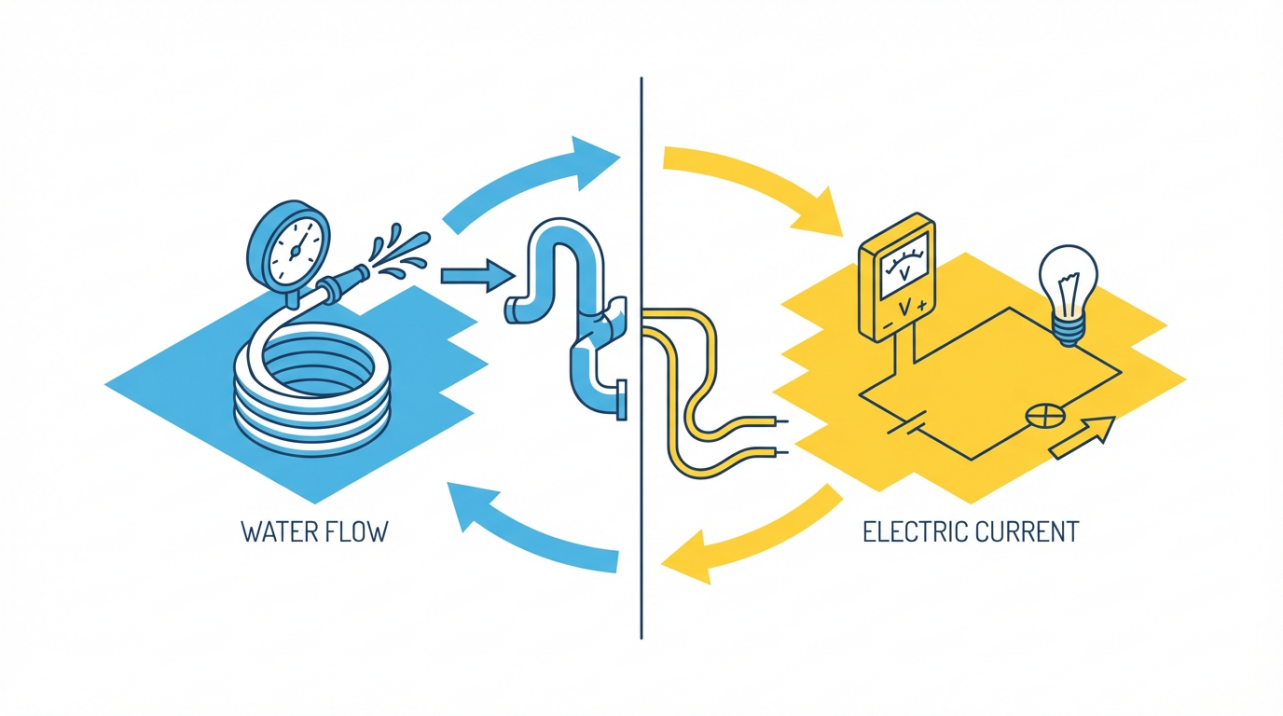
This guide explains amps and volts using a hose-and-water analogy so you can size wires, batteries, and inverters safely for off-grid and retrofit systems.
Amps are how much electricity is flowing, and volts are how hard it is being pushed. Once you see them as water flow and water pressure in a hose, choosing cable sizes, batteries, and inverters becomes far less confusing.
If you have ever stared at a breaker panel, an inverter label, or a lithium power station spec sheet while the numbers blur together—120, 240, 15, 30, 200, 2,400—one wrong assumption can leave you with tripped breakers, hot wires, or a battery bank that falls flat as soon as you start a big load. A single hose-and-water picture lets you decode amps and volts at a glance and make confident, safe upgrade decisions.
The Fast Picture: Hose, Water Flow, and Pressure
Think of your wiring as a garden hose, electrons as the water inside it, and the battery or grid as the spigot.
The water flow through the hose is your amps. It tells you how much “stuff” is moving every second. Current in amps is how much charge passes a point each second, just like how many gallons per minute pass a point in a hose.
The water pressure at the spigot is your volts. Voltage is the electrical potential energy per unit charge—the push that motivates electrons to move through the circuit—so higher pressure in the hose matches higher voltage in the wires.
The squeeze or width of the hose is your resistance, measured in ohms. A narrow, kinked hose resists water flow; in the same way, thin wires, long runs, or corroded connections resist current and waste energy as heat.
With that in mind, you can feel the core rule: for the same hose, more pressure gives more flow, and for the same pressure, a tighter hose gives less flow. That is Ohm’s law in plain language.
Amps: How Much Electricity Is Actually Flowing
Amps tell you how much electrical flow is moving through your “hose” at any moment. Current is the rate at which charge moves through a circuit, measured in amperes, with 1 amp equal to 1 coulomb of charge each second.
Back to the hose. Open the spigot just a little and you get a trickle—that is low current. Open it wide and you get a strong stream—that is high current. The pipe diameter and kinks matter, but in daily work, amperage is the number you watch for wire heating, breaker sizing, and how hard your batteries are being worked.
A practical example: a 1,500-watt appliance on a 120-volt circuit draws about 12.5 amps because power equals volts times amps. Rearranging gives amps equal watts divided by volts, so 1,500 divided by 120 is roughly 12.5. That 12.5-amp figure is what the breaker and wiring must safely carry.
The more amps you push through a given wire, the more it heats up. Abnormally high current through resistance shows up as hot spots, burned conductors, and insulation damage. That is why off-grid upgrades that pile more loads onto old wiring often fail at the lugs and breakers, not at the battery.

Volts: The Electrical Pressure Behind the Flow
Volts are the pressure pushing electrons through the hose. Voltage is electrical potential energy per unit charge, the “push” that drives current from a higher potential to a lower one.
In the hose analogy, imagine raising your water tank higher on a hill. The higher it sits, the more pressure at the spigot. That is higher voltage. Leave the hose and nozzle alone and crank up the pressure; the same hose will deliver more gallons per minute because the stronger push overcomes resistance more effectively.
The same power expressed at different voltages gives very different currents. For example, a 4,000-watt air conditioner on a 240-volt supply draws about 16.6 amps. Spread the same 4,000 watts across 120 volts instead and the current doubles to around 33.3 amps. You now need much heavier wiring and a bigger breaker for the very same power.
Higher system voltage is why serious off-grid and backup systems step up from small, low-voltage layouts: you get the same work done with fewer amps, cooler wires, and less loss.

How Amps and Volts Work Together: From Hose to Power
You now have flow (amps) and pressure (volts). Power, in watts, is how hard that jet of water can hit a water wheel and do work.
The key equation is simple: power equals volts times amps. In hose language, more pressure or more flow will spin the wheel faster. In your electrical system, more voltage or more current increases watts, which is the actual work your loads are doing.
Consider a typical home service. A 200-amp service at 240 volts can theoretically supply up to 48,000 watts, because 200 times 240 equals 48,000. For safety, good practice is to use only about 80% of that capacity, roughly 160 amps, which translates to about 32,000 watts of continuous load. That safety margin keeps wiring and equipment from running at their thermal limits all day.
Portable power stations show the same relationship. A unit rated as a 2,048-watt-hour system with 2,400 watts of output on a 120-volt circuit can provide about 20 amps of current. If you try to pull more than that, the internal protection will shut you down, just like a breaker would, even though the voltage stays at 120.
In almost every case, the tripwire for overload is amps, while voltage in a properly designed system stays roughly constant.
Comparing Amps and Volts with the Hose Analogy
Concept |
What it means electrically |
Hose analogy |
Why it matters for upgrades |
Volts |
Electrical pressure pushing charge through a circuit |
Water pressure at the spigot |
Higher volts let you move the same power with fewer amps and smaller cables, but raise safety and equipment requirements. |
Amps |
Rate of charge flow through conductors |
Gallons per minute in the hose |
Higher amps heat wires, stress breakers and connectors, and are the main limit for wiring, panels, and power electronics. |
Voltage is the push, current is the amount flowing, and resistance is the squeeze. When you design or retrofit a system, volts define your “pressure level” and standards, while amps tell you whether any particular wire run, breaker, or connector will survive.
High Volts vs High Amps: Practical Pros and Cons
For the same power, raising voltage cuts current. Reducing current for a given power level improves efficiency because resistive losses grow with current and resistance. Thicker wire, shorter runs, and tight connections all lower resistance, but raising voltage is often the most effective way to keep current manageable.
In practical terms, running a big load at a higher voltage lets you use smaller conductors and keeps lugs cooler. That is a clear advantage in long off-grid runs from an equipment shed to a tiny home or workshop.
The tradeoff is that higher voltage demands tighter discipline. Both high voltages and high currents can cause shock and burns, but higher voltage systems especially require correct insulation, clearances, and protective devices, and they must follow code more strictly.
On the other side, staying at lower voltage means more current for the same power. That can be convenient for small, short-run DC circuits, but as your loads grow, cable size and heat become the limiting factors. Increased resistance from age, corrosion, or undersized wiring drives up heat and wastes energy when current is high.
The sweet spot is to match voltage to the application and then size everything around the resulting amps. That pattern shows up in explanations of battery banks, inverter sizing examples, and panel guidance for residential services.
Safety: Why Understanding Amps vs. Volts Prevents Damage and Fires
You care about amps and volts not just for performance, but for safety. The severity of electric shock is governed mainly by current through the body, but voltage is the push that can overcome body resistance and force that current to flow. More volts make it easier for dangerous current levels to develop.
On the system side, data on home fires show that a significant share of incidents stem from electrical failures or malfunctions, often involving overloads and overheating. Those failures are almost always about too much current for the wiring, not voltage alone.
It helps to monitor resistance and current together. If voltage stays the same but current climbs, resistance is likely too low or a short is forming; if current drops and voltage stays the same, resistance has increased, often from loose or corroded connections. In both cases, Ohm’s law ties the three together, and a simple multimeter lets you check volts and amps directly and infer resistance.
For practical work on lithium retrofits and off-grid systems, that means checking three things whenever you add a serious new load: whether your panel or power station has enough amp capacity at its rated voltage, whether your branch wiring can carry the extra amps without exceeding its rating, and whether your connections stay cool under full load.
FAQ: Fast Clarifications That Unlock Better Designs
Which matters more, amps or volts, when sizing my system?
Neither stands alone. Wattage is the actual power, and watts equal volts times amps. Volts set the system level and safety rules; amps determine wire size, breaker ratings, and how hard your batteries and electronics are being pushed. Start with the watts your loads need, choose an appropriate system voltage, then calculate the resulting amps and size everything to handle them comfortably.
Why do people talk about “80% of panel capacity”?
A 200-amp panel at 240 volts can theoretically deliver 48,000 watts, but code practice and good engineering keep continuous loads at about 80% of that current, around 160 amps. That headroom allows for startup surges, uneven loading between circuits, and aging equipment. It is a practical way to prevent chronic overheating and nuisance trips, and the same mindset applies when you plan loads on inverters and portable power stations.
How does the hose analogy help with lithium and off-grid upgrades?
The hose picture turns abstract formulas into instincts. Higher volts are like higher pressure; they let you move more power through smaller “hoses.” Higher amps are like forcing more water through what you already have; it works up to a point, then the hose swells, leaks, or bursts. When you look at an inverter, breaker, or cable and see both its pressure rating (volts) and flow rating (amps), you stop guessing and start designing deliberately.
A smart power upgrade is not about chasing bigger numbers; it is about choosing the right pressure, then giving the flow a safe, low-resistance path. Once amps and volts feel as natural as water flow and pressure in a hose, you can retrofit, expand, and harden your system with confidence instead of crossing your fingers every time you flip a switch.
References
- https://en.wikipedia.org/wiki/Electric_current
- https://people.cs.pitt.edu/~wiebe/courses/CS447/Info/howVoltageCurrentResistanceRelate.html
- https://a1solarstore.com/amps-to-volts.html
- https://askfilo.com/user-question-answers-smart-solutions/what-is-the-resistance-i-11-5-v-380-r-3334373337333333
- https://battlebornbatteries.com/amps-volts-watts/
- https://resources.pcb.cadence.com/blog/2024-voltage-stability-in-power-systems-key-concepts-and-analyses
- https://dewesoft.com/blog/volts-and-currents-explained
- https://www.electronics-tutorials.ws/dccircuits/dcp_1.html
- https://expresselectricalservices.com/how-many-watts-can-a-200-amp-panel-handle/
- https://spikeelectric.com/what-is-difference-between-voltage-current/



Leave a comment
This site is protected by hCaptcha and the hCaptcha Privacy Policy and Terms of Service apply.