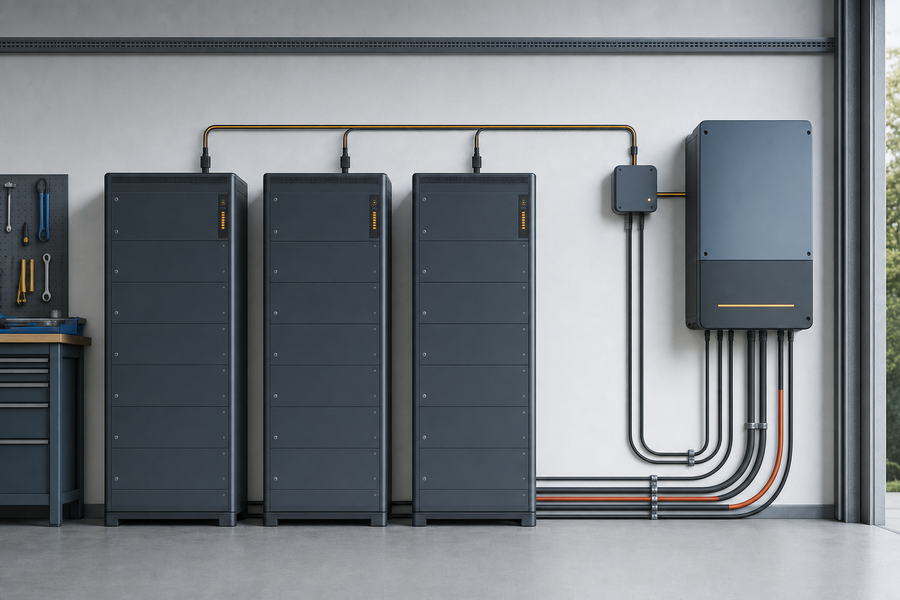

More RV owners are moving to 24V electrical systems to handle bigger inverters and solar arrays with less heat and smaller wiring, while 12V still makes sense for simpler, low‑demand rigs.
Do you ever flip on the microwave and air conditioner at the same time and watch the lights dim, fans slow down, or cables get worryingly warm? In modern rigs packed with fridges, induction cooktops, and rooftop solar, owners who move to higher‑voltage house power report cooler hardware and longer, steadier run time from the same battery space. This guide explains what is really driving the shift toward 24V setups in 2025, when it makes sense to join the trend, and when dialing in a well‑built 12V system is still the smarter move.
The Big Shift: From 12V Basics to 24V Powerhouses
For decades, 12V has been the default RV language. Most factory rigs still leave the lot with 12V house systems because nearly every core device is built around it: lights, fans, water pumps, many fridges, and all those “cigarette lighter” outlets. RV training providers and battery manufacturers consistently frame 12V as the plug‑and‑play choice for modest, weekend‑style power demands under roughly 3,000 watts of total load.
The picture changes as soon as an RV starts looking more like a tiny home. Lithium house banks, residential refrigerators, large inverters, powerful solar arrays, electric cooking, and even heat pumps are no longer exotic. Guides from Renogy, Battle Born Batteries, Redodo, EV‑focused lithium brands, and RV tech courses converge on the same point: once you push beyond about 3,000 watts of combined inverter and DC load, a 12V standard becomes bulky, hot, and expensive to wire, while 24V turns into the more efficient backbone.
In real‑world builds, that means a small Class B van with a compact fridge, a few lights and fans, a laptop, and a couple hundred watts of solar is usually happiest staying 12V.

A large fifth‑wheel with a 3,000‑watt inverter, serious roof solar, air conditioning, and electric galley gear starts to look like a natural 24V candidate.
12V vs 24V: What Actually Changes
The core math behind the trend is simple. Electrical power in watts is the product of voltage and current. Doubling system voltage from 12 to 24 means you get the same power with about half the current. Lower current is the real prize: it shrinks wire size, cuts voltage drop, reduces heat, and lets inverters and charge controllers work in a better operating range.
Manufacturers spell this out with concrete examples. Renogy and Battle Born Batteries note that a typical 50‑amp solar charge controller can handle around 700 watts of panels on a 12V bank but roughly 1,400 watts on a 24V bank, instantly doubling the array each controller can manage. FarOutRide’s van‑electrical analysis shows that a 4/0 cable, which is about as big as consumer DC wiring gets, comfortably supports around a 3,000‑watt inverter on 12V, yet the same cable can feed roughly 5,000 watts at 24V before you have to double up runs.
To see how this plays out in practice, take a roughly 2,400‑watt inverter similar to the one in Renogy’s inverter guide. At 12V, that inverter demands about 200 amps from the battery bank. At 24V, the same power draw is closer to 100 amps. In copper terms, that often means dropping from massive, hard‑to‑route cable to something a size or two smaller, with less heating and far less voltage sag when a big load like a microwave kicks in.
A quick comparison helps frame the choice.
Design question |
12V system |
24V system |
Typical sweet spot for total loads |
Up to about 3,000 W |
Roughly 3,000–6,000 W and larger inverters |
Current for a 2,400 W inverter |
About 200 A |
About 100 A |
Solar on a 50 A MPPT controller |
Around 700 W of panels |
Around 1,400 W of panels |
Parts and appliance availability |
Excellent; most RV gear is 12 V |
Growing but still thinner; many 12 V loads need a converter |
Those numbers are not marketing fluff; they come from engineering‑focused resources that all show higher voltage is about managing current, not magically creating more energy.
When 24V Really Pays Off in an RV
The first question is simple: does your rig actually live in the 24V use case, or are you being seduced by buzzwords?
Multiple independent sources converge on a similar threshold. Renogy, Battle Born Batteries, Improvecn, and Redodo recommend sticking with 12V when total continuous power demand remains under about 3,000 watts, which matches traditional RV use: lighting, fans, a water pump, and perhaps a small inverter for laptops and a TV. They suggest moving to 24V once you regularly cross that 3,000‑watt neighborhood with larger inverters, more solar, or both, and considering 48V only for truly high‑end, off‑grid‑home‑level loads well above 6,000 watts.
A practical example makes this concrete. Imagine a full‑time rig that wants a 3,000‑watt inverter to support a mid‑sized air conditioner, microwave, and outlets, plus around 1,800 watts of roof solar. On 12V, that means enormous currents, heavy 4/0 cabling at its limit, big fuses, and multiple large charge controllers. Battle Born Batteries and FarOutRide show that at 24V, the same inverter size and a larger solar array are easier to feed because current is halved and each MPPT controller can handle about twice the panel wattage.
The efficiency gain continues inside the battery bank. Goldenmate, LithiumHub, Herewin Power, and Sunrich Energy highlight that 24V systems lose less energy as heat in the cables and connections when pushing high loads or running power over longer distances. That translates into real‑world benefits like cooler wiring bundles, inverters that are not constantly near thermal limits, and a bit more usable energy out of the same watt‑hour battery capacity.
For big Class A coaches, large fifth‑wheels, or expedition rigs running air conditioning, electric cooking, big fridges, and ambitious solar, moving to 24V is less a fad and more the cleanest way to stop fighting physics.

Where 12V Still Wins in 2025
Most RVers still do not need 24V, and forcing it can waste money and add failure points.
Experienced builders on Expedition Portal, along with FarOutRide, Tracer Power, LithiumHub, EVLithium, and RVTechCourse, stress that 12V remains the best match for smaller RVs, simple van builds, and modest solar systems. Almost every DC appliance designed for RV use expects 12V. Shops, campgrounds, and fellow travelers have spares and knowledge that assume 12V. Batteries, fuse blocks, pumps, fans, and lighting are cheaper and easier to find.
For a weekend camper with a 1,000–2,000‑watt inverter, a few hundred watts of solar, and daily loads well under about 3,000 watt‑hours, a well‑designed 12V lithium bank is lighter, cleaner, and cheaper than jumping to 24V. FarOutRide’s cost analysis shows that once you add the required DC‑DC converter and sometimes more expensive 24V appliances, any cable savings from higher voltage often evaporate, especially in compact rigs with short wire runs where voltage drop is naturally low.
There is also the conversion penalty. FarOutRide, Goldenmate, Tracer Power, and Redodo all point out that most 24V systems still need to feed a lot of 12V loads through DC‑DC converters. Those devices are often around 92–95 percent efficient, which means every amp headed to classic 12V lights, fans, or refrigerators loses several percent as heat. In a small van where nearly everything is native 12V, that extra complexity rarely pays for itself.
If your rig’s wish list reads like “better batteries, clean wiring, a few solar panels, and maybe a slightly larger inverter,” the fastest upgrade in 2025 is still a solid 12V lithium bank, a smart charge controller, and careful wire sizing, not a complete voltage overhaul.
Hardware Trends Making 24V Easier Than Before
What is new in 2025 is not the physics; it is the hardware ecosystem catching up.
Lithium brands such as Redodo, Goldenmate, LithiumHub, and Weize now offer purpose‑built 24V LiFePO4 batteries alongside familiar 12V modules. Articles from these manufacturers emphasize that LiFePO4 chemistry brings higher usable depth of discharge, better resistance to overheating, and long cycle life, while 24V variants are sized for high‑demand RV, marine, and off‑grid work. Weize even highlights smart 48V lithium packs designed to drop into 24V or 48V architectures with app monitoring and integrated battery management systems.
On the inverter side, Samlex explains why 24V pure sine wave units have become the go‑to for mid‑sized off‑grid systems: they draw half the current of equivalent 12V models, run cooler, and sustain larger or more continuous loads without punishing the battery bank. Renogy’s inverter guidance echoes the same pattern, using a 2,400‑watt example to show how much more manageable current becomes at 24V.
Solar hardware is following suit. Battle Born Batteries, FarOutRide, Improvecn, Redodo, and Renogy show in their examples that stepping the battery bank up to 24V lets a given MPPT controller handle roughly double the panel wattage compared with 12V. That means fewer controllers, cleaner wiring, and better array utilization on crowded roofs.
Charging from the engine is also evolving. ARCO’s engineering notes on “true” 24V and 48V alternators warn that many so‑called 24V alternators are actually built around 12V rotors, forced to run with restricted field current. In practice, that limits output, increases heat, and creates a failure risk if a regulator misbehaves. Their field data from commercial boats and emergency vehicles shows that alternators designed from the ground up as native 24V units stay cooler, deliver more consistent output at low engine speed, and need less maintenance. For RVers relying heavily on alternator charging, pairing a genuine 24V alternator or a well‑sized DC‑DC charger with a 24V bank is a key part of a reliable upgrade path.
Put together, these trends mean that in 2025 you can assemble a 24V system with mainstream, well‑supported components instead of hunting for niche parts. That availability is a major reason the 24V conversation has moved from fringe forums into mainstream RV planning guides.
Planning Your Own Upgrade Path
If you are trying to decide whether to stay 12V, switch to 24V, or even aim at 48V, the most productive step is to sketch your future loads rather than obsessing about voltage labels.
Guides from Renogy, Redodo, Improvecn, Goldenmate, LithiumHub, Sunrich Energy, and Herewin Power recommend a similar process. Start by listing the devices you want to run, noting their wattage and approximate daily runtime. A simple example from Goldenmate takes a 100‑watt refrigerator running all day and shows it consumes about 2,400 watt‑hours. Do the same for your lights, fans, laptops, cooking appliances, and especially any air conditioning. Once you know your daily energy target and the biggest simultaneous loads, you can match that to system voltage: under about 3,000 watts total, 12V is usually fine; above that, 24V becomes a strong contender; beyond roughly 6,000 watts and full‑house loads, 48V starts to make sense.
Next, examine wire runs and physical layout. Herewin Power gives examples where high current at 12V over several yards of cable forces extremely thick, expensive wiring that can cost as much as adding another battery. If you know you will have long runs between battery bank, inverter, and rooftop solar combiner boxes, that leans the decision toward 24V or even 48V, because higher voltage sharply reduces current and voltage drop.
Then look at how your batteries will be arranged. Sources like Improvecn, Redodo, and Sunrich Energy explain that wiring two identical 12V batteries in series gives you a 24V, 100‑amp‑hour bank, while wiring them in parallel keeps 12V and doubles amp‑hours. The energy in watt‑hours is similar either way; the point of series wiring is to change how that energy flows through your system. If you already own several good 12V lithium batteries, series‑wiring pairs into 24V can be a cost‑effective bridge as long as they are the same brand, capacity, and age.
Finally, be realistic about what needs to change. Renogy, Redodo, Improvecn, Samlex, and Weize underline that a move from 12V to 24V is not just a battery swap. The inverter or inverter‑charger must match the new voltage. Solar charge controllers must be rated for 24V banks. Protection devices such as fuses, breakers, and switches need appropriate voltage and current ratings. Existing 12V loads either need dedicated DC‑DC converters from 24V to 12V or replacement with 24V‑ready appliances. Higher‑voltage lithium packs demand a robust battery management system and careful attention to installation and maintenance, as detailed in Herewin Power’s high‑voltage strategy guidance.
Stepping back, the clearest pattern across these sources is to decide on a backbone voltage once, design around it thoughtfully, and only then start writing checks for hardware.

FAQ: Common 12V to 24V Questions
Do I have to convert my entire RV to 24V to benefit?
No. Many modern rigs use a 24V backbone for the battery bank, inverter, and solar, then feed existing 12V lights, fans, and other legacy loads through a high‑quality DC‑DC converter and 12V fuse panel. FarOutRide, Tracer Power, Weize, and Redodo all point to this hybrid layout as the practical way to adopt 24V without tearing out every 12V device. The key rule is that individual circuits must be one voltage or the other; you never mix 12 and 24 on the same branch.
Is 48V better than 24V for RVs?
Sometimes, but not often. RV training articles and detailed van‑build guides generally treat 48V as a specialty option for very large, house‑like rigs with huge inverters, multiple air conditioners, and big solar arrays where currents at 24V would still be extreme. FarOutRide and RVTechCourse caution that 48V components are less common, more expensive, and trickier to integrate with standard RV hardware, and Herewin Power notes that high‑voltage systems demand even more discipline around protection and battery management. For most RVs, 24V is the sweet spot once 12V runs out of headroom.
Is 24V safe, and what about battery chemistry?
Manufacturers emphasize that 24V is still considered low‑voltage DC, but it can deliver serious current, so proper fusing, wire sizing, and installation practices matter. Lithium brands such as Goldenmate, LithiumHub, Redodo, and Weize strongly favor LiFePO4 chemistry for both 12V and 24V banks because it is more stable thermally and supports deep discharge with long cycle life. Herewin Power adds that any high‑voltage lithium pack should be paired with a robust battery management system and maintained with simple habits such as periodic connection checks and storing batteries at partial charge when idle to maximize lifespan.
Powering Forward
The real 2025 trend is not that every RV should abandon 12V; it is that owners finally have a clear, well‑supported path to 24V when their rigs outgrow the old standard. If your wish list includes big inverters, serious solar, and house‑like comfort, a properly designed 24V system can run cooler, cleaner, and more efficiently for years. If your needs are modest, a sharp 12V lithium upgrade is still the highest‑value move. Decide based on the loads you truly plan to run, then build the voltage around your travel life rather than the other way around.
References
- https://moe.stuy.edu/libweb/Y2GKhg/3S9059/2_Battery-24_Volt__Wiring-Diagram.pdf
- https://batteryfinds.com/12v-system-or-24v-system-which-is-better-for-rv/
- https://battlebornbatteries.com/12v-vs-24v/
- https://engineerswhovanlife.com/12v-vs-24v/
- https://www.evlithium.com/Blog/optimizing-rv-electrical-system-12v-vs-24v.html
- https://faroutride.com/12v-24v-48v/?srsltid=AfmBOoru8p47Ju_t-fMEc1bSX36GSkuQFQObLB9X80nd8i7ZJpYXgm0B
- https://www.improvecn.com/articles/12v-vs-24v-battery-systems-for-rvs-determining-the-optimal-voltage-for-your-needs
- https://lithiumhub.com/the-difference-between-12v-and-24v-which-is-best-for-your-needs/
- https://manlybattery.com/12v-vs-24v-trolling-motor-battery-which-is-best-for-your-boat/
- https://samlexamerica.com/why-24v-power-inverters-are-the-smarter-choice-for-off-grid-systems/