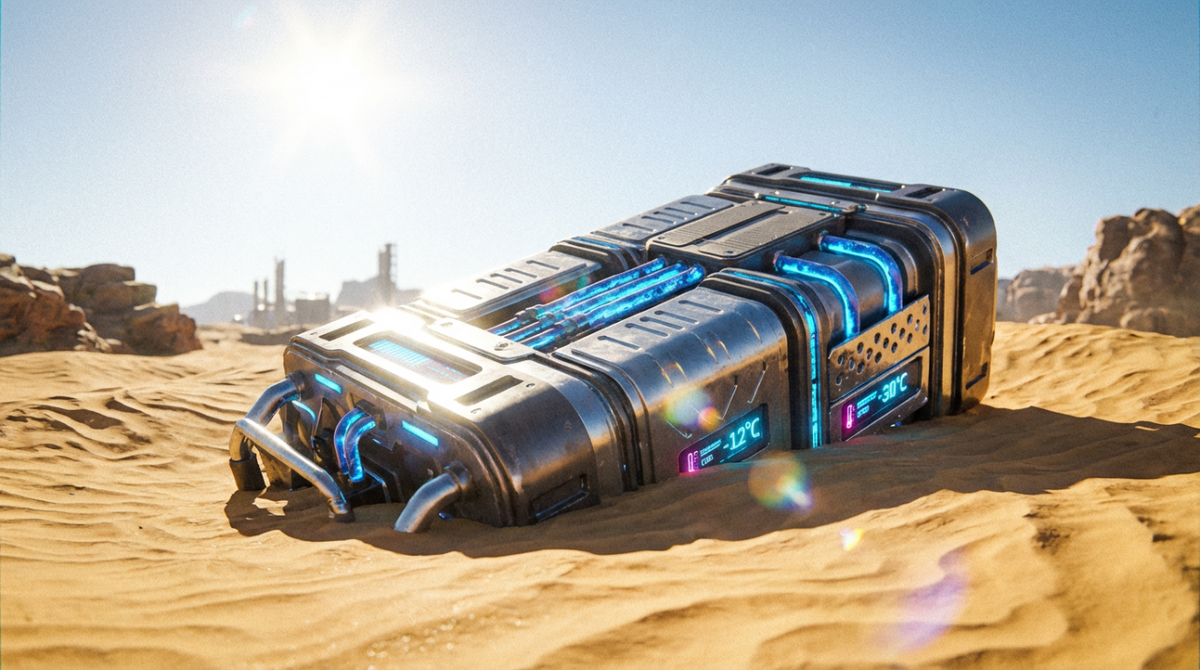

Hot sand and steep dunes are a worst-case stress test for lithium battery packs, so to keep your dune buggy or off-road EV pulling hard instead of overheating, you need targeted upgrades to cooling, airflow, and driving strategy tuned for desert heat.
Know Your Battery's Heat Limits
Lithium packs deliver their best power and life only in a tight temperature window around 70-90°F, and running much hotter accelerates chemical aging and safety risk. Once cells spend long stretches above roughly 110-120°F, you are trading away years of life for a few minutes of fun.
In a closed buggy parked on hot sand, pack temperatures can quickly climb toward the 140°F zone where lithium batteries face dangerous failure modes. That is exactly the range you see when you fast-charge hard, then hit the dunes at midday.
Note: Lab specs disagree on the exact ideal number, but for desert builds it is practical to treat 70-90°F as the sustainable target window for continuous dune runs.

Upgrade to Desert-Proof Liquid Cooling
In dune-bashing duty, basic air cooling is a dead end. One benchmark showed that air-cooling systems needed roughly 2-3 times more energy than liquid methods to hold the same average cell temperature, and still struggled with hot spots you cannot afford in deep sand.
Key liquid-cooling steps for desert EV buggies:
- Add or upgrade an indirect liquid loop with cold plates tight to the pack floor.
- Upsize radiator surface area by about 25-50% and mount it where it sees clean airflow, not buried behind bodywork.
- Run a high-flow pump and a fresh water-glycol mix, and bleed out every last air bubble before you hit the dunes.
Modern EV packs use precision microchannel plates to keep battery temperatures uniform across the whole pack.

When you retrofit older builds, borrow that playbook: thin, wide channels under the cells, short hose runs, and a dedicated loop that is not sharing coolant with motors or inverters.
Control Airflow and Shield From Hot Sand
In real desert fleets, buggy rental operators see how summer heat loosens sand, overloads cooling, and shreds hardware. Your pack is fighting not just hot air, but radiant heat from sand that can be far hotter than the breeze at hood height.
Key airflow fixes that go a long way:
- Duct cool air from high on the nose straight to the radiator, and avoid pulling from low, sand-blasted zones.
- Use coarse, easily washable mesh ahead of radiators and fans so sand does not cake the fins.
- Add a vented skid plate or heat shield beneath the pack so it sees flowing air, not a 200°F-plus frying pan of sand.
If you must mount the pack low for stability, leave at least a couple inches of clearance and avoid sealing the cavity tight. Give hot air a clear path out the back or sides.

Drive and Charge Like a Thermal Engineer
Dune bashing is a heat budget problem as much as a traction problem. On desert trips, a self-drive desert safari is usually timed for early morning or late afternoon to dodge peak heat; your EV should follow the same rulebook.
Your BMS will tell you when you are flirting with trouble. Smart thermal management in EVs keeps packs in a narrow operating band to protect performance and life, and battery thermal management is built on exactly that principle. Treat those temperature readouts as hard limits, not suggestions.
Key desert operating habits:
- Run your hardest climbs at sunrise and sunset, not noon.
- Pause any full-throttle runs when pack temperatures approach your BMS warning threshold.
- Avoid back-to-back DC fast charges in midday heat; charge longer and more gently when sand and air are hottest.
- Never leave the buggy powered on and baking on a dune crest; park in shade or at least on lower, cooler sand.
Pre-Run Checklist for Your Dune EV Build
Key pre-run checks before you sign off a desert retrofit:
- Liquid cooling loop pressure-tested, bled, and logged under load on a hot day.
- Radiator, pump, and fan sized for sustained high-load climbs, not just street cruising.
- Pack thermistors or BMS temperatures visible to the driver, with clear "back off now" thresholds agreed.
- Underbody shielding that deflects sand hits but still lets hot air escape.
- Operating plan that avoids midday full-send sessions and bans fast-charging a scorching-hot pack.
Dial in these cooling mods and habits, and your dune EV stops being a fragile science project and starts behaving like a purpose-built desert weapon that pulls hard all session long.