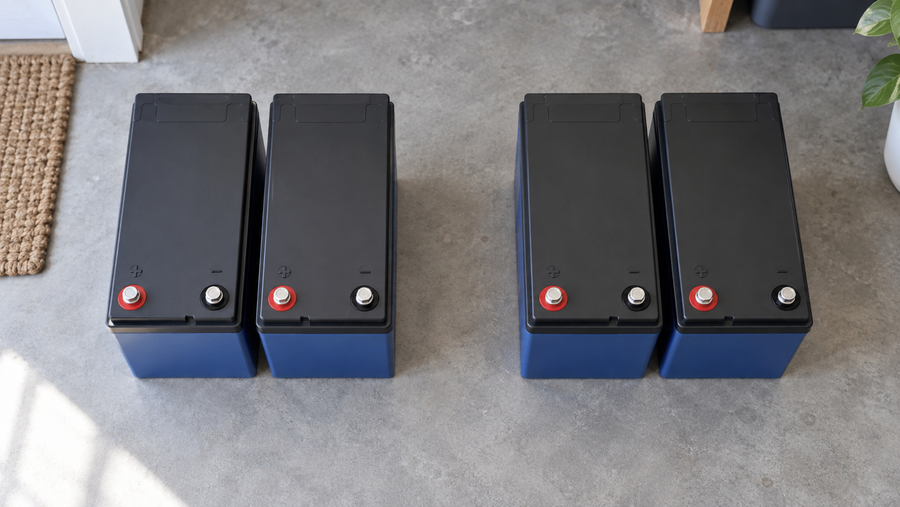

In modern tournament rigs, AGM batteries cannot keep up with the all-day draw of big graphs, forward-facing sonar, and high-thrust trolling motors, so pros are shifting to lithium for more usable energy, less weight, and faster turnaround between tournament days.
The New Power Reality in Tournament Bass Fishing
For serious competitors, lithium batteries are rapidly replacing traditional lead-acid and AGM banks as sonar screens get bigger, trolling motors get stronger, and practice days stretch 10–12 hours.
A typical pro rig now runs multiple 12–15 in. graphs, live imaging, big livewells, and a 24V or 36V trolling motor, all expecting rock-solid voltage from blast-off to weigh-in.
When you are grinding through multi-day events, any voltage sag that dims a screen or slows a trolling motor is not just an inconvenience; it is lost waypoints, missed bites, and money left on the table.

Where AGM Falls Short for Pros
AGM batteries were a big upgrade over flooded lead-acid, with spill-proof construction, better vibration resistance, and decent deep-cycle performance, and AGM marine batteries still make sense for moderate loads.
But they are heavy. Many Group 31 AGMs are around 60–70 lb, so a three-battery trolling bank can stack close to 200 lb in the stern.
They also only tolerate giving up roughly half to maybe two-thirds of their rated capacity repeatedly; push them deeper day after day and cycle life drops fast, especially in summer heat.
Charging is another bottleneck: AGMs typically take longer to recover, so after a long practice day and a late tackle session, you can wake up to banks that never quite made it back to 100%.
In tournament terms, that means shorter effective run time with each consecutive day of an event.
Lithium’s Competitive Edge: More Casts, Less Weight
Lithium (LiFePO4) flips those constraints. Compared with AGM, quality lithium packs routinely offer 2–3 times the usable energy, can safely use nearly their full rated capacity, and shed roughly half to two-thirds of the weight.
On bass boats that get upgraded, dropping three AGMs for a comparable lithium bank often cuts 120–150 lb from the transom, which sharpens hole shot, helps the boat hold plane at lower rpm, and keeps the bow from wallowing in a crosswind.
Because lithium holds higher voltage deeper into the discharge curve, graphs stay bright and trolling motors stay crisp late in the day instead of getting "mushy" during the last hour.
Then there is lifespan: where many AGMs are done after a few hard seasons of deep cycling, lithium deep-cycle packs are commonly rated into the thousands of cycles, so over eight to ten years of heavy use, the total cost per season can actually favor lithium.
How Pros Are Transitioning Off AGM
Most pros do not rip everything out at once; they redesign the system around isolated roles and redundancy.
A common pattern is keeping a robust AGM or dedicated cranking battery for the outboard, then moving trolling and electronics to lithium banks, often in a layout similar to the redundant bass boat system tournament anglers share.
In practice, that often looks like a lithium bank (24V or 36V) dedicated to the trolling motor, a separate 12V lithium battery for sonar, live imaging, pumps, and lights, and smart DC-to-DC chargers that prioritize the crank battery and then top off the lithium banks while the boat is running.
This layout not only maximizes run time, it also isolates sensitive electronics from engine starting surges and protects your ability to crank the outboard at the end of the day.

When AGM Still Has a Place
AGM is not dead; it is just mismatched to the heaviest tournament use cases.
For anglers who fish smaller lakes, run modest electronics, or only hit a few events a year, AGM batteries are cheaper upfront and integrate easily with existing chargers and alternators.
Engine manufacturers also remain more comfortable with AGM for starting in many cases, and some explicitly discourage lithium cranking batteries, so an AGM starter plus lithium house and trolling mix is still a smart, warranty-friendly compromise.
*If you are a weekend angler with modest power needs, a healthy AGM bank can still be the right call, but if you are chasing checks on big water with power-hungry electronics, lithium is quickly becoming the new minimum standard.