
A dead LiFePO4 battery should never go in the trash; it belongs in a certified lithium battery recycling or take-back stream so its materials are recovered safely instead of becoming a fire and pollution risk.
Picture the day your off-grid bank finally gives up: your inverter is screaming, the lights are pulsing, and that once-mighty LiFePO4 block is now a hundred pounds of “What do I do with this thing?” Across power sheds and garages, “dead” lithium banks quietly turn from backup assets into safety liabilities and missed recycling value. With a clear path, you can move that battery from problem to resource in one afternoon, and this guide shows where it should go, how to prepare it, and what actually happens to it next.
Why a Dead LiFePO4 Battery Is Not “Just Trash”
Used lithium-ion batteries must not go in household trash or curbside recycling, even when they seem completely discharged. When they are crushed or punctured in trucks and sorting equipment, they can spark and ignite fires that put waste workers and nearby neighborhoods at risk. The U.S. Environmental Protection Agency has found that most discarded lithium-ion batteries are likely hazardous waste because of their fire and reactivity hazards, which puts them in a different category than everyday household garbage.
LiFePO4 batteries are a subtype of lithium-ion: they trade some energy density for long cycle life and a lower tendency to ignite, but they still carry a lot of stored energy in a compact box and use flammable electrolyte. Specialized recyclers note that lithium iron phosphate batteries must be recycled and not landfilled, even though many alkaline AA or AAA batteries can legally go in the trash in most states. In other words, that “safer” chemistry does not give you permission to toss it.
From a materials perspective, throwing away lithium batteries wastes critical minerals. Lithium itself is classified as a critical material by the U.S. Department of Energy, and only about 5% of lithium-ion batteries are currently recycled. Recovering metals like lithium, iron, and copper from old packs reduces demand for new mining, cuts energy use, and lowers pollution from raw material extraction, making battery recycling one of the highest-impact choices you can make as a power-system owner.

Exactly Where to Take a Dead LiFePO4 Battery
For end-of-life LiFePO4, the right destination depends on who you are and how big the battery is, but the rule of thumb is simple: treat it as a lithium-ion battery, not as generic “junk.”
Home and Off-Grid Systems
For homeowners and off-grid users, federal guidance recommends recycling lithium batteries and battery-containing devices through certified electronics or battery recyclers, retailer take-back programs, or local solid waste and household hazardous waste programs; these options are spelled out in EPA advice on used lithium-ion batteries. Many counties run periodic hazardous waste days or maintain year-round drop-off centers that accept large-format packs used in RVs, home storage, and boats.
If your local options are unclear, national directories and locator tools help you find a drop-off point. A practical starting point is the Call2Recycle drop-off locator, which aggregates participating retailers and municipal sites across the country. Not every location accepts heavy off-grid batteries, so plan to call ahead, describe the chemistry (LiFePO4), physical size, and approximate weight, and confirm whether they can handle it safely.

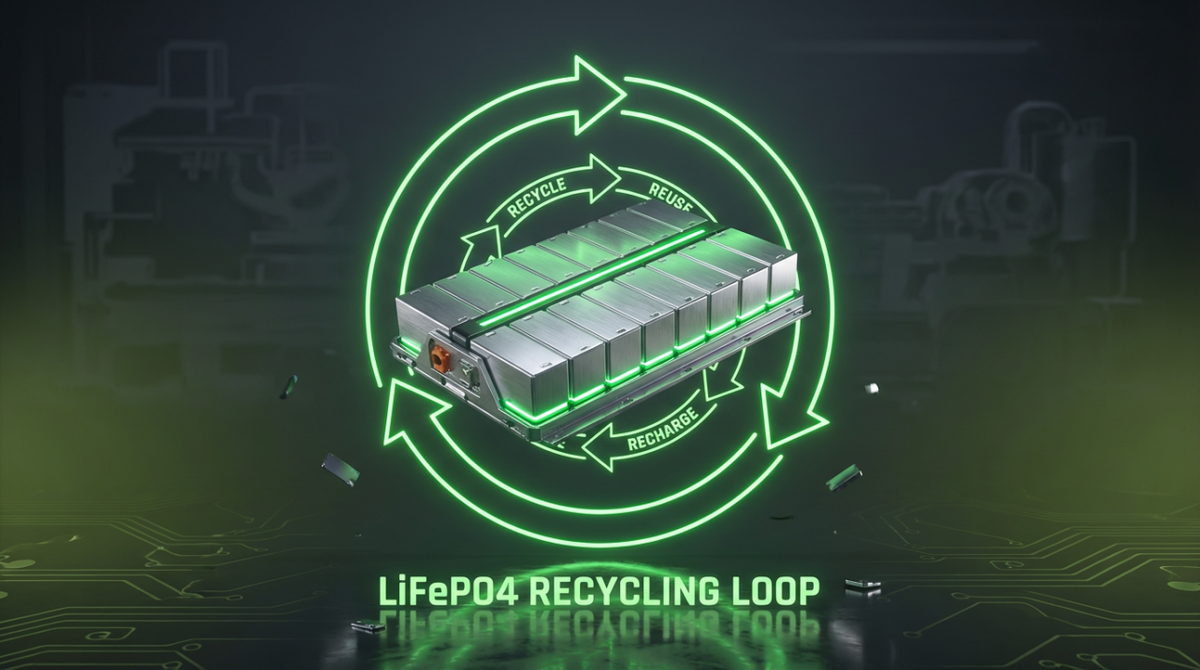
Some LiFePO4 manufacturers and storage brands now operate structured take-back or trade-in programs that turn returned batteries over to certified recyclers. Case studies of LiFePO4 take-back loops for residential storage show that these programs can recover lithium, iron, phosphate, copper, and aluminum for reuse in new batteries while building a more resilient, domestic supply of critical materials in the process, as described in a LiFePO4 recycling case study. Before you haul a heavy pack yourself, check your warranty documents and the manufacturer’s site; in many cases, arranging a take-back is the simplest move.
Installers, Fleets, and Businesses
If you are an installer, fleet owner, or business retiring LiFePO4 banks, you do not get the same regulatory leniency households enjoy. Under federal hazardous waste rules, most discarded lithium-ion batteries are considered hazardous, and EPA recommends that businesses manage them under streamlined “universal waste” standards, including labeling, accumulation time limits, and shipment to approved destinations. That means documenting what you generate, storing it correctly, and using permitted recyclers rather than informal scrap channels.
For large volumes or very heavy LiFePO4 packs, specialized recyclers can pick up on site, pack according to Department of Transportation rules, and provide certificates that the material was handled legally. Battery Recyclers of America, for example, offers nationwide pickup and packaging services for lithium iron phosphate batteries and emphasizes compliance with EPA rules and the Universal Waste Regulation in its program for LiFePO4 battery recycling. For a commercial solar-plus-storage retrofit or a mini-grid upgrade, building a relationship with one of these firms is as important as choosing the new hardware.
Public agencies are also working to standardize best practices. EPA is developing national guidance on collection systems, storage, transport, and public communication as part of its battery collection program, described in its overview of battery collection best practices. As that framework matures, you can expect clearer routes for everything from e-bike packs to large off-grid banks.
Quick Decision Guide
Here is a simple way to match your situation to a first phone call.
Situation |
Typical pack size |
Best first call |
Why it works |
Single cabin or RV LiFePO4 bank |
50–200 lb |
Designed to handle hazardous consumer materials, often at low or no cost |
|
Multiple banks from a professional retrofit |
200–2,000 lb |
Specialized lithium battery recycler |
Can provide compliant packaging, transport, and certificates |
Small LiFePO4 packs from tools or portable power stations |
Under 25 lb |
Retailer drop-off or locator-based site |
Small-format batteries are a focus of battery collection best practices and many retailers participate |
How to Make a Dead LiFePO4 Pack Safe to Move
In the field, the most dangerous mistakes with dead packs happen before they ever reach a recycler. Proper preparation protects you, your vehicle, and everyone who touches that battery downstream.
First, confirm that the battery is truly at end of life rather than tripped protection. LiFePO4 packs have robust battery management systems, and many “dead” reports turn out to be low-voltage cutoff or a blown fuse. If you are not certain, contact the manufacturer or your installer; extending a battery’s working life is one of the most effective ways to reduce waste and avoid premature disposal, a point echoed in consumer guidance on more sustainable battery use.
Once you decide the pack is done, think “prevent sparks.” Safety guidance from recyclers stresses that you should cover battery terminals with electrical tape as soon as you remove the cables. Avoid metallic tape; use electrical or other non-conductive tape, and make sure no bare metal is exposed on lugs or posts. For multi-module banks, tape each module individually rather than relying on the outer case.

EPA suggests placing each battery or battery-containing device in its own bag or non-conductive container to avoid contact between terminals, especially for transport to collection sites, as noted in its guidance on used lithium-ion batteries. In practice, that can mean setting a 12 V 100 Ah LiFePO4 block in a sturdy plastic crate with a nonflammable cushion at the bottom, then tying it down so it cannot slide in your truck. Keep it upright, away from gasoline cans, and do not stack heavy objects on top.
If the battery is swollen, leaking, smells odd, or has visible burn marks, treat it as higher risk. Store it outside your home or power shed in a place protected from rain but away from anything that could catch fire, and call the manufacturer or recycler for specific instructions. Transport rules for damaged, defective, or recalled lithium batteries are stricter, and professional guidance is worth the time.
What Recyclers Actually Do With Your LiFePO4 Battery
From the outside, it may look like your battery disappears into a warehouse, but the internal process is where the environmental benefit happens.
Most industrial recyclers start by carefully discharging, dismantling, and shredding spent batteries or devices to produce a granular mixture of anode and cathode materials known as “black mass,” along with streams of copper and aluminum foils, plastics, and steel. EPA highlights this shredding step and the resulting outputs in its overview of lithium-ion battery recycling, while process developers describe similar flows in their explanations of how lithium-ion batteries are recycled. Black mass then becomes the feedstock for metal recovery.
To recover metals, recyclers mainly use high-temperature smelting (pyrometallurgy) and solution-based hydrometallurgy. Hydrometallurgical routes dissolve metals from black mass into liquid and use solvent extraction or precipitation to separate them, achieving recovery efficiencies that can exceed about 90–95% for key metals like cobalt and nickel, according to hydrometallurgical operators who detail how lithium-ion batteries are recycled. For LiFePO4, there is less cobalt and nickel to chase, so many processes focus on extracting lithium as carbonates or phosphates and recovering iron and phosphate where economically viable, as described in technical summaries of LFP recycling methods.
Economic challenges have slowed LiFePO4 recycling because its materials are less valuable than cobalt-heavy chemistries, but that is starting to change. Researchers are developing water-based electrochemical methods that selectively recover lithium and phosphate from spent LiFePO4 cathodes, producing battery-grade lithium phosphate with modest energy input and the ability to regenerate acids, as reported in new electrochemical methods for LFP recycling. In parallel, the Battery Recycling and Water Splitting process developed at Ames National Laboratory uses only water and CO2 to recover nearly all of the lithium from graphite anodes while generating hydrogen and sequestering CO2, as outlined in its earth-friendly recycling method. Both lines of work point toward recycling flows that are cleaner and more profitable, which is critical for widespread adoption.
On the systems side, circular-economy projects are closing the loop from used batteries back into new ones. A LiFePO4 take-back and recycling program for residential storage shows how design for disassembly, standardized cell formats, and digital tracking via QR codes or RFID can cut recycling costs and feed recovered lithium carbonate directly into new cathode production, as described in a LiFePO4 take-back recycling case study. Automation specialists are also building robots that speed up disassembly, as noted in overviews of sustainable battery recycling. The practical takeaway: your “dead” pack is feedstock for an increasingly sophisticated industrial ecosystem.
Recycling also delivers measurable climate benefits. Analyses of circular battery use suggest that battery recycling can cut emissions by roughly 80% compared with producing the same materials from new mining, as highlighted in discussions of battery circularity and EV sustainability. Independent assessments also find that recycled battery metals can generate up to 80% less greenhouse gas emissions than primary mined materials when used in new cells, a figure echoed in the LiFePO4 recycling case study. Routing a single multi-kilowatt-hour bank into the recycling stream is worth far more than the few minutes it takes to tape and haul it.
Second Life or Straight to Recycling?
When you upgrade a power system, you often face a choice: repurpose the old LiFePO4 bank for lighter duty, or send it straight to the recycler. Making that call wisely squeezes the most value out of your investment while still doing right by the environment.
Large-format lithium batteries often still hold 70–80% of their original capacity when they are retired from demanding uses like electric vehicles, which makes them strong candidates for second-life roles such as stationary solar or backup power, as described in work on battery circularity and EV sustainability. Circular battery specialists emphasize that repurposed packs can support renewable energy, building backup, and industrial loads before they eventually move to final recycling, a model detailed in overviews of sustainable ways to recycle used batteries. The same logic applies to home LiFePO4 banks: a pack that can no longer carry your whole cabin overnight might be perfect for running a workshop, barn lights, or an internet router.
From a practical power-upgrade perspective, it makes sense to treat “downgrade and reuse” as a deliberate project, not an afterthought. That means measuring real capacity, ensuring the BMS is healthy, and designing a safer, lower-stress application with proper overcurrent protection. For example, a 10 kWh LiFePO4 bank that has dropped to about 75% of its original capacity can still comfortably handle a 2–3 kWh daily critical-load panel when paired with solar, giving you years of extra service before it reaches true end of life.
Once a pack is physically damaged, swollen, leaking, or has a failed BMS that cannot be economically repaired, it should skip second life and go directly into a controlled recycling stream. At that point, the safety and regulatory risks outweigh the benefit of squeezing out a few more cycles. The good news is that every path eventually converges on the same destination: properly managed recycling, where metals and minerals are recovered instead of buried.
Pros and Cons of Your End-of-Life Options
Different disposal paths have different strengths; choosing the right one keeps your project clean and your paperwork simple.
Manufacturer or installer take-back programs are usually the lowest-friction option. They bundle transport, compliance, and recycling into a single transaction, often with trade-in credits that help offset the cost of your new bank. Case studies of closed-loop LiFePO4 programs show that this route makes it easier to verify that materials truly re-enter new batteries rather than being exported or landfilled, aligning your upgrade with a circular-economy approach described in battery circularity work.
Specialized lithium battery recyclers provide maximum control and documentation, which is especially valuable for businesses. Firms offering nationwide LiFePO4 recycling services handle packaging and transport under federal rules and issue certificates documenting compliant processing, as described in LiFePO4 recycling services. The trade-off is that you need to schedule pickups and may pay fees, though high metal content and larger volumes sometimes qualify for compensation.
Municipal programs and retailer drop-offs are ideal for smaller batteries and for households without manufacturer support. EPA notes that small-format batteries, such as those under about 11 lb, are a focus area in its development of battery collection best practices, and consumer guidance highlights libraries, community centers, and stores as common collection points in many areas. The downside is that these programs may not accept large off-grid banks, and capacity can vary widely by region, so planning and confirmation calls are essential.
Informal routes, such as tossing batteries in a general scrap pile or curbside recycling bin, combine the worst of all worlds: fire risk, environmental damage, and increased hazard for workers. Environmental organizations and recycling advocates emphasize that improperly discarded batteries can leak harmful substances or explode, and that responsible recycling and proper disposal are key to making batteries more sustainable across their life cycle. For a serious power upgrade, there is simply no place for this option.
Short FAQ
Can I store a dead LiFePO4 battery in my garage until I can recycle it?
Short-term storage is acceptable if you treat the battery as hazardous and control the risks. Tape the terminals, place the pack in a sturdy non-conductive container, and keep it in a cool, dry area away from gasoline, solvents, and anything that can burn. National efforts to define battery collection best practices emphasize safe storage and transport as core elements of responsible management, so aim to move the battery into a formal collection or recycling stream within weeks rather than letting it sit indefinitely.
Is it ever legal to throw a LiFePO4 battery in the trash?
For practical purposes, assume the answer is no. Industry recyclers state plainly that LiFePO4 batteries must be recycled and not landfilled, and EPA guidance explains that lithium-ion batteries must not go in household trash. State-level rules can be even stricter. Treat every LiFePO4 pack, from a small tool battery to a full house bank, as a candidate for recycling or hazardous waste programs, not curbside pickup.
Does recycling one off-grid bank really make a difference?
Yes, and not just symbolically. Environmental analyses indicate that using recycled battery metals instead of newly mined materials can cut lifecycle greenhouse gas emissions by around 80%, a reduction cited in discussions of battery circularity and echoed in case studies where recycled metals generate up to 80% less emissions than primary mining, as noted in the LiFePO4 recycling case study. Add in fire prevention, reduced landfill pollution, and improved supply security for lithium and other critical minerals, and each bank you route into the recycling stream becomes a high-impact part of your overall power upgrade.
Conclusion
A LiFePO4 battery that can no longer carry your loads is not a dead end; it is a concentrated block of critical materials and stored environmental effort waiting for one last smart decision. If you choose a proper collection route, prepare the pack safely, and design your system upgrades with second life and recyclability in mind, you turn an awkward disposal problem into a clean, confident step in your off-grid evolution.