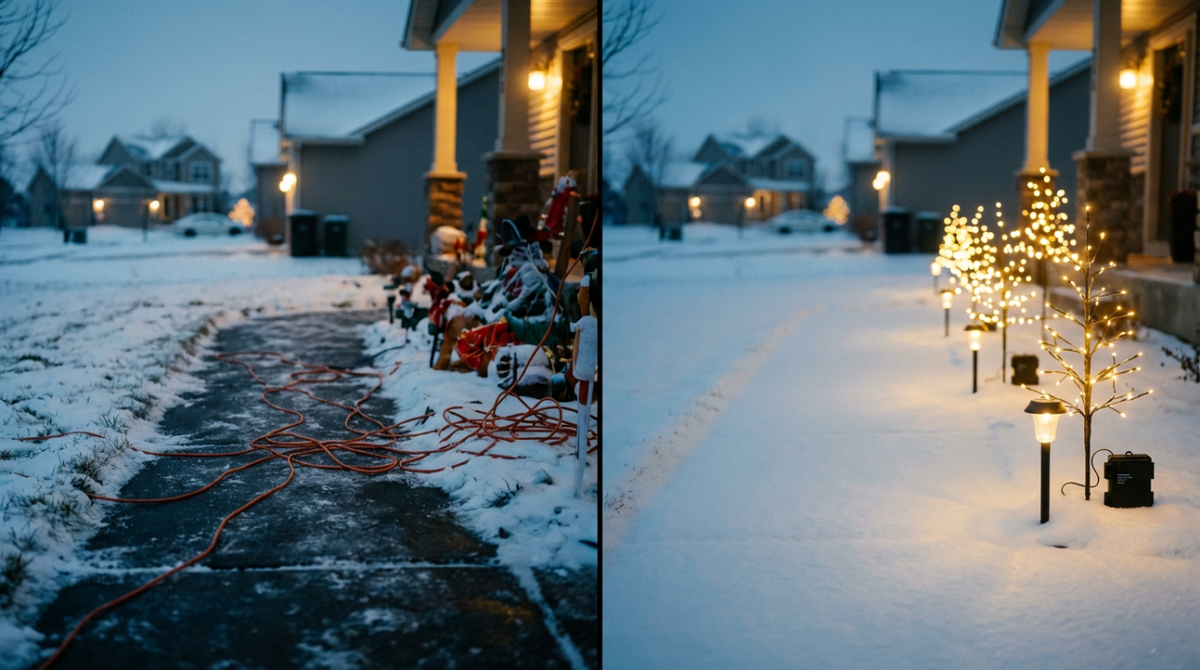

Using independent battery power for your Christmas lights keeps cords off walkways, cutting trip, shock, and overload risks while still giving you a bright, festive yard.
The Hidden Hazards of Cord-Heavy Christmas Displays
Holiday decorating injuries send about 160 people per day to emergency rooms, and a big share of those injuries are falls around cluttered yards and steps.
Every cord you snake across a sidewalk, driveway, or porch edge is a trip point waiting for cold boots, excited kids, and visitors carrying packages.
Add wet grass, snow, or ice and those cords are not just trip hazards; they’re also potential shock paths if insulation is pinched, cut, or waterlogged.
That’s the wiring model your neighbors are using when they “just run another cord from the garage.”
Why Batteries Beat Long Cords for Safety
As a power-upgrade specialist, I treat your yard like a small off-grid site: power where it’s needed, not dragged through where people walk.
Battery-powered micro-systems let you drop a sealed lithium pack (or portable power station) beside a tree, archway, or yard display, then run short, low-voltage leads that never cross a walkway.
Eliminating cords across paths directly reduces trips and falls in the same way that thoughtful pathway lighting reduces missed steps and stumbles.
Independent battery packs also remove a lot of shock and fire risk: no overloaded exterior circuits, no questionable adapters in damp outlets, and no daisy-chained cords lying in puddles.
With modern LiFePO₄-based power stations, you get stable output, thousands of cycles, and much cooler-running, safer electronics than the old car-battery-in-a-tub approach.

Designing a Cord-Free (or Cord-Lite) Holiday Layout
Start with a quick layout walk after dark and mark three zones: paths and steps, main displays, and “don’t touch” areas like kids’ play routes and driveway turns.
Your design rule is simple: no power or signal wiring crossing people’s natural walking lines.
A practical sequence:
- Map where people walk first, then place décor outside those lanes.
- Assign one battery pack per cluster (front trees, porch rail, yard figures).
- Use short, low-voltage leads secured to structures, not laid on the ground.
- Add stake or step lights to clearly define edges and elevation changes.
You end up with a clean display that also works as safety lighting, guiding guests just like well-designed landscape fixtures improve navigation and security for everyday use.

Smart Power Choices: LEDs, Timers, and Runtime Math
The key is pairing batteries with efficient LEDs and smart controls.
LED holiday strings use around 75–80% less power than old incandescents, so a modest 300 Wh portable lithium pack can run roughly 50 W of LEDs for about 6 hours—ideal for an evening window of “on” time.
Timers or smart plugs cut runtime further: if your lights run from 5:30 PM to 10:00 PM instead of all night, you can downsize your battery or stretch it comfortably through the whole season.
Choose warm-white, outdoor-rated LEDs so your safety lighting also looks inviting; well-lit homes deter intruders and reduce accidents while keeping energy use low.
If you do need a few conventional cords for rooflines or large trees, keep them at the perimeter, use outdoor-rated gear on GFCI-protected outlets, and never route them where a boot, stroller, or wheelchair should roll.
Let your neighbors keep wrestling tangles of cords and trip hazards—your independent, battery-backed display will be brighter, safer, and engineered to perform all season long.