
The available authoritative evidence does not establish one universal consumer rest period for checking LiFePO4 open-circuit voltage. For repeatable comparisons, you can choose 60 minutes after disconnecting charging and loads, then use that same interval for every check. Treat 60 minutes as a standardized comparison interval, not as a proven LiFePO4 optimum, minimum, or full-equilibration point.
Check voltage consistently

- Disconnect charging and loads. Open-circuit voltage is measured without a charger or load connected to the battery.
- Use a 60-minute comparison interval. Start timing after disconnecting the battery. The USABC Electric Vehicle Test Manual specifies a rest of no less than 60 minutes after charging and discharging before characterization and reference tests, allowing voltage and temperature to stabilize. Using 60 minutes for routine comparisons borrows that test convention; the manual does not establish it as a universal consumer requirement.
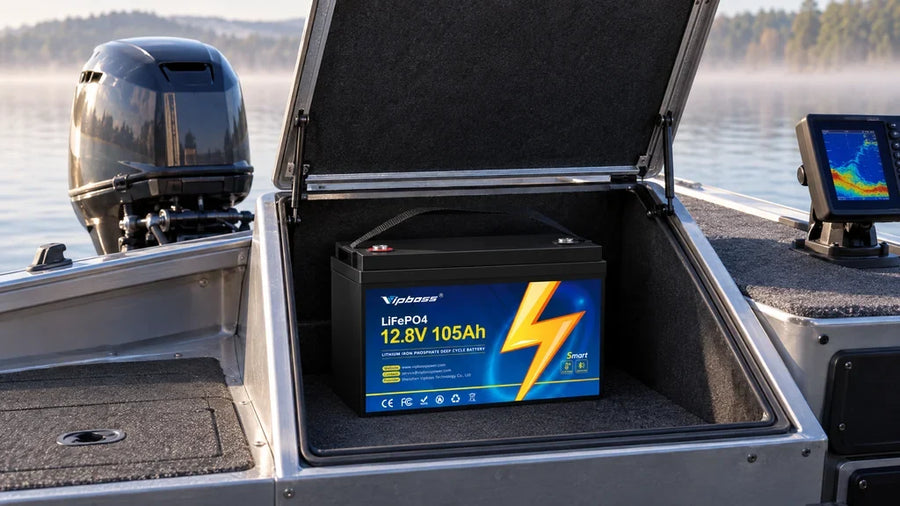
- Measure at the battery terminals. Record the voltage, elapsed rest time, and whether charging or discharging came first. If you use the Vipboss 12V 105Ah Bluetooth LiFePO4 battery, record its Bluetooth-monitored battery status at that same 60-minute point and keep the timing identical in later comparisons.
- Keep comparison conditions consistent. Use the same rest interval and the same prior charge-or-discharge condition when comparing readings.
Longer-rest readings may differ
A study of repurposed LiFePO4 cells used one-hour rests between charge and discharge processes and recorded post-charge open-circuit voltage at 5 minutes, 1 hour, and 24 hours. These separate observation times show why a 60-minute reading and a later-rest reading should not be assumed to be interchangeable; they may differ. The study does not identify one of those intervals as the universal equilibration time for every LiFePO4 battery.
Use 60 minutes when you need a practical, repeatable comparison protocol. If your goal is to identify full equilibration, the available evidence does not provide one waiting period that applies to every LiFePO4 battery.
FAQs
Is 60 minutes a universal LiFePO4 battery rest time?
No. It is a repeatable comparison interval borrowed from a battery-testing convention, not a proven universal optimum, minimum, or full-equilibration time for every LiFePO4 battery.
Can a LiFePO4 voltage reading change after a 60-minute rest?
Yes. The cited study recorded post-charge open-circuit voltage at 5 minutes, 1 hour, and 24 hours, so a 60-minute reading and a later reading should not be assumed to be interchangeable.
What conditions should remain consistent when comparing rested voltage readings?
Use the same rest interval, disconnect charging and loads, measure at the same point, and record whether charging or discharging came immediately before the rest period.