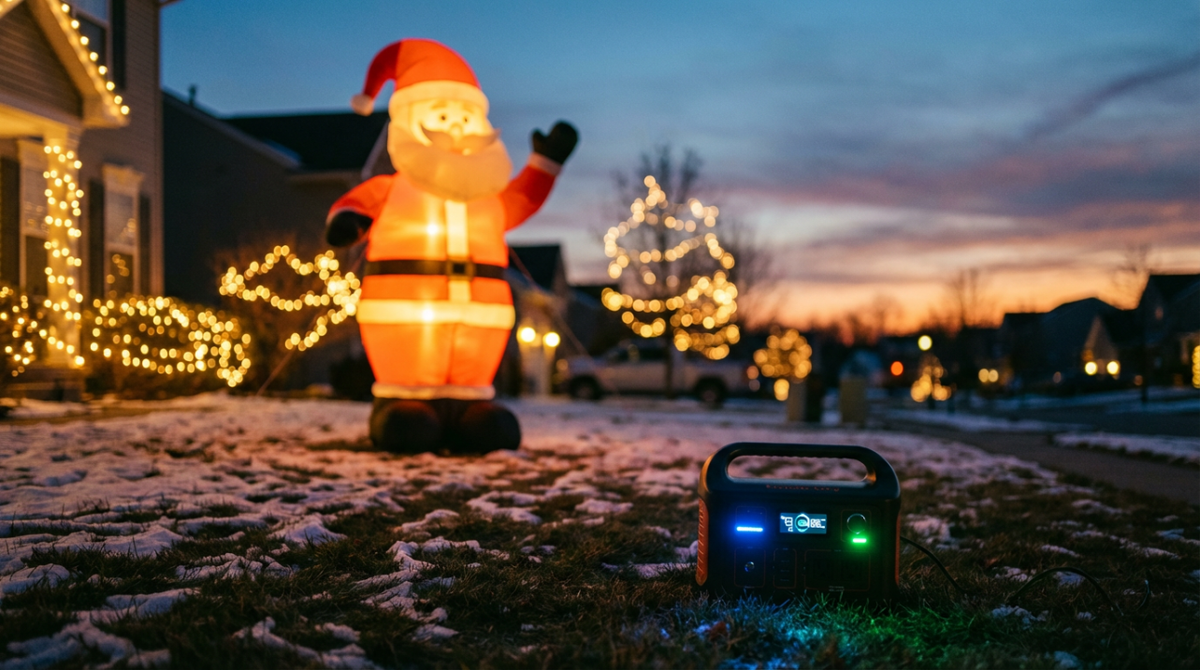

Most inflatable Santas use surprisingly little power, and a simple runtime calculation lets you match your portable battery box to the exact hours you want the display glowing.
You plug in your inflatable Santa, the yard looks magical for a while, and then either the breaker trips or your portable power station quietly dies before bedtime. After testing many holiday displays, a consistent pattern appears: the inflatables themselves usually draw far less power than people fear; the real problem is guessing instead of measuring and planning. This guide explains how to check what your Santa really uses, estimate the cost, and calculate how long a given battery box will keep it standing tall and lit. The same amp-hour runtime calculations used for outdoor pest control devices apply directly to holiday decorations.
Why Inflatable Santa Feels Like a Power Hog
Holiday bills jump because you stack several new loads on the same circuits: strings of lights, inflatables, extra cooking, and sometimes electric fireplaces and heaters. Energy advisors repeatedly flag decorative lighting and big yard pieces as key contributors to those higher bills, especially when they run all evening and late into the night, so the feeling that "Santa is expensive" makes intuitive sense.
The reality is more nuanced. Utility and efficiency programs show that switching from old incandescent strings to LED holiday lights can cut lighting energy by about three quarters while still giving a bright display, because residential LEDs use at least 75% less energy and last much longer than filament-based bulbs. That reduction frees up capacity and budget for a few inflatables without blowing up the bill when you manage them with timers and smart plugs, as recommended in holiday tips from ComEd's guidance on energy‑efficient decorations and lighting controls for seasonal displays.
Inflatable Santa becomes a problem when you treat it like a mystery load. If you do not know its wattage, do not spread devices across circuits, and do not consider how many hours you actually need it running, then any power source—outlet, generator, or battery box—will feel unreliable and either oversized or undersized in random ways.
Step 1: Find Santa's Real Power Draw
The crucial number for runtime is watts. Every inflatable fan has a label or nameplate that lists either watts directly, or volts and amps. Event suppliers note that small to medium commercial inflatables typically consume around 1,000 to 1,500 watts, while large units can pull 1,500 to 2,000 watts or more on standard 115‑volt circuits that are usually limited to about 15 amps, which is around 1,800 watts of safe load on a typical household circuit for multiple inflatables.
A typical residential lawn Santa is much smaller than a commercial bounce house, so its fan is nearer the low end of that spectrum. Many yard inflatables fall in the 100 to 250 watt range, and broader outdoor data on Christmas decorations places large inflatables around 100 to 200 watts, with a common example of 150 watts running a few hours per evening through the season and using only a few dozen kilowatt‑hours over an entire month. That is more like running a bright floor lamp than operating a space heater all night.
If the label only lists volts and amps, multiply those numbers to approximate watts. Once you have that wattage, you can stop guessing and start doing precise runtime planning.
Continuous‑Air vs. Sealed‑Air Santa
Most inflatable Santas are continuous‑air designs: a blower fan runs nonstop to keep the fabric inflated and to recover quickly from gusts of wind or kids bumping into it. Commercial vendors describe these continuous‑air units with blowers in the few hundred watt range for smaller pieces and higher for large arches or bounce structures, and they are ideal when the display must shrug off constant interaction and remain crisp.
Sealed‑air inflatables work differently. They are inflated once, then sealed, so there is no ongoing fan draw; manufacturers point out that their only electrical cost is the brief inflation period, where even large arches inflated for 20 to 30 minutes use only a fraction of a kilowatt‑hour. For multi‑day or remote displays, sealed‑air designs can be dramatically easier on any off‑grid power system because they free up the portable battery for lighting or sound once inflation is done.
Knowing which type you have is important.

A continuous‑air Santa has a steady, predictable power draw that you must plan for hour by hour. A sealed‑air Santa barely touches your battery after setup, so the runtime math is much simpler.
Step 2: Turn Watts Into Energy Use and Cost
Watts tell you how "heavy" the load is at any moment; energy and cost depend on how long you run it. Inflatable manufacturers and event suppliers explain this using kilowatts (kW) and kilowatt‑hours (kWh): divide watts by 1,000 to get kilowatts, and remember that 1 kilowatt running for 1 hour uses 1 kilowatt‑hour. Landmark Creations shows, for instance, that a small internal blower system uses about 0.336 kWh per hour, while a larger external blower system can consume around 1.32 kWh per hour of continuous operation.
That same source translates inflatables into dollars at a representative electricity rate of $0.12 per kWh. An average 8‑foot inflatable at 0.336 kWh per hour costs roughly $0.04 per hour, or about $0.97 for a 24‑hour day, while a 20‑foot inflatable at 1.32 kWh per hour costs about $0.16 per hour and around $3.80 for a full day of nonstop operation. Example calculations with a 250‑watt blower show similar results: continuous operation for 24 hours uses about 6 kWh and costs roughly a dollar at current average U.S. prices, reinforcing the idea that even large visual inflatables are modest energy users compared with heating appliances.
Here is a simple way to picture different wattages of inflatable Santa at a typical grid rate of $0.12 per kWh.
Inflatable blower size |
Approximate watts |
Energy per hour (kWh) |
Cost per hour at $0.12/kWh |
Small yard Santa |
100 |
0.10 |
$0.01 |
Medium yard Santa |
150 |
0.15 |
$0.02 |
Large yard Santa or arch |
250 |
0.25 |
$0.03 |
Commercial bounce unit |
1,000 |
1.00 |
$0.12 |
The "too much power" feeling usually comes from hours, not watts. A Santa that costs two or three cents per hour becomes noticeable only if it runs from late afternoon until early morning every single day of the season. That is where timers and smarter scheduling do more good than trying to eliminate the inflatable entirely, an approach echoed by efficiency programs that emphasize limiting run time for decorations to control holiday energy use.
Step 3: The Simple Runtime Formula for Your Portable Battery Box
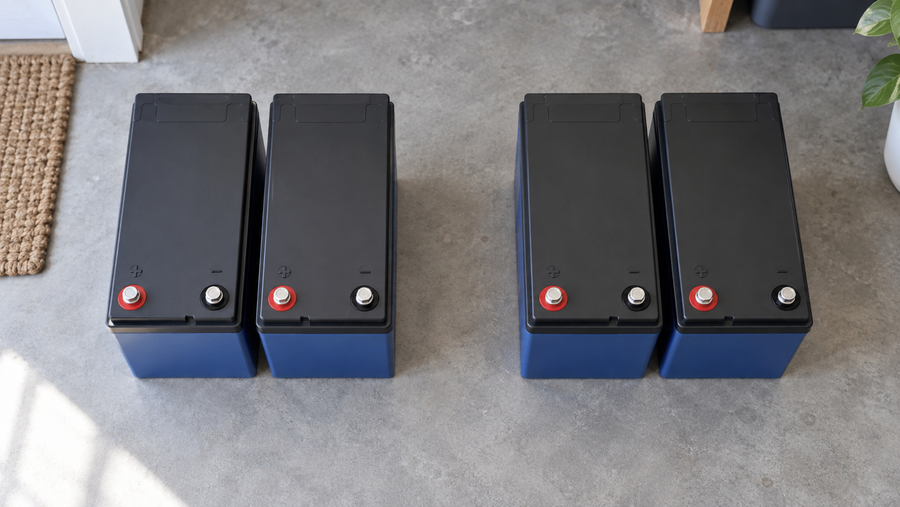
Portable battery boxes and power stations are usually rated in watt‑hours (Wh). This is just stored energy: 1,000 Wh equals 1 kWh. To estimate how long they can run your inflatable Santa, use this straightforward formula:
Runtime in hours ≈ battery capacity in watt‑hours ÷ Santa's watts.
Suppose your portable power station is labeled 1,000 Wh and your Santa's blower is 150 watts. Divide 1,000 by 150 and you get about 6.7 hours of theoretical runtime. A 500 Wh unit with the same 150‑watt Santa works out to roughly 3.3 hours, enough for a focused evening window. If you step up to a 2,000 Wh‑class power station, that same 150‑watt Santa could run for around 13 hours on paper.
Real‑world runtimes are always a bit shorter than the raw math. Portable power stations lose some energy inside their inverters, and cold weather modestly reduces effective battery capacity. Manufacturers of high‑capacity units designed for inflatables, such as EcoFlow's DELTA 3 Max line, highlight that having over 2 kWh of usable energy is enough to power fans at full output through the coldest part of the night; they specifically recommend running inflatables from around 2:00 AM to 7:00 AM to keep fabric from freezing flat on the ground during winter nights with long‑duration portable power.
If you want to be conservative, plan on using only 70 to 80 percent of your station's labeled watt‑hours in your runtime calculation. For a 1,000 Wh battery and a 150‑watt Santa, that would give you a planning number closer to 5 hours instead of 6.7, building in a margin for cold weather and inverter losses while still using the same simple math.
Example Runtime Scenarios
Imagine three common setups for inflatable Santa on a battery box.
In the first scenario, you have a compact 500 Wh power station and a modest 100‑watt Santa. On paper that gives 5 hours, which is comfortably enough to run from dinner until bedtime. If you instead power a 250‑watt Santa from the same 500 Wh box, your calculated runtime drops to about 2 hours, which will feel too short unless you only switch it on when visitors arrive.
In the second scenario, a 1,000 Wh battery box drives a 150‑watt Santa. Here your rough runtime is nearly 7 hours, which pairs nicely with a timer window from early evening until just after most neighborhood traffic dies down. In field use, that combination tends to feel "set and forget," leaving margin for a few extra loads like a string of LED lights without major drama.
In the third scenario, a high‑capacity station with around 2,000 Wh powers a large 250‑watt Santa and a few LED strings. Even if the total continuous draw is 300 watts, the math still offers more than 6 hours of runtime, enough to run the display through the evening and into the coldest pre‑dawn hours, an approach aligned with the strategy of keeping fans on during the chilly part of the night to prevent icing while still relying on portable power to hold inflatables upright.
Step 4: Stretch Runtime with Smart Scheduling and Controls
Once you understand your Santa's wattage and your battery's watt‑hours, the biggest remaining lever is operating hours. Efficiency programs that target holiday decorating consistently emphasize timers, photosensors, and smart plugs as the easiest way to cut wasted run time without sacrificing ambiance through smart holiday lighting controls.
A simple mechanical or digital timer can turn your Santa and associated lights on at dusk and off a few hours later, matching the window when your street actually has visitors. This mirrors advice that lights and inflatables should not stay on all night; energy specialists note that turning decorations off during late‑night hours both reduces energy use and improves safety, since overheating risks accumulate when equipment runs unattended for too long.
If your portable battery box supports smart plugs or app‑based control, you can go further. You might run Santa at full power during the early evening, then switch to lights‑only later, or stagger different inflatables across nights so each gets a share of the runtime budget without needing a much larger battery. SmarterHouse and similar guides also point out that turning off some indoor ambient lighting while displays are on and using reflective decorations like tinsel and mirrors amplifies the visual punch of your existing lights instead of adding more load.
The same logic that keeps grid bills in check makes a portable battery feel much bigger.

If you trim unnecessary hours and avoid overnight operation, your calculated runtime stops being a hard limit you crash into and instead becomes a budget you spend deliberately.
Safety and Cord Management When Running Santa Off‑Grid
Powering Santa from a portable battery does not remove the need for good cord practices. Blower manufacturers and inflatable rental companies warn that the wrong extension cord can cause voltage drop, blower failures, and even fire hazards; they strongly recommend short, thick, heavy‑duty cords with 12‑gauge wire or better for high‑amp inflatable blowers using extension cords designed for inflatables.
That advice applies whether the cord plugs into a wall outlet or into your portable power station. Using one continuous outdoor‑rated cord instead of daisy‑chaining several shorter ones reduces voltage drop and connection points that can overheat. Regular inspection before each use for damage, melted plug tips, or exposed conductors is essential, and any suspect cord should be retired immediately instead of repurposed.
Safety organizations and utilities also stress that all outdoor electrical connections should be kept off the ground and protected from moisture. When plugging lights and inflatables into outlets, including those on a battery box, connections should hang downward and be sheltered from rain and snow, and whenever possible plugged into ground‑fault circuit interrupter (GFCI) outlets to mitigate shock risk following holiday lighting safety practices. Avoid running cords under rugs or through doorways where they can be stepped on or pinched, and treat your portable station as a live power source that deserves the same respect as the main panel.
Finally, do not forget the upstream limits when you recharge the battery box from a household circuit. Event planners advise keeping each 15‑amp circuit below about 1,800 watts of combined load and spreading multiple inflatables across separate circuits to avoid nuisance breaker trips and sudden outages during an event. The same principle applies when your charger and other gear share a garage or porch outlet.
Portable Battery vs. Wall Power for Inflatable Santa
Choosing between a portable battery box and a standard outlet is ultimately a design decision, not a moral one. Grid power is still cheap per kilowatt‑hour in most areas, and the operating cost of a typical Santa is modest whether it is on a wall outlet or a battery charged from that same grid. The portable battery earns its keep in flexibility and resilience, not necessarily in raw energy savings.
A battery box shines when the best visual location for Santa is far from the house, when outlets are already at or near capacity, or when you want the display to stay up even during short grid outages. Event guidance recommends generators when inflatables are more than about 50 feet from power or when outlets are unavailable; a modern battery station can play the same role but with no fumes and far less noise. For remote cabins or off‑grid front yards, sealed‑air Santas that only need power briefly for inflation pair well with portable stations because they leave most of the battery budget available for lights, music, and other loads once the blower is off.
Wall power, on the other hand, is simple and effectively unlimited when circuits are laid out well. If your Santa is close to a porch outlet and you are not short on capacity, a heavy‑duty outdoor cord and a good timer may be all you need. Upgrading older incandescent light strings to modern LED versions and using scheduling controls on holiday lighting can reduce the overall load enough that adding a Santa barely moves the needle, which can be more cost‑effective than buying a larger battery just for seasonal decor.
Framing the choice this way helps avoid over‑specifying the off‑grid system. Instead of assuming Santa is "too much," you can see whether grid circuits, a modest battery, or some combination of both provide the safest and most reliable power for the display hours you actually care about.
Quick FAQ
How do I know if my battery box is big enough for multiple inflatables?
Add up the wattage of all inflatable blowers you plan to run at the same time, then divide your battery's watt‑hours by that total wattage to estimate shared runtime. Remember that commercial guidance for household circuits recommends keeping combined loads under about 1,800 watts on a 15‑amp breaker, and the same awareness applies to a battery's inverter capacity; if your inflatables total 1,200 watts but the inverter is only rated for 1,000 watts, you need to reduce the number of units or step up to a higher‑capacity station.
Is it safe to leave inflatable Santa running all night on a portable battery?
Safety hinges on the quality of your equipment and installation more than the power source itself. Use outdoor‑rated, heavy‑gauge cords sized for the blower's current, keep all connections dry and off the ground, and follow manufacturer limits on continuous run time for both the fan and the power station, mirroring the use of timers and shutoffs that utilities recommend for holiday lighting to cut risk and energy waste. From a battery‑life perspective, it is usually smarter to concentrate run time into the hours when people actually see the display rather than burning through the entire charge overnight.
Why does my inflatable sag even though the battery still shows charge left?
Inflatables need stable voltage and adequate airflow. Long, undersized extension cords can cause voltage drop that weakens the blower, which is why inflatable specialists emphasize short, thick, 12‑gauge cords and avoiding chained cords to prevent blower issues. As a battery discharges, its inverter may also struggle with surge demands, so keeping the total load well below the inverter's maximum rating and using appropriate cords often restores a firm, upright Santa even when the battery is only partly full.
A well‑planned inflatable Santa setup does not bully your power system; it works with it. Measure the watts, match them to your watt‑hours, tighten up scheduling and cord safety, and your portable battery box will stop feeling like a weak link and start behaving like the quiet, dependable heart of your holiday upgrade.