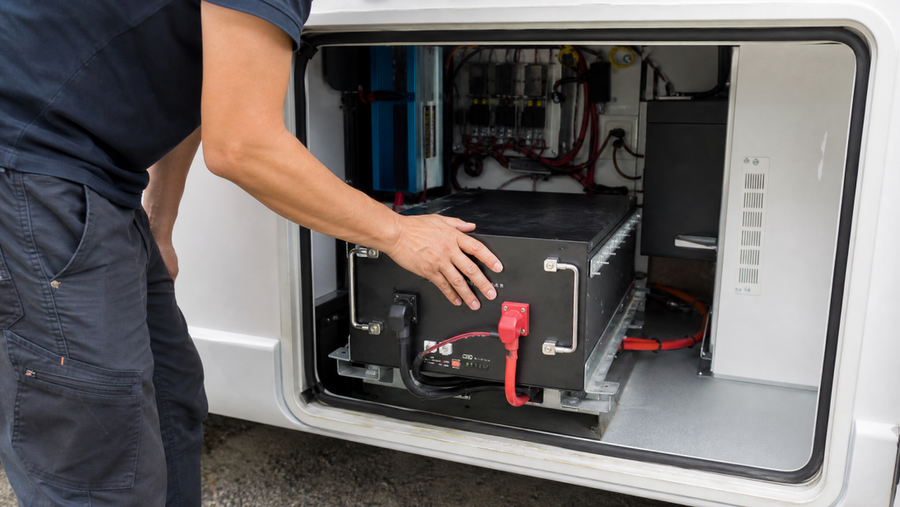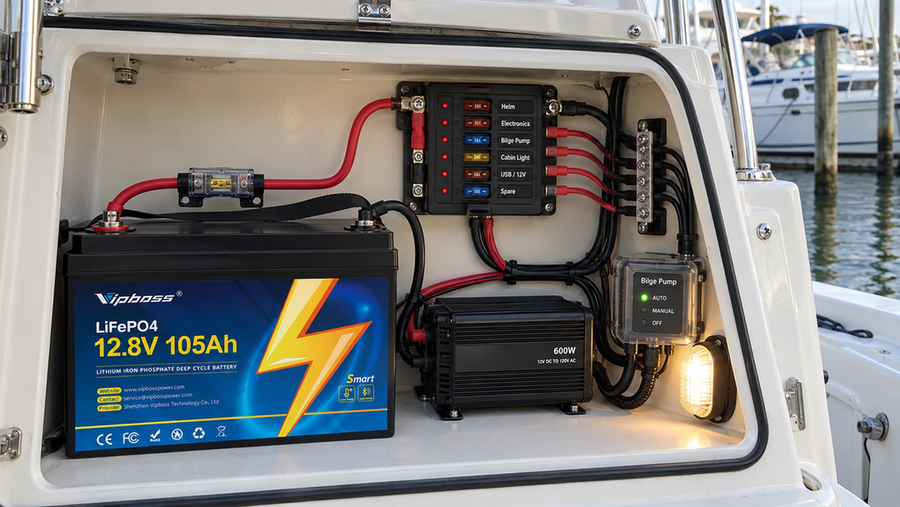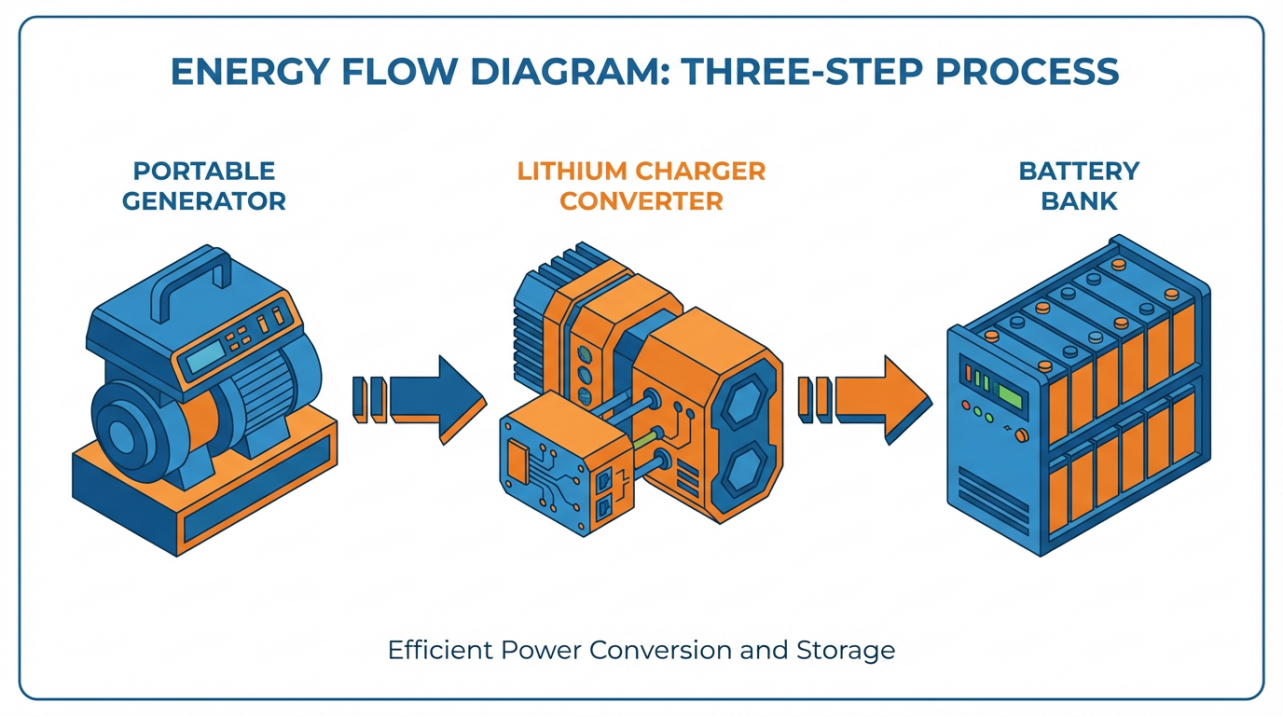

You can charge lithium batteries from a portable generator, but you must run a lithium‑compatible charger or converter between them instead of connecting the generator directly to the battery bank.
What Your Generator Can (and Can't) Do
A portable generator is just a 120 V AC power source, typically rated around 1,000–4,000 W. It does not control voltage and current the way lithium batteries require during charging.
Lithium banks need a tightly controlled constant‑current/constant‑voltage (CC‑CV) profile and firm voltage limits when charging lithium batteries, not raw AC or a crude "12 V DC" tap from a generator. A direct connection can hit cells with excessive voltage or current, trip the battery management system (BMS), and in the worst case damage the pack.
Those little "12 V battery charging" ports on some generators are meant for lead‑acid, are often poorly regulated, and still need a proper charger in between for lithium. Treat your generator as the wall outlet in the woods and let a charger or converter handle battery‑safe charging.
The Converter or Charger You Actually Need
Between the generator and your lithium bank you need an AC‑DC device that "speaks lithium." In practice that usually means a dedicated lithium charger (bench or onboard), an RV converter/charger with a lithium profile, or an inverter‑charger or all‑in‑one power unit.
For LiFePO4, the charger should follow a two‑stage CC‑CV LiFePO4 charging profile around 14.2–14.6 V for a 12 V pack, then stop—no long float at 13.8 V like lead‑acid. It also must match system voltage (12 V, 24 V, or 48 V) and deliver a charge current within your battery's specification.
When the charger is powered by a generator, make sure the generator is a clean sine‑wave unit with enough wattage; Minn Kota's guidance on portable chargers warns that "dirty" AC can damage sensitive chargers and electronics. Some high‑end lead‑acid chargers can be adjusted to behave in a more lithium‑friendly way, but in retrofit work it is still safest to use purpose‑built lithium chargers unless the battery manufacturer explicitly approves another option.

Sizing Generator and Charger to Your Lithium Bank
Think in two directions: how hard you want to push the battery, and how hard the generator can work without running at full, noisy throttle.
A good everyday target for LiFePO4 is roughly a 0.3–0.5C charge rate—for a 200 Ah bank, about 60–100 A. That is fast enough for real‑world off‑grid use but gentler on the cells; higher current and heat clearly shorten battery lifetime.
Power draw is simple: volts × amps. A 24 V, 13 A charger only pulls about 312 W; in one Victron example, that left a 2,200 W Honda generator badly underused, and even a 1,000 W unit would have been fine. On the RV side, it is common to charge your RV batteries with a generator in the 2,000–4,000 W class so you can both charge quickly and run a few AC loads at the same time.
As a rule of thumb, add up your charger's maximum input watts plus any simultaneous AC loads, then choose a generator with at least 25–30% headroom. That margin lets it run in eco mode instead of at full blast.
Safe Hookup: Quick Start Checklist
Before every charging session, treat the system like a mini power plant, not a phone charger. ESFI's guidance on how to charge lithium-ion batteries safely applies even more when you add gasoline and exhaust to the mix.
- Run the generator outdoors on level ground, at least 5 ft from windows and doors; warm it up for 5–10 minutes.
- Verify charger settings: correct battery chemistry, system voltage, and lithium‑appropriate charge voltages.
- Plug the charger or RV shore cord into the generator, then turn on the charger and confirm it is actually in lithium mode.
- Watch voltage, current, and temperature; if cables, charger, or battery feel unusually hot, reduce the current or shut down. A simple touch test can reveal undersized or problematic cables before they become a serious hazard.
- Stop when the bank is full or at your target state of charge—do not leave lithium on "float forever" like an old lead‑acid battery.
When a Portable Power Station Makes More Sense
If your entire "bank" is a single box, a modern portable power station may be smarter than DIY generator‑to‑charger wiring. These units integrate lithium batteries, a BMS, and a charger/inverter so you just plug them into AC (from the grid or a generator) and go; lab tests of portable power stations show many can fully recharge in a couple of hours.
For light loads—laptops, CPAP, lights—a small lithium power station similar to this small lithium power station is often cheaper, quieter, and simpler than retrofitting a full lithium bank plus generator‑compatible charger. Once you move up to a serious RV or cabin system, a properly sized generator feeding a true lithium charger is the upgrade path that keeps your batteries—and your ears—far happier.