


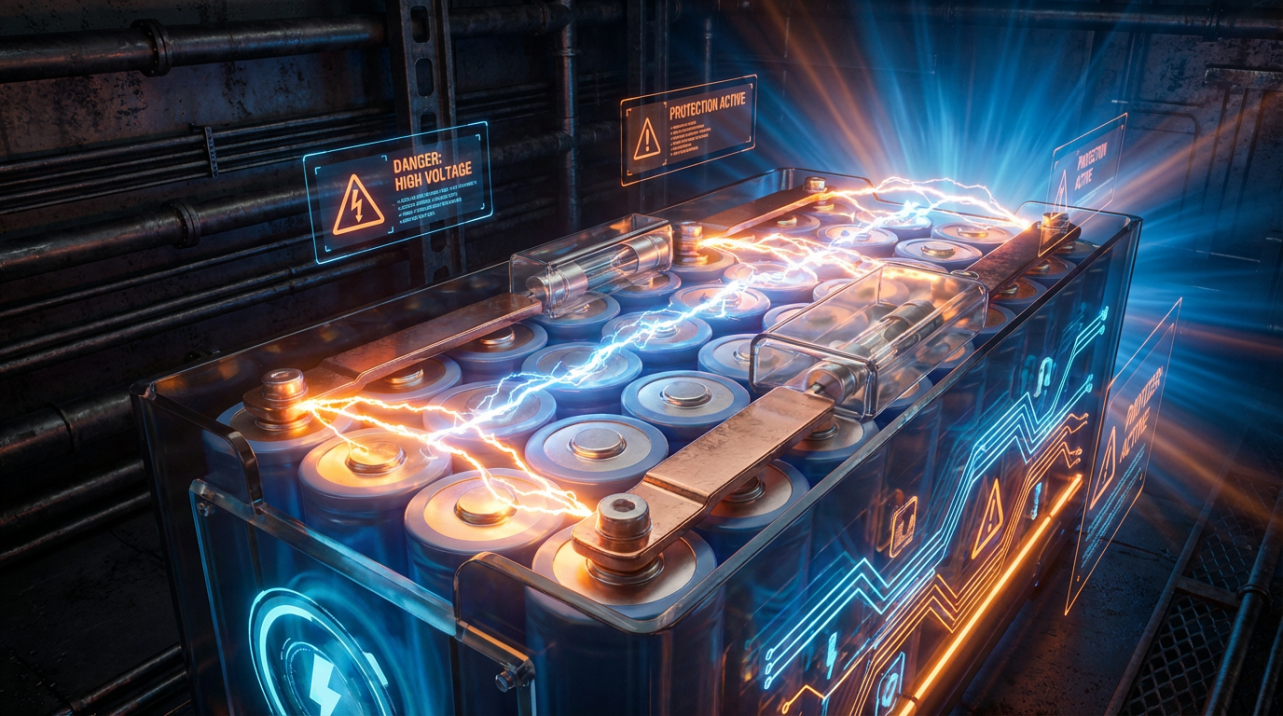
Mounted inches from the battery, a properly sized high‑interrupt fuse provides more reliable fire protection for lithium banks than ANL fuses or DC circuit breakers used alone.
You flip on a big load and suddenly hear a violent pop from the battery bay, followed by that terrifying hot‑plastic smell that makes you picture your rig or cabin going up in flames. The systems that walk away from moments like this have one thing in common: the current is forced through protection sized for lithium fault currents, not just whatever fuse block or breaker was on sale. This guide shows how ANL fuses and circuit breakers behave in real faults, where each belongs, and how to combine them so a wiring mistake never turns into a fire.
Why Fire Risk Is Different with Lithium
Lithium (especially LiFePO4) batteries can deliver thousands of amps into a short because their internal resistance is so low. LithiumPro and Attainable Adventure Cruising both highlight that even a modest 12 V, 400 Ah house bank can sustain several thousand amps, and worst‑case short‑circuit currents can climb into the tens of thousands of amps. That is far beyond what many automotive fuses or panel breakers were ever built to interrupt.
Fuses and breakers are the last mechanical line of defense between that fault current and vaporized copper, molten lugs, and a very real chance of fire. Multiple sources, including Roamer, LithiumPro, and OG Solar Store, stress that choosing the wrong device is not just a durability issue; an underrated fuse can sustain an arc, weld itself shut, or even explode instead of clearing the fault cleanly.
Battery management systems add a valuable layer of electronic protection, but Roamer and MorgansCloud both emphasize that BMS electronics and contactors are not a substitute for a properly rated external fuse at the battery.

When a wrench bridges the terminals or a cable chafes through, you want a passive device that will open no matter what the software is doing.
ANL Fuses in Lithium Banks
How ANL Fuses Work and Where They Shine
An ANL fuse is a bolted, sacrificial metal strip in a compact body. When overload or short‑circuit current heats the element enough, it melts and opens the circuit. Because there are no moving parts, good ANL fuses are simple, rugged, and inexpensive. LithiumPro notes that ANL fuses are widely used for general 12 V loads and chargers in marine and RV systems, and some marine‑grade ANL designs reach interrupt ratings up to roughly 6,000 A.
For small to mid‑size 12 V systems where short‑circuit current is limited and cable runs are modest, a carefully chosen ANL fuse can offer solid protection for chargers, DC panels, or auxiliary loads. OG Solar Store agrees that cartridge and ANL fuses can perform well when their voltage and interrupt ratings are matched correctly to the battery bank.
The Fire‑Safety Gap with ANL Fuses
The problem is that most ANL fuses were designed for legacy automotive and boat wiring, not for aggressive lithium fault currents. OG Solar Store explicitly warns that many ANL fuses fall short on voltage and interrupt‑current specs for modern lithium banks, and Roamer and LithiumPro both show how low‑interrupt fuses can fail dangerously when short‑circuit current exceeds their rating.
Anern’s comparison of fuse families puts most MEGA and ANL fuses in the range of roughly 32–58 V DC and about 2,000–6,000 A interrupt ratings, whereas high‑rupture Class T fuses are rated for similar voltages but can interrupt fault currents measured in tens of thousands of amps. LithiumPro and MorgansCloud reinforce that contrast, recommending Class T with around 20,000 A interrupt capacity as the gold standard for large lithium banks.
A real‑world example from a LiFePO4 forum illustrates the gap. A 12.8 V, 280 Ah LiFePO4 kit shipped with a 250 A CNL fuse rated for only about 2,500 A interrupt. When the owner compared time‑current curves, a 250 A Class T fuse would open in roughly 0.1 seconds at about four times its rating and still be well below its 20,000 A interrupt capacity. A terminal‑mount MRBF fuse with a 10,000 A interrupt rating opened in a similar time at around 5.5 times its rating. The CNL fuse needed roughly 10 times its rating at 0.1 seconds, right at its interrupt limit, raising the risk that the arc would not be quenched cleanly.
The takeaway, echoed by LithiumPro and Roamer, is that ANL‑style fuses are a compromise at best for primary lithium battery protection. They can be acceptable for smaller systems when carefully chosen, but as bank size and prospective short‑circuit current rise, you reach the point where a high‑AIC fuse (MRBF near the posts, or Class T slightly further away) is no longer optional.
DC Circuit Breakers: Protection or Convenience?
Strengths of DC Breakers in Off‑Grid Systems
A DC battery breaker is a resettable switch that trips automatically on overcurrent, generally using thermal, magnetic, or electronic sensing. PowMr describes them as fundamental safety components in solar and off‑grid systems, especially between the battery and inverter and between the charge controller and battery.
There are practical reasons system builders like breakers. After a trip, you reset instead of crawling in with a wrench to change a fuse. A correctly rated DC breaker can also double as a manual disconnect in emergencies, letting you isolate the battery quickly. PowMr shows how to size these devices: for example, a 12 V battery feeding a 2,000 W inverter at about 91% efficiency needs around a 180 A breaker on the battery side, with a 1.25 safety factor baked into the math.
Anern’s technical overview adds that modern DC breakers (MCBs and MCCBs) can be built with serious interrupt ratings at higher voltages, especially in industrial gear. DC MCCBs complying with standards like UL 489 and IEC 60947‑2 may reach 10,000 A or more of interrupt capacity at higher DC voltages, making them suitable as main disconnects when coordinated with upstream fuses.
Where Breakers Fall Behind Fuses for Fire Protection
Despite those strengths, breakers are not automatically the best fire‑protection tool right at the battery posts. Anern points out that fuses are passive devices whose elements melt in milliseconds under severe faults and can be engineered to have very low let‑through energy. Class T fuses, for example, are designed to clear massive short‑circuits rapidly and minimize the energy that reaches cables and terminations.
Most DC breakers, by contrast, use thermal or magnetic mechanisms that introduce a delay, and their arc‑quenching structures are bulkier. Anern notes that typical DC MCBs have interrupt ratings around 6,000–10,000 A, which sounds impressive until you consider a 48 V LiFePO4 bank with about 3 milliohms of total loop resistance: that is a theoretical fault current near 16,000 A. In that scenario, a breaker with marginal interrupt capacity can struggle to clear the arc cleanly.
Schneider Electric’s guidance on 80%‑rated vs 100%‑rated breakers adds another nuance: most molded‑case breakers are intended to carry only about 80% of their nameplate rating continuously and must be sized at 125% of continuous load. Oversizing to avoid nuisance trips is common practice, but in high‑fault‑current lithium systems this can push the device further away from the weakest‑link role the primary protective element should play.
Multiple sources converge on the same strategy: use DC breakers where you need resettable protection and convenient isolation—between charge controllers and batteries, between batteries and DC load panels, and sometimes between the main DC bus and the inverter—but do not treat a breaker as your only protection at the battery posts.

ANL Fuse vs. Circuit Breaker vs. High‑AIC Fuse
A useful way to cut through the confusion is to compare ANL fuses, DC breakers, and the high‑AIC fuses that lithium specialists keep recommending.
Feature |
ANL fuse (typical) |
DC breaker (battery‑rated) |
High‑AIC fuse (MRBF / Class T) |
Behavior on fault |
Sacrificial, melts open |
Trips mechanism, opens contacts |
Sacrificial, very fast melt and arc quench |
Reset/reuse |
One‑time; must be replaced |
Resettable |
One‑time; must be replaced |
Typical DC voltage rating |
Around 32–58 V |
Device‑specific; many up to 60–250 V |
MRBF up to about 58 V; Class T often up to around 125 V |
Typical interrupt capacity |
Roughly 2–6 kA (varies by model) |
Small MCBs around 6–10 kA; larger MCCBs higher |
MRBF roughly 10 kA at 12 V; Class T around 20 kA or more |
Best roles in lithium systems |
Small 12 V loads and chargers, when verified |
Branch/feeder protection and convenient isolation |
Primary battery protection and main feeders, especially larger banks |
OG Solar Store, Roamer, LithiumPro, MorgansCloud, and Anern all align on the same core conclusion. For primary fire protection at the lithium battery:
- A high‑interrupt fuse near the battery positive terminal is the first line of defense.
- ANL fuses are second‑tier options best reserved for smaller systems or non‑critical circuits unless you can prove their interrupt and voltage ratings exceed your bank’s short‑circuit current.
- DC breakers are best used downstream, where their interrupt duty is lower and their resettable nature becomes an asset, not a liability.
So if the question is strictly “ANL fuse vs. circuit breaker, which better protects your lithium system from fire?”, the honest answer is that neither generic choice is ideal. A correctly specified high‑AIC fuse placed inches from the battery wins that job. Between just ANL and breaker at the battery, a properly rated ANL with documented high interrupt capacity is generally safer than relying on a breaker alone, but once the system grows beyond modest current levels the right move is to step up to MRBF or Class T rather than pushing either ANL or a breaker beyond its sweet spot.
Practical Sizing and Placement Examples
Consider a compact van build with a single 12 V, 100 Ah LiFePO4 battery feeding a 1,000 W inverter and modest DC loads. LithiumPro’s sizing approach says to sum the maximum continuous load: 1,000 W at 12 V is about 83 A. Applying the common 1.25 factor gives just over 100 A, so a 125 A primary fuse is appropriate, provided it does not exceed the cable’s current rating. In a system of this scale, an MRBF fuse rated for 125 A mounted directly on the battery positive post gives you very short unfused cable length and around 10,000 A interrupt at 14 V, which Roamer and LithiumPro describe as a solid match for compact lithium setups. A DC breaker of roughly 100–125 A can then sit downstream as a manual disconnect and branch protection, with an ANL or MEGA fuse used for a separate charger or DC panel only if its ratings check out.
Now push into a cabin or coach install with a 12 V, 280 Ah bank and a 2,000 W inverter. LithiumPro’s method again starts with power: 2,000 W at 12 V is about 167 A; multiply by 1.25 and you are around 208 A, so you pick the next standard fuse size, perhaps 225 A or 250 A. MorgansCloud and Roamer both recommend a Class T fuse in this size range mounted within about 7 in of the battery positive. Attainable Adventure Cruising notes that a bank of this size can deliver thousands of amps into a short, so the roughly 20,000 A interrupt rating of a Class T fuse buys substantial safety margin compared with a 2,000–6,000 A ANL.
For a 48 V off‑grid system, Anern’s example is even more stark. A 10 kWh 48 V LiFePO4 bank with a total loop resistance of roughly 3 milliohms can see a theoretical short‑circuit current near 16,000 A. In that world, 58 V‑rated ANL fuses with 2–6 kA interrupt ratings are simply not engineered for the job. Anern recommends a Class T fuse around 250 A with at least 20 kA interrupt mounted within roughly 8–12 in of the battery, feeding a main DC breaker and smaller branch DC breakers for charge controllers and DC loads.
In every one of these examples, the pattern is the same: the device closest to the battery is a high‑AIC fuse sized to continuous load and cable ratings, with breakers and, where appropriate, lower‑duty fuses handling downstream circuits.
FAQ: Common Upgrade Questions
If there is already an ANL fuse in the system, does it have to be ripped out?
Not automatically. Start by reading the markings and datasheet: confirm the DC voltage rating meets or exceeds your system voltage and the interrupt rating exceeds your estimated short‑circuit current with margin, using guidance from LithiumPro, OG Solar Store, and Anern on how to estimate fault currents. If the ANL fuse is clearly under‑rated, especially on a large lithium bank, it is prudent to replace it with an MRBF or Class T in the same ampere size and adjust the mounting so it sits as close to the battery as practical.
Can a good BMS replace external fuses and breakers?
No. Roamer, MorgansCloud, and LithiumPro all stress that while a BMS can limit charge and discharge currents and shut down on certain faults, it is not designed to interrupt the full worst‑case short‑circuit current of a lithium bank in all failure modes. Contactors and MOSFETs can fail, and BMS wiring can be damaged. The mechanical, passive nature of a high‑AIC fuse is exactly what you want for the last line of defense against fire.
Is it safe to use a breaker alone at the battery and skip the fuse?
For small systems where fault currents and code requirements are modest, some manufacturers do permit a correctly rated DC breaker near the battery as the primary protective device. However, Anern’s comparison of let‑through energy and the interrupt ratings cited by MorgansCloud, Roamer, and LithiumPro all point toward high‑AIC fuses being more reliable for clearing the worst faults, particularly as banks grow in size and cable runs get longer. The most robust pattern is a high‑AIC fuse at the battery feeding a main DC breaker, not a breaker alone.
Closing Thoughts
If the goal is to keep a lithium system from turning a simple wiring error into a fire, think in terms of fault energy, not just ampere ratings printed on a shell. ANL fuses and DC breakers both have important roles, but the device that truly stands between your battery and a catastrophic short is a high‑interrupt fuse placed inches from the positive terminal. Treat that as non‑negotiable, let breakers handle the convenience and isolation work, and verify every rating against what your bank can actually deliver. Do that, and your next pop in the battery bay is far more likely to end with a blown fuse and a quick fix instead of a lost rig or cabin.
References
- https://www.batterydesign.net/how-to-select-ev-fuses/
- https://www.rvforum.net/threads/what-fuse-to-use.911887/
- https://www.lithiumpro.co.uk/the-essential-guide-to-lithium-battery-fuses-sizing-types-and-safety
- https://bourns.com/products/mini-breakers
- https://www.littelfuse.com/assetdocs/fuses-for-energy-storage-systems-technical-paper?assetguid=7fd2f45b-22f5-4169-b7e7-36001d9a0060
- https://www.airforums.com/threads/battery-upgrade-to-lithium-wiring-size-vs-circuit-protection.1389182/page-2
- https://www.anernstore.com/blogs/off-grid-solar-solutions/100ah-lithium-battery-camping-power#:~:text=A%201C%20rating%20on%20a,extreme%20temperatures%2C%20and%20short%20circuits.
- https://diysolarforum.com/threads/battery-fuse-sizing.20729/
- https://expion360.com/blogs/blog/circuit-protection-for-lithium-battery-system?srsltid=AfmBOooQw9cvcyaJFZER_TG4FsNXSiqB0wR_05qRFL0G6uWQ0dZAi90i
- https://www.irv2.com/threads/fuse-question-on-lithium-batteries.2065565/



Leave a comment
This site is protected by hCaptcha and the hCaptcha Privacy Policy and Terms of Service apply.