
A 12V lithium battery usually shuts off at the instant an appliance starts because the brief starting demand is higher than the battery, inverter, or wiring can support. First, watch whether the inverter also turns off and measure battery voltage at the battery terminals during the start attempt; a sharp drop or a protection warning points to a surge or voltage-sag problem, while a steady battery reading with an inverter overload points elsewhere. Stop retrying if cables or terminals become hot, smell burnt, or show damage.
What the shutdown tells you
Appliances with motors, compressors, pumps, or transformers can draw more current while starting than they draw after reaching normal speed. That short demand can make voltage fall across the battery, cables, fuse, or connections. The inverter may then report low input voltage or overload, or the battery management system (BMS) may disconnect the battery to protect it.
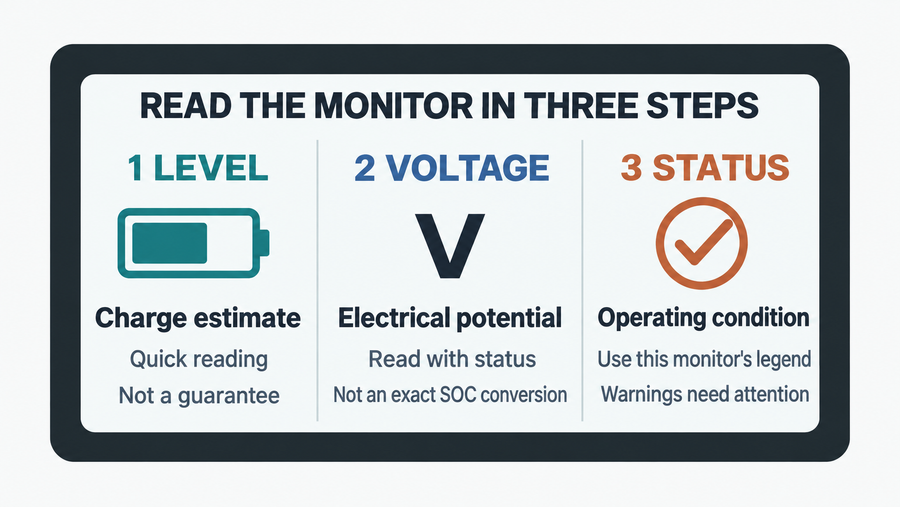
A BMS is the battery's built-in protection controller. In this situation, the useful question is not simply “Is the battery full?” It is “Which protection point reacted first?”
- The inverter goes dark or reports low voltage: suspect voltage sag, cable loss, a loose connection, a cold or depleted battery, or an inverter low-voltage limit.
- The inverter reports overload or surge: compare the appliance's starting requirement with the inverter's surge capability.
- The battery disappears from the inverter but later returns: the BMS may have opened its output during the event.
- Only one appliance causes the shutdown: its starting demand is more likely than a general battery fault.
- Several small loads cause the same shutdown: inspect the battery state, connections, cables, fuse, and inverter before blaming the appliance.
The shutdown itself does not prove that the battery is defective. It shows that one part of the power path reached a limit during startup.
Check the power path in the order the failure occurs
Turn off other loads and try the appliance once while observing the inverter display or app. Record the battery voltage before startup, the lowest value visible during startup, the inverter message, and whether the battery remains connected afterward. A meter that cannot capture the brief dip may miss the lowest voltage, so treat a normal-looking resting voltage as incomplete evidence.
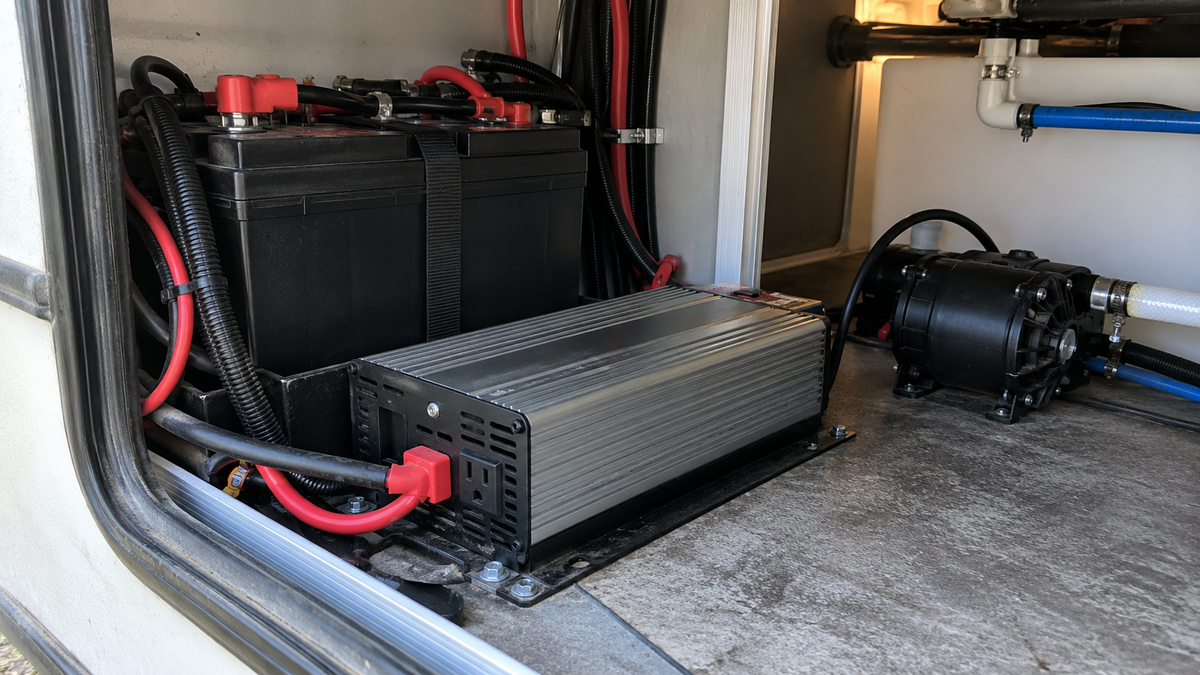
Then inspect the complete path:
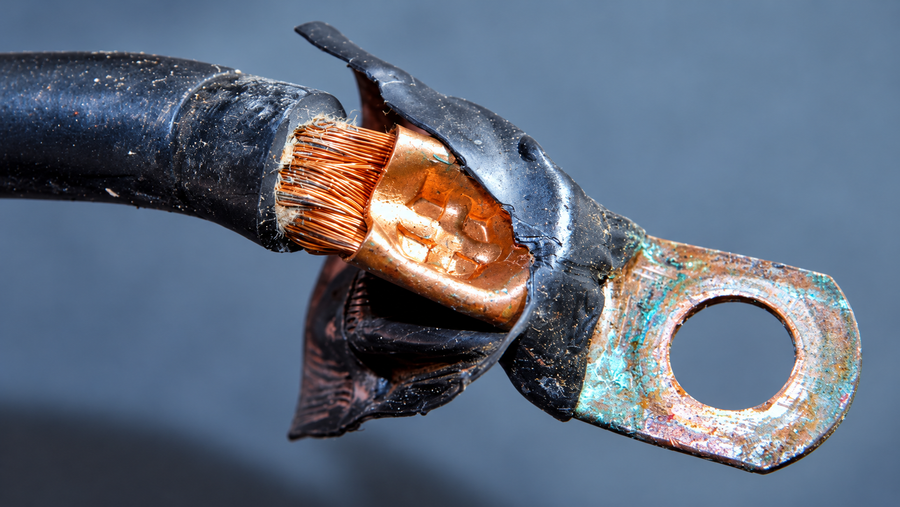
- Check that the battery terminals, fuse connections, disconnects, and inverter terminals are tight and clean. Do not work on energized wiring.
- Check cable size, cable length, fuse rating, and inverter connections against the battery and inverter instructions. A long or undersized cable can lose enough voltage during a high-current event to trigger shutdown.
- Test the appliance with every other load off. If it starts alone but not with another load running, the combined demand is the likely change.
- Compare the appliance's running and starting requirements with the inverter's continuous and surge ratings. A running-watt label alone may not describe motor startup demand.
- Check the battery's protection status or Bluetooth history, if available. A recorded overcurrent or low-voltage event is more useful than guessing from the battery's resting voltage.
Do not continue the startup test if the battery, cable, fuse, or inverter shows heat, burnt odor, or visible damage. Do not repeatedly force the appliance to start; use the relevant battery and inverter instructions before another attempt.
Why motor appliances are harder to start
A heater or other mostly resistive appliance often draws near its labeled power once switched on. A refrigerator compressor, air conditioner, pump, or power tool can need a much larger current for a short time. The inverter must supply that burst, and the battery must deliver the corresponding DC current after conversion losses.
The battery current can be estimated for planning, not as a substitute for the appliance and inverter manuals:
DC current ≈ appliance watts ÷ (battery voltage × inverter efficiency)
Illustrative example: a 1,200-watt appliance at an assumed 90% inverter efficiency and 12.0 volts would require about 111 amps while running. Its startup demand could be higher, and the battery voltage may dip during that event. The calculation does not reveal the appliance's actual surge requirement, so use it only to show why a seemingly modest AC load can create a large 12V demand.
If the appliance starts normally when connected to another suitable power source but not from the inverter, compare the inverter's surge rating, output waveform requirements, and protection message before changing the battery.
When voltage sag points to cables, connections, or battery condition

Voltage sag is a temporary drop while current rises. Measure at the battery terminals and, if you can do so safely, at the inverter input during the same start attempt. A much lower reading at the inverter than at the battery points toward cable, fuse, terminal, or connection loss. A large drop already visible at the battery points toward battery condition, temperature, state of charge, or a battery protection response.
The advice changes with the starting condition:
- The battery is cold, nearly depleted, or has recently been stored: warm or recharge it according to its instructions before comparing results. Do not assume a full display means the battery can deliver every surge.
- The battery voltage looks stable but the inverter trips: investigate inverter surge capability, appliance startup demand, and simultaneous loads before replacing the battery.
- The inverter input collapses while the battery terminals remain steadier: inspect cable length, cable size, fuse holders, disconnects, and crimped connections.
- The battery output stops and a protection event is recorded: remove the triggering load, allow the system to recover as directed by the battery instructions, and identify the recorded fault before trying again.
These observations narrow the cause; they do not create a universal voltage or current threshold. Use the exact battery, inverter, and appliance manuals for their protection limits.
For 12V systems that benefit from high capacity and real-time battery visibility, the Vipboss 12V 210Ah Bluetooth LiFePO4 battery combines 2,688Wh of nominal energy with a 200A smart BMS and a stated 200A maximum continuous discharge current. Its Bluetooth monitoring provides convenient access to battery status when reviewing system behavior during appliance startup and ongoing use. Pairing these battery specifications with an inverter, cabling, and protection equipment sized for the appliance's continuous and surge demand creates a coordinated 12V power system.
Frequently asked questions
Why does my battery shut off only when an appliance starts?
The appliance may have a startup surge that exceeds an inverter, cable, voltage, or battery-protection limit even though its normal running load is lower.
Can a loose cable cause a startup shutdown?
Yes. Resistance at a loose, undersized, corroded, or damaged connection can cause voltage sag during a high-current start.
Should I keep retrying after a shutdown?
No. Stop if you observe heat, damage, or burning odor, and identify the limiting part of the power path before another attempt.